An Indiana spinal cord settlement can cover past and future medical costs, attendant care, home modifications, lost wages and earning capacity, and pain and suffering, including loss of consortium. Several factors move the number, including injury severity, your age at injury, and the insurance limits actually available. Indiana’s filing rules and comparative-fault rules then affect how much of that value you can collect.
TL;DR:
- A life care plan should price future attendant hours, equipment, home changes, and ongoing medical care, since those costs can exceed past bills.
- Indiana reduces recovery by the injured person’s share of fault, while liability limits can cap collection unless other coverage, including underinsured motorist insurance, applies.
- NSCISC lifetime cost estimates vary by age and impairment, but they are not payout forecasts; liens, prior payments, fault, and policy limits affect net recovery.
- Preserve chronological treatment records and keep a daily journal, because consistent care notes and expert reports help answer disputes over future needs and lost earnings.
Table of Contents
- What damages can you recover in an Indiana spinal cord case?
- How are spinal cord settlement amounts calculated?
- What do lifetime costs look like by injury severity?
- Which Indiana laws affect your settlement?
- How do you prove spinal cord damages?
- What is the settlement process and timeline?
- Why does an experienced Indiana attorney matter?
- Why early contact matters: how we approach these cases
- Talk to our Indiana spinal cord injury team
- FAQ
- Sources
What damages can you recover in an Indiana spinal cord case?
A settlement is a single payment that stands in for several different categories of loss. Sorting them out early helps you see what is being valued and what a fair offer should account for.
Economic damages are the measurable costs:
- Past medical bills, including emergency care, surgery, hospital stays, and inpatient rehabilitation
- Projected future medical costs and long-term care
- Attendant care, whether provided by family members, home health aides, or a facility
- Home and vehicle modifications such as ramps, widened doorways, lifts, and hand controls
- Rehabilitation, physical and occupational therapy, and assistive devices like wheelchairs and standing frames
- Lost wages to date, plus projected future earnings and lost benefits
Non-economic damages compensate for harm that has no receipt attached:
- Pain and suffering
- Emotional distress, including anxiety and depression after a life-altering injury
- Loss of consortium, which belongs to a spouse who loses companionship and support
- Diminished enjoyment of life, from hobbies and travel to everyday independence
Other items may apply depending on the facts. Out-of-pocket costs and transportation to medical appointments are recoverable when documented. Punitive damages are available in Indiana only in narrow circumstances involving conduct such as gross recklessness, and they are the exception rather than the norm.
For a catastrophic injury, the future-care items usually dwarf the past bills. A person injured at a young age may need years of equipment replacement, caregiver hours, and medical follow-up, and those future needs require a defensible dollar figure. That is why we push for a complete accounting of the injury’s long-term effects before any number is discussed with an insurer.
How are spinal cord settlement amounts calculated?
No formula produces a settlement. Insurers, juries, and attorneys all work from the same raw inputs, then argue about how much weight each deserves.
The main inputs are:
- Injury severity. Clinicians classify spinal injuries using the ASIA Impairment Scale, which separates complete from incomplete injuries and describes the level of function below the injury. Higher, more complete injuries generally carry greater care needs.
- Medical needs, current and future. Treating physicians describe what care you need now and what you are likely to need as you age.
- Age at injury. A longer life expectancy with the injury means more years of care to pay for.
- Pre-injury income and employability. A skilled worker who can no longer perform the job has a different earnings loss than someone whose injury leaves some work capacity.
- Permanency. Courts and insurers look at how much function is expected to return, if any.
Experts translate those inputs into dollars. A life-care planner builds an itemized plan of future needs. Treating physicians support the medical necessity of each item. A vocational expert assesses what work, if any, you can still do, and an economist reduces future costs and lost earnings to present value.
Then reality trims the theoretical total. Under Indiana’s fault rules, any percentage of fault assigned to you reduces the award. The at-fault party’s insurance limits cap what is practically collectible unless other coverage applies. Liens from Medicare, Medicaid, or health insurers can reduce your net recovery, as can earlier payments.
Pro Tip: Defense teams commonly hire their own experts to challenge whether the injury caused your future needs or whether that care is truly necessary, a pattern legal commentators on spinal injury claims describe. Consistent treatment notes made at the time of care, plus a credible expert report, give you the strongest answer.
What do lifetime costs look like by injury severity?
Lifetime cost estimates anchor many damages calculations because they show the scale of long-term care. The National Spinal Cord Injury Statistical Center (NSCISC) at the University of Alabama at Birmingham publishes tables in its Facts and Figures material that estimate lifetime costs by neurological category and age at injury. The categories most often used are:
- High tetraplegia (C1–C4)
- Low tetraplegia (C5–C8)
- Paraplegia
- Incomplete motor function at any level
The pattern across those categories is consistent. Injuries higher on the spinal cord with more complete loss of function produce the highest projected lifetime costs, and incomplete injuries produce lower, though still substantial, totals. Because the exact dollar figures depend on the age bracket you read from in the table, we recommend pulling the current tables directly rather than relying on a number repeated elsewhere. The NSCISC FAQ points readers to those tables for rough lifetime-cost estimates, and the center’s Facts and Figures publication carries the empirical data behind them.
The NSCISC and UAB tables show that estimated lifetime costs vary greatly by age at injury and by neurological impairment.
That variation matters for settlement planning. Younger people injured with the same impairment generally face higher lifetime totals because they have more years of care ahead. A 20-year-old with paraplegia and a 55-year-old with the same injury present very different long-term projections.
These tables are cost estimates, not predicted payouts. A projected cost of several million dollars does not mean a case will settle for that sum. Several factors stand between the estimate and your check:
- The at-fault party’s liability insurance limits
- Any share of fault assigned to you
- Whether other coverage, such as underinsured motorist coverage, is available
For background on what spinal injuries involve clinically, the National Institute of Neurological Disorders and Stroke offers an authoritative overview, and the Christopher & Dana Reeve Foundation summarizes the practical costs and insurance questions families face. We use these resources alongside the NSCISC tables because they explain what the dollar figures represent in daily life: equipment, aides, medications, and medical follow-up that do not stop.
Which Indiana laws affect your settlement?
Several areas of Indiana law shape what you can realistically recover.
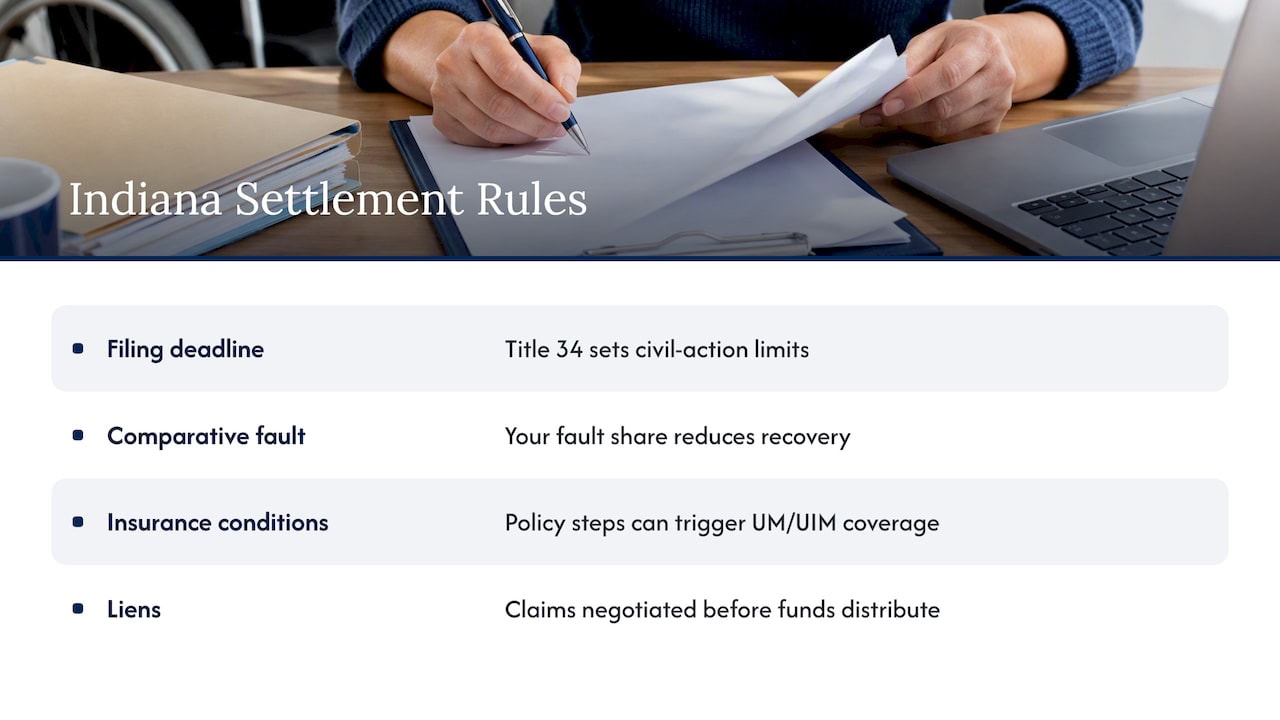
The filing deadline. Indiana’s time limits for civil actions are set out in Title 34. Check the applicable deadline promptly, since missing it can affect your right to sue. Our page on Indiana car accident filing deadlines explains how this plays out in practice.
Comparative fault. Indiana’s rules for actions based on fault require the jury to determine each party’s percentage of fault. The verdict against each defendant is that defendant’s percentage of fault multiplied by the total damages. If you share responsibility, your recovery shrinks accordingly.
Insurance conditions. Policy language can decide whether coverage applies at all. Indiana case law, including Frech v. Mullin and State Farm, shows how policy conditions and procedural steps can determine whether underinsured or uninsured motorist coverage is triggered. The Indiana Department of Insurance publishes auto insurance basics for consumers, which is a useful starting point for understanding your own policy.
Liens and subrogation. Medicare, Medicaid, and private health insurers may claim part of a settlement to repay what they paid for your care. Those claims are negotiated before funds are distributed, and handling them properly is part of how net recovery is protected.
The practical lesson for catastrophic claims is that the policy limits of the person who caused the injury are often the ceiling. Reviewing every available coverage source early keeps options open.
How do you prove spinal cord damages?
Proof is what turns a large estimate into a persuasive number. A strong file typically includes these steps:
- Organized medical documentation. Hospital records, surgical reports, therapy notes, and ongoing treatment records from treating physicians, kept in chronological order.
- A life-care plan. An itemized, expert-prepared projection of equipment, home modifications, medications, and attendant-care hours, with costs attached. Insurers and courts take well-supported plans seriously because they tie each item to a medical need.
- A vocational evaluation. An assessment of your remaining work capacity, which supports a lost-earning-capacity claim.
- An economic-loss report. An economist’s calculation that converts future costs and earnings losses into present-value figures.
- Clear demonstrative exhibits. Timelines, anatomical illustrations, and cost summaries that make a complicated injury understandable to a jury or adjuster.
Each piece answers a likely defense attack. If the defense disputes the need for future care, the life-care plan and treating physician respond. If it disputes earning loss, the vocational and economic reports do.
Pro Tip: Keep a simple daily journal of pain, mobility limits, and tasks you can no longer do. Contemporaneous notes are far more credible than recollections written years later.
Our guide on what injured people need to do in a spinal cord injury lawsuit walks through the early steps, including what to preserve.
What is the settlement process and timeline?
Most catastrophic cases follow a similar path, though the timing varies widely.
- Immediate care and documentation. Your medical needs come first, and every record starts building the case.
- Demand package. Once your condition is stable enough to project future needs, your attorney assembles the records, expert reports, and a settlement demand.
- Insurer investigation and negotiation. The insurer reviews the demand, may request more information, and responds with offers.
- Mediation or settlement conference. A neutral third party helps the sides close the gap.
- Trial, if necessary. When talks fail, a jury decides liability and damages.
Catastrophic cases often take many months or years because life-care planning, discovery, and expert work cannot be rushed. Settling before you understand your long-term needs risks leaving you short.
While a case is pending, medical providers and health insurers may assert liens, and your attorney negotiates those so they do not consume your recovery. Some plaintiffs also look into pre-settlement funding, a short-term, non-medical financial option offered while litigation proceeds. It is a financial arrangement, not a legal remedy, so read any terms carefully before agreeing.
Why does an experienced Indiana attorney matter?
A spinal cord claim has many moving parts, and an attorney’s work directly affects what you net. We assemble medical and life-care experts, build the damages model, negotiate liens, and press insurers when offers undervalue future needs.
What you can verify about our practice:
- We handle personal injury cases across Indiana, Michigan, and New Mexico
- We offer free case evaluations
- We work on a contingency-fee basis, so you pay no fee unless we recover for you
To get the most from a free evaluation, bring:
- Medical records and bills
- Your insurance information and any policies in the household
- Accident or police reports
- A summary of your ongoing care needs
Our overview of how our team handles Indiana catastrophic injury cases explains our approach in more detail.
Why early contact matters: how we approach these cases
When someone is facing paralysis, the legal question is rarely the first thing on their mind, and it should not have to be. Our approach is hands-on and client-first: you get direct access to the attorneys and paralegals working your file, and we start lining up the medical and life-care experts early so the case is built while the evidence is fresh. Waiting can create problems that are hard to see, from lost records to a filing deadline approaching. Because we are paid only if we recover, calling us does not put your finances at risk.
Talk to our Indiana spinal cord injury team
A serious spinal injury deserves a legal team that treats future care as seriously as past bills. We represent injured people in catastrophic car and truck accident cases, and you owe us nothing unless we win. Request your free case evaluation today, or read how our Indiana car accident spinal cord injury cases are handled.

This article is general information, not a substitute for advice from a qualified lawyer. Consult a qualified legal professional about your own circumstances before acting on anything here.
FAQ
How much is a spinal cord injury lawsuit worth?
Value depends on injury severity, age, lifetime care costs, lost earning capacity, and the insurance coverage available. No single figure applies to every case. The NSCISC lifetime-cost tables show how widely projected costs vary by age and impairment.
What are the typical payouts for spinal injury compensation?
Payouts range widely because policy limits and fault percentages cap what is collectible. A high projected cost does not equal a high payout if coverage is limited. Reviewing every available insurance source, including underinsured motorist coverage, is key to a fuller recovery.
Does Indiana workers’ compensation pay for pain and suffering?
Generally, no. Workers’ compensation covers medical care and wage-related benefits but not pain and suffering. If a third party outside your employer caused the injury, a separate personal injury claim may allow non-economic damages, so it is worth asking an attorney about both.
Will physical therapy increase my settlement?
Consistent therapy supports your claim by documenting the injury’s effects and your future needs. Records of therapy sessions help show medical necessity and ongoing limitations. Gaps in treatment, by contrast, give the defense room to argue that your injuries are less serious.