
If a defective product injured you in Michigan, you likely have a claim if the harm traces back to a design flaw, a manufacturing error, or a missing warning, and you generally have three years from the date of injury to file under MCL 600.5805. Michigan caps noneconomic damages, though that cap can be removed if you prove the manufacturer willfully disregarded a known danger. Preserve the product and contact a Michigan attorney promptly, because evidence and deadlines both work against you the longer you wait.
TL;DR:
- You generally have three years after the injury to file; products in use for 10 years or more lose certain legal presumptions.
- Noneconomic damages are capped at $280,000, or $500,000 for death or permanent loss of a vital bodily function; willful disregard can remove the cap.
- Keep the product in its condition after the incident, photograph it and your injuries, and avoid repairs or testing until an attorney coordinates inspection.
- Manufacturing defect claims require proof that a practical alternative production method existed at the time and would have prevented harm without significantly reducing usefulness.
- Michigan reduces damages by your share of fault rather than automatically barring recovery, while unforeseeable alterations or ignored warnings can strengthen the manufacturer’s defense.
Table of Contents
- What Counts as a Michigan Product Liability Claim
- Statute of Limitations and Special Timing Rules for Older Products
- Damages: Economic vs. Noneconomic Awards and Michigan’s Statutory Caps
- How Plaintiffs Prove a Product Liability Claim and Preserve Key Evidence
- Common Defenses Manufacturers Raise and How They Affect Your Claim
- How to File a Claim and What to Expect
- Keller & Keller’s Experience With Michigan Product Liability Claims
- Michigan Comparative Negligence and Your Product Liability Claim
- Potential Compensation in Michigan Product Liability Cases
- Why Expert Witnesses Matter in Michigan Product Liability Claims
- Michigan’s Product Liability Statutes: A Quick Legal Map
- How Michigan Courts View Your Use of the Product Before Injury
- What the Statutes Don’t Tell You
- Start Your Free Michigan Product Liability Case Evaluation
- FAQ
- Sources
What Counts as a Michigan Product Liability Claim
Michigan law defines “production” broadly. It covers design, testing, warnings, instructions, and even component parts, not just the factory assembly line, under MCL 600.2945. That means your claim can target a failure at almost any stage before the product reached you, and courts recognize three main defect categories:
- Design defects: the product was dangerous even when manufactured exactly as intended, like a space heater with no tip-over shutoff.
- Production or manufacturing defects: something went wrong during assembly, such as a missing weld that weakens a ladder rung.
- Failure to warn or instruct: the manufacturer didn’t flag a known risk, like a medication label that omits a dangerous drug interaction.
We should note that Michigan doesn’t use a standalone “strict liability” label the way some states do. Instead, plaintiffs typically plead negligence or breach-of-warranty theories, built around these same defect categories.
Statute of Limitations and Special Timing Rules for Older Products
Michigan gives you three years from the date of injury to file a product liability claim under MCL 600.5805. Miss that window and you generally lose the right to recover, regardless of how strong your evidence is.
- The clock usually starts at the injury date, not when you first suspected the product caused it, so document the date carefully and preserve records as soon as symptoms appear.
- Products in use for 10 years or more carry a higher burden. You lose certain legal presumptions and must prove your case without that built-in advantage, a distinction drawn from the statutory language governing older products.
- Narrow tolling exceptions exist for circumstances like the injured person’s minority or incapacity, but you shouldn’t count on one applying to your situation without a lawyer’s review.
Damages: Economic vs. Noneconomic Awards and Michigan’s Statutory Caps
Michigan product liability cases can recover two broad categories of compensation. Economic damages cover medical bills, lost wages, and the cost of repairing or replacing the defective product itself. Noneconomic damages cover pain, suffering, and loss of enjoyment of life, and these come with statutory limits.
- Standard cap: noneconomic damages are capped at $280,000 under MCL 600.2946a.
- Higher cap: the limit rises to $500,000 for cases involving death or permanent loss of a vital bodily function, also set by MCL 600.2946a.
- Annual adjustment: both figures are adjusted yearly by the state treasurer.
These caps aren’t shared with the jury. Michigan law keeps jurors unaware of the statutory limits, letting them decide the facts on the merits, and the court adjusts the final award afterward to conform to the cap. The exception that matters most: if you prove the manufacturer had actual knowledge of the defect and a substantial likelihood of injury, yet willfully disregarded it, the cap can be waived entirely under MCL 600.2949a.
How Plaintiffs Prove a Product Liability Claim and Preserve Key Evidence
Proving a Michigan product liability claim generally requires showing the product wasn’t reasonably safe when it left the manufacturer’s control, that causation connects the defect to your injury, and that you suffered real damages. For production defects specifically, you also need to show a practical, technically feasible alternative production practice existed at the time that would have prevented the harm without significantly impairing the product’s usefulness, a standard set out in MCL 600.2946.
Evidence that matters most includes the physical product itself, photos of the scene and your injuries, medical records, purchase receipts, instruction manuals, serial numbers, witness statements, and any repair or maintenance logs.
- Keep the product exactly as it was after the incident. Don’t repair it, discard it, or let anyone alter it.
- Photograph everything immediately, including the product, packaging, labels, and your injuries, from multiple angles.
- Gather paperwork: receipts, warranty cards, manuals, and any prior complaints or recall notices tied to the product.
- Get a preservation letter sent if a business or third party has possession of the product, so it isn’t disposed of before testing.
- Involve an attorney early so they can issue subpoenas, arrange expert inspection, and coordinate engineering or medical specialists before evidence degrades.
Pro Tip: Store the product in its post-incident condition, in a sealed container if possible, and let your attorney coordinate any testing so the chain of custody stays intact.
Common Defenses Manufacturers Raise and How They Affect Your Claim
Manufacturers rarely concede a defect outright. Expect one or more of these defenses, each requiring a different kind of counter-evidence:
- Misuse or alteration: they’ll argue you used the product in a way it wasn’t designed for. Foreseeable misuse, like overloading a ladder slightly beyond its rating, is different from an unforeseeable alteration, and your usage history and any modifications matter here.
- Compliance with standards: if the product met relevant industry or agency approvals, Michigan law creates a rebuttable presumption of non-liability, per statutory language on manufacturer protections. You can rebut this by showing the standard didn’t address the specific hazard that caused your injury.
- Assumption of risk: they may claim you knowingly accepted a visible danger, which warnings and your own conduct at the time can help dispute.
Countering these defenses usually comes down to records, expert testimony, and a clear timeline showing how you used the product.
How to File a Claim and What to Expect
Filing a Michigan product liability claim follows a fairly predictable sequence once you’ve sought medical care and started preserving evidence.
- Seek medical treatment first and keep every record, since gaps in treatment can be used against you later.
- Schedule a free case evaluation, bringing medical bills, photographs, receipts, and warranty information so an attorney can assess viability quickly.
- Expect an investigation phase, including preservation letters, expert inspection of the product, and formal discovery if the case proceeds.
- Understand the contingency-fee model: your attorney’s fee comes out of any settlement or award, so there’s no upfront cost and no fee unless you recover money.
Settlement talks often follow the investigation phase, and cases that don’t resolve there can move toward trial, though most product liability claims settle before reaching a courtroom.
Keller & Keller’s Experience With Michigan Product Liability Claims
We built our Michigan product liability practice around the reality that these cases move fast once evidence starts disappearing. We represent injured clients and have handled numerous cases against large insurance companies and corporate defendants on a contingency-fee basis, meaning you owe us nothing unless we recover compensation for you.
When you come to us for a product liability claim, we preserve evidence, coordinate engineering and medical experts, and keep you and your family informed with direct access to attorneys and paralegals throughout the process rather than routing you through a call center. Before your free case evaluation, gather your medical records, the product itself if you still have it, photos, and any receipts or manuals. We’ll use that consultation to evaluate the strength of your claim and outline realistic next steps.
Michigan Comparative Negligence and Your Product Liability Claim
Michigan applies a comparative negligence rule to product liability cases, meaning your own conduct leading up to the injury can affect how much you recover, but it rarely bars your claim outright. If a jury finds you partly at fault, your damages award is reduced by your percentage of fault rather than eliminated.
Alleged misuse matters most in cases, since manufacturers frequently argue the injured person contributed to their own harm by ignoring warnings or using the product outside its intended purpose.
The practical effect is that your own actions before the injury become part of the evidentiary record. How you used the product, whether you followed printed warnings, and whether any modification played a role all get scrutinized. This is one more reason early evidence preservation matters: a clear, documented account of how the incident happened protects you from an inflated fault allocation that a manufacturer’s legal team will try to establish without strong countering proof.
Potential Compensation in Michigan Product Liability Cases
Michigan product liability claims can recover several distinct types of compensation, depending on the severity and circumstances of your injury.
Economic damages cover the measurable financial impact: medical bills, future treatment costs, lost wages, reduced earning capacity, and the cost of repairing or replacing the defective product.
Noneconomic damages cover pain, suffering, disfigurement, and loss of enjoyment of life. These are the damages subject to Michigan’s statutory caps described earlier, capped at $280,000 in standard cases and $500,000 where death or permanent loss of a vital bodily function occurred, under MCL 600.2946a.
Punitive damages are rare in Michigan product liability cases generally, but the willful-disregard exception that lifts the noneconomic damages cap functions similarly in practice: when a manufacturer knowingly disregarded a substantial risk, the usual ceiling on noneconomic recovery disappears, allowing a jury’s full assessment of your harm to stand.
Which categories apply to your case depends heavily on the facts, the severity of injury, and what your evidence can prove about the manufacturer’s knowledge and conduct.
Why Expert Witnesses Matter in Michigan Product Liability Claims
Product liability cases almost always turn on technical questions a jury can’t evaluate without help. Did a feasible alternative design exist? Did the warning label meet the standard a reasonable manufacturer should have followed? These questions usually require engineers, materials scientists, or medical specialists to answer credibly.
Expert testimony becomes especially important when proving the feasible alternative production practice standard required for production-defect claims under MCL 600.2946. An engineer who can demonstrate that a safer, practical design existed at the time your product was made, without significantly impairing its usefulness, often makes or breaks that element of your case.
Medical experts play a parallel role, connecting your specific injuries to the defect through causation testimony that withstands cross-examination. Early expert involvement also matters for practical reasons: testing a product, inspecting it before it degrades, and documenting findings while the chain of custody remains intact all require coordination that’s far harder to arrange after evidence has been lost or altered. This is one of the clearest reasons to involve an attorney before you’ve done any testing or repairs yourself.

Michigan’s Product Liability Statutes: A Quick Legal Map
Michigan’s product liability framework lives primarily in a cluster of statutes rather than a single named act, though it’s often referred to collectively as addressing products liability actions. The core provisions include:
MCL 600.2945 defines the key terms, including a broad definition of “production” covering design, testing, and warnings. MCL 600.2946 sets out the feasible alternative production practice standard for production-defect claims and the rebuttable presumption of non-liability for compliance with relevant standards. MCL 600.2946a establishes the noneconomic damages caps and the rule shielding juries from knowing about them. MCL 600.2949a outlines the willful-disregard standard that can lift those caps. MCL 600.5805 sets the three-year statute of limitations.
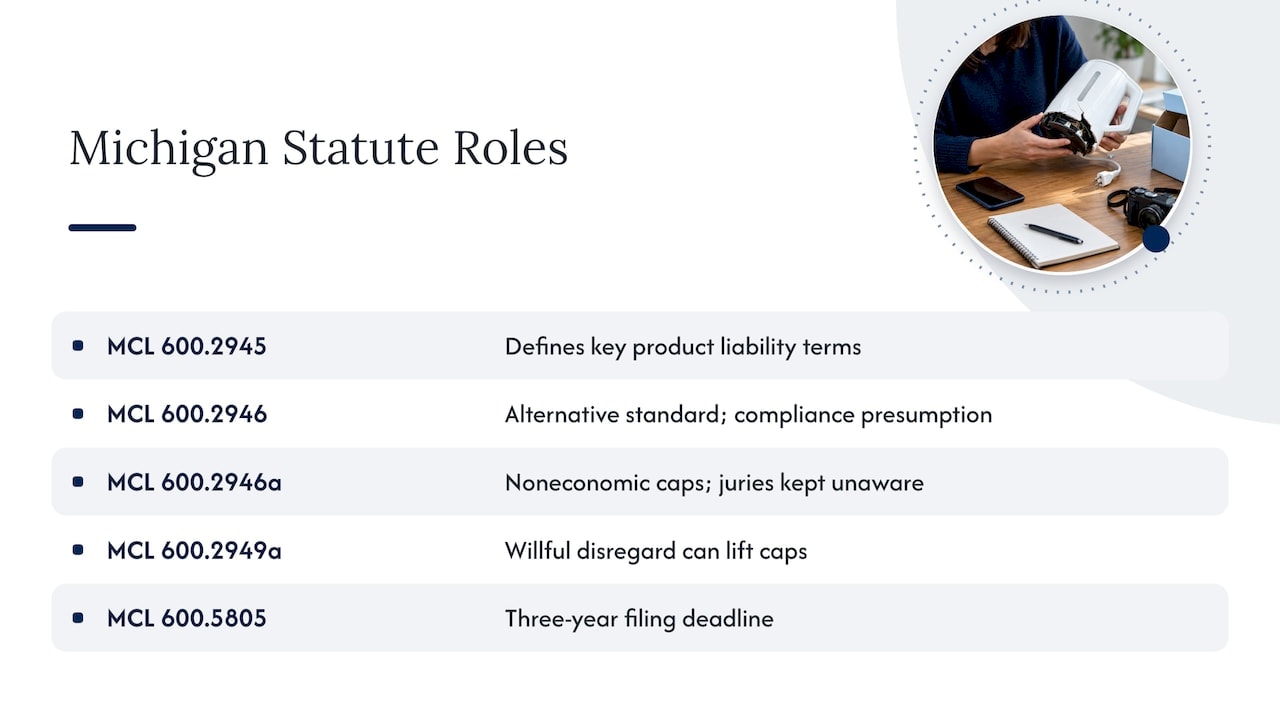
Together, these statutes shape nearly every strategic decision in a Michigan product liability case, from which defect theory to plead to how damages get calculated at the end. Understanding which section governs which issue helps you ask sharper questions when you first meet with an attorney.
How Michigan Courts View Your Use of the Product Before Injury
Courts in Michigan look closely at how you used a product before you were hurt, because that history often decides whether a misuse defense succeeds. Using a tool, appliance, or vehicle in a way the manufacturer couldn’t have reasonably foreseen tends to weaken a claim, while foreseeable misuse, the kind manufacturers should anticipate and design or warn against, generally doesn’t defeat it.
Courts also weigh whether you followed printed warnings and instructions. If a label warned against a specific use and you ignored it, that cuts against your claim under Michigan’s comparative negligence framework, though it typically reduces rather than eliminates recovery. Conversely, if the warning was unclear, missing, or buried in fine print, that same conduct can support a failure-to-warn theory against the manufacturer instead.
For products modified after purchase, whether by you or a prior owner, courts examine whether the alteration caused or contributed to the defect that led to injury. An unauthorized modification that introduced a new hazard can shift liability away from the original manufacturer. This is why documenting your product’s condition and use history, ideally before any incident occurs, matters so much once a claim is underway. A partner resource on product liability examples walks through several real-world scenarios illustrating how usage history shapes these outcomes.
What the Statutes Don’t Tell You
Michigan’s statutes read like a technical roadmap, and most guides to this topic stop at summarizing the caps and the filing deadline. That’s useful but incomplete. The real leverage in a Michigan product liability case almost always comes down to two things the statutes only hint at: how fast you preserve evidence, and whether you can meet the feasible alternative production practice standard with credible expert testimony.
Too much general advice treats the three-year deadline as the only clock that matters. In practice, the evidence clock runs faster. A product that gets thrown away, repaired, or left outside for a few weeks can lose the forensic value that would have proven your case, long before the legal deadline arrives. We’d rather see injured readers treat the first 48 hours after an incident as the most consequential window in the entire claim, not an afterthought before “the real legal work” begins.
The willful-disregard exception also deserves more attention than it typically gets. It’s a high bar, but for readers facing a capped noneconomic award that doesn’t reflect the severity of their injury, it’s worth a serious conversation with an attorney rather than an assumption that the cap is final.
— Adam
Start Your Free Michigan Product Liability Case Evaluation
If a defective product injured you in Michigan, we offer a free case evaluation with no obligation and no fee unless we recover compensation for you. We review your medical records, photos, and any product documentation you’ve preserved, then walk you through whether your claim fits the statutory framework and what evidence still needs to be gathered.

- Call or submit our contact form to reach our Michigan product liability team directly.
- Bring what you’ve preserved: photos, medical bills, receipts, and the product itself if you still have it.
- Pay nothing upfront: our contingency-fee model means you owe us nothing unless we win or settle your case.
We’ll use your free evaluation to outline realistic next steps and, if we take your case, start coordinating evidence preservation and expert review right away.
This article is general information, not a substitute for advice from a qualified lawyer. Consult a qualified legal professional about your own circumstances before acting on anything here.
FAQ
What is the deadline to file a product liability claim in Michigan?
You generally have three years from the date of injury to file under MCL 600.5805. Missing this deadline usually bars you from recovering compensation, regardless of how strong your evidence is.
Are there caps on damages in Michigan product liability cases?
Yes. Noneconomic damages are capped at $280,000, rising to $500,000 for death or permanent loss of a vital bodily function, under MCL 600.2946a. These caps can be waived if you prove the manufacturer willfully disregarded a known defect under MCL 600.2949a.
What has to be proven in a Michigan product liability claim?
You generally need to show the product wasn’t reasonably safe when it left the manufacturer’s control, that the defect caused your injury, and that you suffered real damages. For manufacturing defects, you also need to show a feasible alternative production practice existed at the time under MCL 600.2946.
Does using a product in an unexpected way hurt my claim?
It depends on whether the use was foreseeable. Courts distinguish foreseeable misuse, which manufacturers should anticipate and design against, from unforeseeable alteration, which can weaken your claim under Michigan’s comparative negligence rules.
How much does it cost to hire a product liability attorney?
Our firm works on a contingency-fee basis, so there’s no upfront cost and you owe nothing unless we recover a settlement or award on your behalf. A free case evaluation is the first step toward understanding your options.