
Yes, a serious, preventable pressure sore caused by neglect can support a Michigan bed sore lawsuit, either as ordinary negligence or as medical malpractice. Michigan’s notice and filing deadlines are strict, so act promptly. Photograph the wound, preserve every medical record, and contact a Michigan nursing home attorney for a free case evaluation before any deadline passes.
TL;DR:
- Observable failures such as missed repositioning, unreachable call buttons, or soiled bedding may support ordinary negligence; treatment decisions usually require malpractice procedures and expert testimony.
- For malpractice claims, Michigan requires written notice at least 182 days before filing, and the facility gets 154 days to respond.
- Malpractice actions generally face a two year filing limit, with a six month discovery period possible, but the six year outer limit still applies.
- Preserve dated wound photos, nursing notes, care plans, medication logs, incident reports, and Section M records; admission records can show whether a sore developed later.
- Families can report suspected neglect to Michigan’s Sentinel Project, LARA, or Adult Protective Services; agency investigations do not pay damages, which require a private lawsuit.
Table of Contents
- What bedsores are and why they matter for a legal claim
- How Michigan law treats bedsore claims: negligence versus malpractice
- Michigan timing rules: notice, limitation periods and discovery
- Damages and case value: what compensation covers
- Evidence checklist: what to gather
- Regulatory reporting in Michigan and how it differs from a lawsuit
- How a bedsore lawsuit typically proceeds in Michigan
- Action checklist for families: what to do now
- Why early attorney involvement matters
- How we can help your family in Michigan
- FAQ
- Sources
What bedsores are and why they matter for a legal claim
A bedsore, also called a pressure ulcer, pressure injury or decubitus ulcer, is damage to skin and underlying tissue caused by sustained pressure. CMS guidance recognizes all of these terms and allows pressure-related skin conditions to be coded in Section M of the Minimum Data Set (MDS) when pressure is the primary cause. That matters because nursing homes record these conditions routinely, and those records become evidence.
Stage drives the legal analysis. Our explainer on bed sore types covers the clinical detail. In short:
- Early: intact skin with persistent redness that does not fade when pressed.
- More advanced: partial skin loss, such as a blister or shallow open wound.
- Severe: full-thickness skin loss reaching fatty tissue.
- Very severe: deep damage exposing muscle or bone, with a high risk of infection, sepsis and osteomyelitis (bone infection).
Early stages usually heal with prompt care. Late stages often require surgery, long hospital stays and months of wound treatment, and each complication adds medical cost and pain and suffering to the claim.
Bridge Michigan’s analysis of more than 3,100 inspection records found Michigan nursing homes were cited 549 times for failing to provide essential care for pressure wounds over a five-year period. Those citations show these failures are documented and recurring, not rare.
How Michigan law treats bedsore claims: negligence versus malpractice
Michigan courts sort claims against care facilities into two categories, and the category controls the procedure. A claim is medical malpractice when it arises within a professional relationship and raises questions of medical judgment. It is ordinary negligence when a layperson could judge the failure without expert help. Michigan’s court guidance, including Meyers v Rieck and related decisions, draws that line.
Observable failures that courts have treated as ordinary negligence include:
- Not turning or repositioning a resident who cannot move alone.
- Placing a call button out of reach.
- Leaving a resident in soiled bedding or clothing.
Questions that usually call for medical judgment include:
- Whether a wound should have been debrided or referred to a specialist.
- Whether a chosen dressing or treatment protocol was appropriate.
- Whether a physician or nurse should have ordered a specific intervention.
The distinction has practical consequences. Malpractice claims require pre-suit notice, an affidavit of merit and qualified expert testimony, which raises cost and complexity. Ordinary negligence claims avoid the notice requirement and often rest on staffing records, care plans and witness accounts. Many bedsore cases contain both theories, which is why an early attorney review matters.
Michigan timing rules: notice, limitation periods and discovery
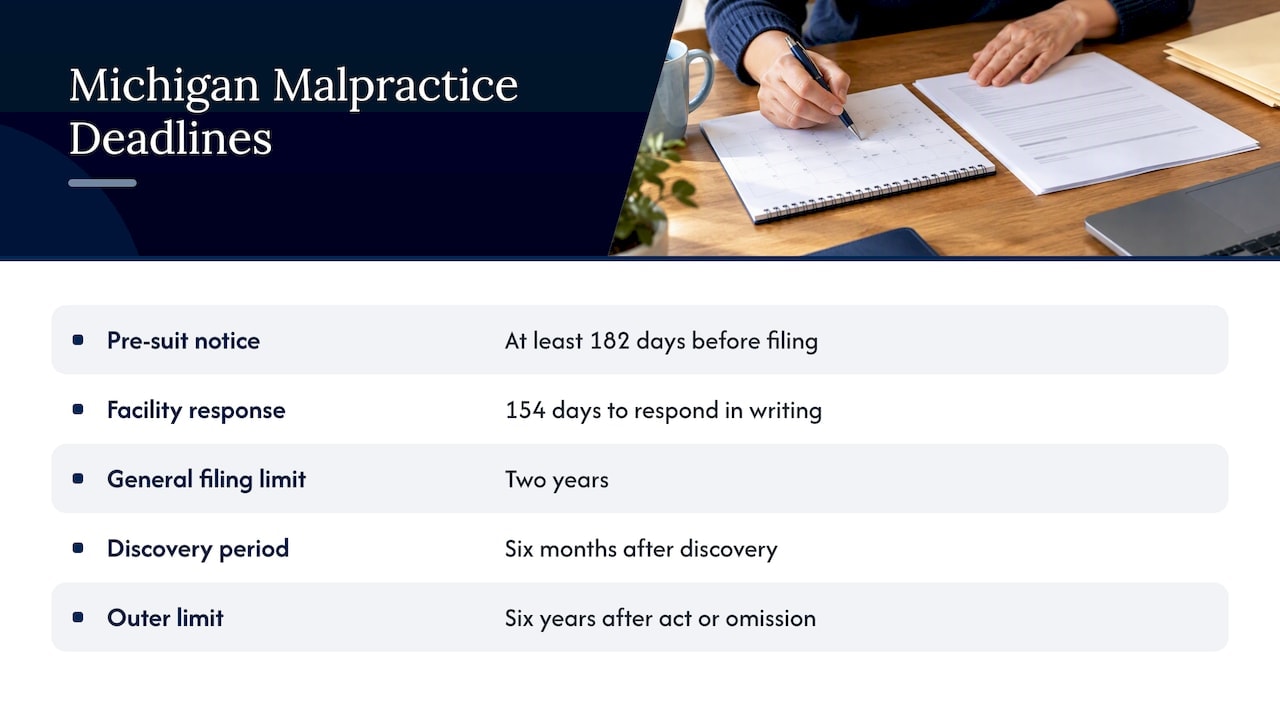
For malpractice claims, MCL 600.2912b requires written notice of intent at least 182 days before filing suit. The facility then has 154 days to respond in writing. Notice must be mailed to the provider’s last known address or the facility where care was given, and proof of mailing is prima facie evidence of compliance. If the facility does not respond in time, or states it will not settle, the claimant may file.
Michigan court guidance says malpractice actions generally must be commenced within two years, subject to discovery rules. A claimant may also have six months after discovering the claim, but never more than six years after the act or omission. Ordinary negligence claims follow different limitation rules, and our page on the Michigan malpractice statute walks through the filing timelines in more detail.
Do not wait to learn which category your case falls into. A missed notice or limitation deadline can bar a valid claim entirely, no matter how severe the injury.
Damages and case value: what compensation covers
Michigan bedsore claims can seek several categories of compensation:
- Past and future medical expenses, including wound care, surgery and hospitalization.
- Pain and suffering.
- Disfigurement from scarring or tissue loss.
- Loss of services provided by the resident.
- Wrongful-death damages when a resident dies from complications.
Several factors move the value up or down:
- The stage of the ulcer and whether it progressed under the facility’s care.
- Infection, sepsis or death.
- How long the neglect continued.
- The quality of the medical documentation.
- The strength of expert testimony linking the wound to the facility’s acts or omissions.
Law firms publish settlement examples across a very wide range, which shows that no average payout reliably predicts any single case. Outcomes turn on the facts: a less severe wound that heals promptly is valued very differently from a deep wound that led to sepsis. Where a resident has died, Michigan law generally requires a personal representative to bring the claim, as we explain in our guide to nursing home wrongful death claims.
Evidence checklist: what to gather
Strong bedsore cases are built on documents created before anyone thought about a lawsuit. Gather these first:
- Time-stamped photos of the wound, taken regularly and with a ruler for scale.
- Physician and nursing notes, including wound measurements.
- Incident reports and any written complaints to staff.
- Medication and wound-care logs.
- The resident’s care plan and any changes to it.
- The full MDS, especially Section M.
Section M records whether pressure ulcers were present at admission and how they progressed. A wound documented as absent at admission that appears later is strong support that it was acquired under the facility’s care. Attorneys pair these records with medical experts, who trace the wound’s progression and connect it to specific missed turns, delayed treatment or understaffing.
Pro Tip: Ask for records in writing and keep a copy of the request, because the date you asked can matter later.
Regulatory reporting in Michigan and how it differs from a lawsuit
Reporting protects the resident and other residents, and it creates an official record. Michigan offers several channels:
- The Attorney General’s Sentinel Project investigates abuse and neglect in long-term care and operates a hotline at 800-242-2873.
- The Bureau of Community and Health Systems at LARA accepts complaints against state-licensed nursing homes and offers hearings and administrative review if you disagree with an investigation’s result.
- Adult Protective Services takes reports at 1-855-444-3911, as the Attorney General’s elder abuse guidance explains.
These agencies target facility compliance, enforcement and criminal referrals. They do not compensate your family member. A private lawsuit does that. Inspection citations and investigative findings can still corroborate a civil claim by showing what the facility knew and when.
How a bedsore lawsuit typically proceeds in Michigan
Every case differs, but most follow this path:
- Document the injury and get your family member appropriate medical care.
- File a regulatory complaint if appropriate.
- Consult an attorney, who reviews records and screens the claim.
- Serve the notice of intent if the claim is malpractice.
- Wait through the facility’s 154-day response window.
- File the complaint, with an affidavit of merit where required.
- Complete discovery and exchange expert reports.
- Negotiate a settlement or proceed to trial.
Timing varies. The notice period alone adds months before a malpractice suit can begin, and serious complications, multiple defendants and wrongful-death claims lengthen the process further. A court sets the schedule once a case is filed, so any estimate is only a rough guide. If the resident has died, the personal representative of the estate files the claim. Most settlement talks happen after discovery gives both sides a clear view of the expert opinions.
Action checklist for families: what to do now
As soon as possible:
- Photograph the wound with the date and time visible.
- Get urgent medical care, ideally from a provider outside the facility.
- Notify facility leadership in writing.
- Ask for copies of the resident’s records.
As soon as you can:
- Request the full medical chart and MDS.
- File regulatory complaints if appropriate.
- Keep a dated care log of visits, conversations and changes in the wound.
- Contact a Michigan nursing home attorney.
Stay courteous with staff. You can protect your relationship with the facility and still protect your legal rights, because written requests and accurate notes are routine and do not signal a fight.
Pro Tip: Send important requests by e-mail or certified mail so you have proof of when you made them.
Why early attorney involvement matters
The strongest cases begin before the wound heals or the records change. Early contact lets us preserve photos and charts, calendar the notice deadline and bring in medical experts while memories are fresh. You pay nothing to start, because we work on contingency and collect a fee only if there is a recovery.
How we can help your family in Michigan
Families do not have to sort out notice rules and expert requirements alone. We handle nursing home abuse and bedsore claims in Michigan, offer a free case evaluation, and charge no fee unless we recover compensation for you. Bring whatever you have: photos, medical records, care plans and your care log. Request your free consultation through our contact page or by phone, and we will tell you where your claim stands and what to do next.

This article is general information, not a substitute for advice from a qualified lawyer. Consult a qualified legal professional about your own circumstances before acting on anything here.
FAQ
Can you sue for a bedsore in Michigan?
Yes, when a serious pressure sore results from neglect rather than from unavoidable medical decline. The claim may be ordinary negligence or medical malpractice, and each category has its own procedure and deadlines.
What is the average payout for a bedsore lawsuit?
No reliable average exists, because published settlements vary widely. Value depends on the ulcer’s stage, any infection or death, the length of the neglect, and the quality of the records and expert testimony.
How long does it take to settle a bedsore lawsuit?
It depends on the case. A malpractice claim must first pass the 182-day notice period before suit can be filed, and discovery and negotiation add more time. Serious injuries and wrongful-death claims usually take longest.
Where can I report suspected nursing home neglect in Michigan?
You can call the Attorney General’s Sentinel Project hotline at 800-242-2873, file a complaint with LARA, or contact Adult Protective Services at 1-855-444-3911. Reporting is separate from a lawsuit, and you may do both.
Sources
- MCL – Section 600.2912b – Michigan Legislature
- Abuse, neglect common in Michigan nursing homes — and no one is coming to help – Bridge Michigan
- Attorney General: Sentinel Project