
Under MCL § 287.351, Michigan imposes strict liability on dog owners for bite injuries that occur without provocation when the victim is on public property or lawfully on private property. You do not need to prove the owner knew the dog was dangerous. The law places responsibility squarely on the owner from the first incident.
Three things every bite victim should know immediately:
- Strict liability applies. The owner is liable regardless of the dog’s history or the owner’s prior knowledge of any aggressive behavior.
- Two primary defenses exist. An owner can argue you provoked the dog or that you were trespassing at the time of the bite.
- You have three years to file. Michigan’s personal-injury statute of limitations under MCL § 600.5805)/mileg.aspx?page=getObject&objectName=mcl-600-5805) runs from the date of the bite. Miss that deadline and your claim is almost certainly gone.
Table of Contents
- What MCL § 287.351 actually says, in plain English
- Who counts as the “owner” and where the statute applies
- Owner defenses under Michigan law and how to counter them
- What damages you can recover and how a claim typically proceeds
- Michigan’s deadline to file a dog bite lawsuit
- Dangerous-dog declarations and criminal consequences for owners
- Step-by-step checklist: what to do right after a dog bite
- How a Michigan personal-injury attorney helps with your dog bite claim
- Can a landlord or third party share liability for a dog bite?
- How local ordinances can expand your rights beyond state law
- What “provocation” actually means under Michigan law
- What happens when a bite occurs outside the statute’s scope
- How a dog bite claim unfolds from start to finish
- Key Takeaways
- Why the Michigan dog bite statute matters more than most victims realize
- Talk to a Michigan dog bite attorney at no cost
- Authoritative sources and further reading
What MCL § 287.351 actually says, in plain English
The official statutory text reads:
Breaking that down element by element:
- “Owner of a dog” — liability attaches to the person who owns the dog, not necessarily whoever was holding the leash at the time.
- “Bites a person” — the statute covers actual bites. Knockdowns, scratches, and other physical injuries caused by a dog may require a separate negligence theory.
- “Regardless of former viciousness or owner’s knowledge” — this is the critical departure from the “one-bite rule” used in some other states. Michigan does not require a prior incident. FindLaw’s analysis of Michigan dog bite laws confirms this distinction directly.
Being “lawfully on private property” covers three categories under the statute: a person performing a duty imposed by state law or U.S. postal regulations (a mail carrier, a meter reader, a code enforcement officer), an invitee (a dinner guest, a customer at a home-based business), or a licensee (a neighbor who has implied permission to enter). Someone who entered the property for an unlawful or criminal purpose does not qualify. For a deeper statutory comparison, 2keller’s overview of Indiana and Michigan dog bite laws walks through how these categories play out in practice.
Who counts as the “owner” and where the statute applies
Michigan courts interpret “owner” broadly. The registered owner of the dog is the obvious defendant, but courts have also examined liability for keepers, caretakers, and others who exercise control over the animal. If a family member, dog-sitter, or tenant was in charge of the dog at the time of the bite, the question of who bears liability can become more complex, and multiple parties may be named.
Where the statute applies:
- Public sidewalks, parks, and streets
- A neighbor’s yard when you were invited
- A business’s property when you are a customer
- The dog owner’s own property when you were lawfully present
Where strict liability under the statute may not apply:
- You were trespassing at the time of the bite
- You entered the property for an unlawful purpose
- The injury was caused by the dog’s behavior other than an actual bite (a jump, a knock, a scratch)
That last point matters. If a dog knocks you down and you break your wrist, the statute does not automatically cover you. Your attorney would likely plead both strict liability and negligence to preserve all recovery avenues, a practice Nolo’s analysis of Michigan dog-bite laws describes as standard among Michigan practitioners.
Owner defenses under Michigan law and how to counter them
Owners facing a claim under the Michigan dog bite statute typically rely on one of three defenses.
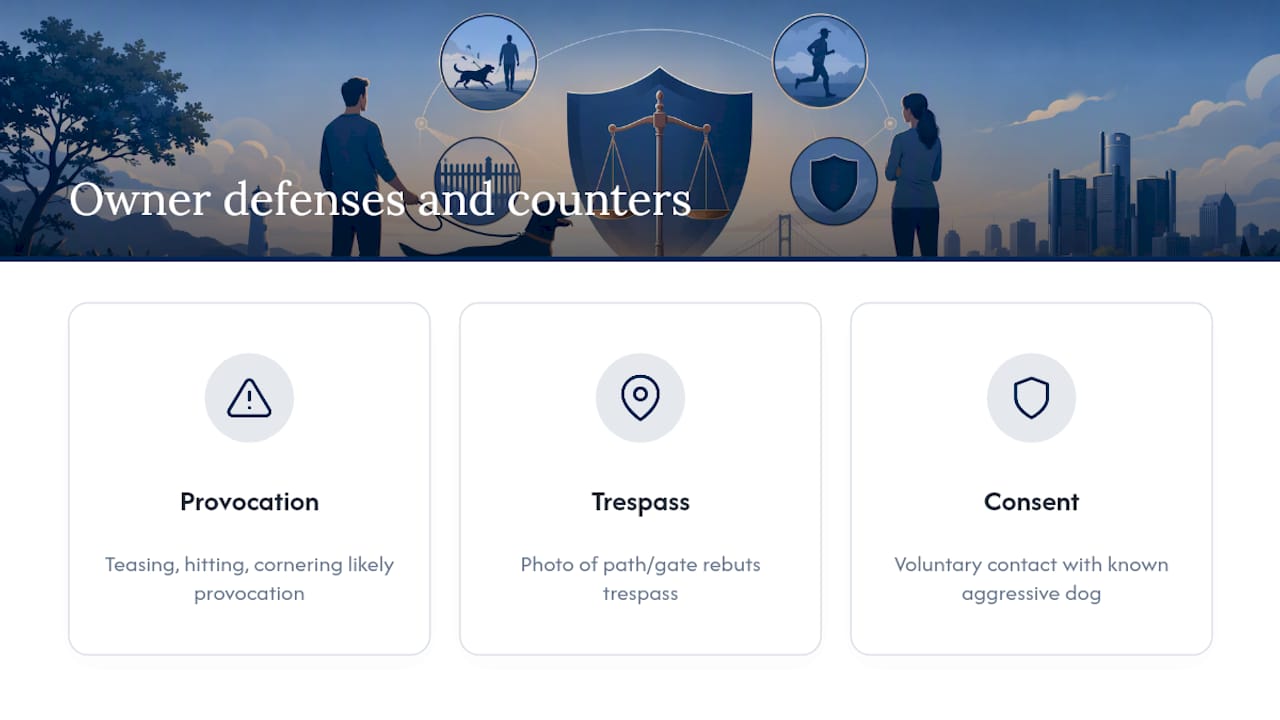
Provocation is the most common. An owner will argue that the victim’s conduct caused the dog to bite in self-defense. Michigan courts look at whether a reasonable dog would have reacted the way this dog did. Accidentally stepping on a dog’s paw generally does not constitute provocation. Deliberately teasing, hitting, or cornering the animal likely does. The line between the two is often contested.
Trespass is the second major defense. If the owner can show you had no legal right to be on the property, the statute’s protection does not apply. This is why your legal status at the moment of the bite matters so much.
Assumption of risk or consent occasionally arises when a victim voluntarily interacted with a dog they knew to be aggressive, though this defense is narrower and harder to establish than provocation or trespass.
Pro Tip: Photograph the location immediately. A photo showing a clear path, an open gate, or a public sidewalk directly counters a trespass defense. Collect names and contact information from any witnesses before you leave the scene, and note the exact time and date. These details are far harder to reconstruct later.
What damages you can recover and how a claim typically proceeds
Michigan dog bite injury claims can include a full range of compensatory damages:
| Damage Category | How It Is Proved |
|---|---|
| Medical expenses | Bills, records, and treatment notes from every provider |
| Lost wages | Pay stubs, employer verification, tax records |
| Pain and suffering | Medical records, photos, personal journals, testimony |
| Scarring and disfigurement | Photographs over time, plastic surgery evaluations |
| Future care costs | Expert medical testimony, life-care planning reports |
Non-economic damages like pain and suffering and disfigurement are often the largest component of a settlement. A Michigan Bar Journal article on damages valuation discusses how practitioners build these claims through contemporaneous documentation and expert support. For serious injuries, a physiatrist or other medical specialist may be engaged to project long-term care needs.
The typical claim follows this sequence: seek medical care, document everything, send a demand to the owner’s insurer, negotiate, and file suit if a fair settlement is not reached. Most homeowner and renter liability policies cover dog bites, so the owner’s insurer is usually the first point of contact. Understanding how homeowner liability coverage responds to a bite claim helps you know what to expect from that negotiation. Watch for a reservation-of-rights letter from the insurer, which signals the company may contest coverage while still defending the claim. That is a signal to have an attorney review the policy.
Michigan’s deadline to file a dog bite lawsuit
The statute of limitations for personal-injury claims in Michigan, including dog bite lawsuits, is three years from the date of the injury under MCL § 600.5805)/mileg.aspx?page=getObject&objectName=mcl-600-5805). The clock starts on the day of the bite, not the day you finished treatment or discovered the full extent of your injuries.
Key tolling exceptions that can pause or extend the deadline:
- Legal disability — A person who is legally incapacitated at the time of the injury may have additional time under Michigan’s disability-tolling rules.
Missing the statute of limitations almost always ends your case. Courts rarely grant exceptions beyond the recognized tolling rules. If you are approaching the three-year mark and have not filed, consult an attorney immediately.
These exceptions are narrow. Relying on them is a risk no victim should take when the straightforward path is to act well before the deadline.
Dangerous-dog declarations and criminal consequences for owners
A single bite incident can trigger administrative and criminal proceedings that run parallel to your civil claim. Michigan’s dangerous-dog statutes and local ordinances give animal-control authorities the power to declare a dog dangerous after a serious bite, particularly when the owner had prior notice of the animal’s aggression.
Once a dog is formally declared dangerous, the owner typically faces court-ordered requirements: secure confinement, specific fencing, muzzling in public, and in extreme cases involving repeated severe attacks, euthanasia. Failure to comply with those orders can itself become a basis for additional civil liability.
Criminal exposure escalates with the severity of the injury and the owner’s knowledge. A first offense involving a dangerous dog may be charged as a misdemeanor. If the owner knew the dog was dangerous and a subsequent attack causes serious injury or death, felony charges become possible. Nolo’s discussion of Michigan dog-bite criminal liability outlines how courts have drawn these lines.
A typical escalation path: a bite is reported to animal control, a hearing is scheduled, the dog is evaluated, and the owner is ordered to comply with specific conditions. A second incident after a dangerous-dog finding carries far heavier consequences. For a local example of how municipalities are tightening these rules, 2keller’s post on Royal Oak’s vicious animal ordinances shows how city-level enforcement can exceed state minimums.
Step-by-step checklist: what to do right after a dog bite
- Report the bite — File a report with your local animal control agency and, if the injury is serious, with local law enforcement. These reports create official contemporaneous records that carry significant weight with insurers.
Pro Tip: When an insurer contacts you early, limit what you say. Provide basic facts about the incident, but do not give a recorded statement without an attorney present. Early recorded statements are frequently used to minimize settlement offers.
How a Michigan personal-injury attorney helps with your dog bite claim
An attorney handles the parts of a claim that are most likely to go wrong without professional guidance: gathering and preserving evidence before it disappears, calculating the full value of your damages (including future care), negotiating with insurers who are trained to minimize payouts, and filing suit if a fair settlement is not offered.
The contingency-fee model means you pay nothing upfront. The attorney’s fee comes as a percentage of the settlement or award, and only if the case resolves in your favor. There is no financial risk to consulting or retaining representation.
What to bring to a free case review:
- Medical records and bills from every treatment
- Photographs of your injuries and the scene
- The police or animal-control report number
- Witness names and contact information
- Any correspondence from the owner or their insurer
- A log of missed workdays and lost income
2keller handles dog bite cases across Michigan as part of its personal-injury practice. A free case evaluation takes about 30 minutes and gives you a clear picture of what your claim may be worth and what steps come next. You can read more about what to expect from a dog bite claim in Michigan before your consult.
Can a landlord or third party share liability for a dog bite?
Yes, in some circumstances. A landlord who knew a tenant’s dog was dangerous and failed to take reasonable steps to address that risk may face liability under a negligence theory, even though the landlord is not the dog’s owner. Michigan courts have examined cases where a landlord had actual notice of a dog’s aggressive behavior and did nothing, and found that duty of care can extend to lawful visitors on the property.
Third-party liability claims are typically brought alongside the primary claim against the dog owner. They require proof that the third party had knowledge of the risk and a reasonable ability to act. These claims are more complex than the strict-liability claim against the owner, but they matter when the owner has limited insurance coverage or assets.
How local ordinances can expand your rights beyond state law
Michigan’s state statute sets a floor, not a ceiling. Cities and townships can and do impose stricter requirements on dog owners. Detroit, Grand Rapids, Lansing, and many smaller municipalities have breed-specific regulations, mandatory leash laws, and enhanced dangerous-dog procedures that go beyond what MCL § 287.351 requires.
A local ordinance violation by the dog owner can support your negligence claim even when the strict-liability statute does not apply. For example, if a local leash law required the dog to be restrained and the owner let it run free, that violation is evidence of negligence per se. Michigan’s state government resources at michigan.gov provide links to local animal-control agencies where you can look up the ordinances that apply in your city or township.
What “provocation” actually means under Michigan law
Michigan courts define provocation by asking whether the victim’s conduct would have provoked a reasonable dog to bite in self-defense. The standard is objective, not based on the owner’s belief about what upset the animal.
Conduct courts have found does NOT constitute provocation:
- Walking past a dog on a public sidewalk
- Accidentally stepping on a dog’s paw
- Reaching toward a dog in a friendly manner
- A child approaching a dog without threatening behavior
Conduct that may constitute provocation:
- Striking, kicking, or throwing objects at the dog
- Deliberately cornering or trapping the dog
- Sustained teasing that a reasonable dog would find threatening
The age of the victim matters. Michigan courts have recognized that young children may not have the capacity to understand that their actions could provoke an animal, and courts apply a modified standard accordingly. If a child was bitten, the provocation defense is harder for an owner to sustain.
What happens when a bite occurs outside the statute’s scope
When a bite happens in a location or circumstance that falls outside MCL § 287.351, strict liability does not automatically apply. But that does not mean the victim has no claim.
Two alternative theories remain available. First, common-law negligence: if the owner knew or should have known the dog was dangerous and failed to take reasonable precautions, a negligence claim can proceed. Second, negligence per se: if the owner violated a leash law, a local ordinance, or another safety regulation, that violation can establish the breach-of-duty element of negligence without requiring proof of prior viciousness.
A trespasser, for instance, cannot use the strict-liability statute. But if the owner knew the dog was dangerous and set it loose in an area where trespassers were foreseeable, a negligence claim may still have merit depending on the facts. Courts examine these cases individually, and the outcome turns heavily on what the owner knew and when.
How a dog bite claim unfolds from start to finish
The timeline of a Michigan dog bite claim varies by complexity, but a general framework applies to most cases.

Weeks 1–4: Medical treatment, evidence collection, reporting to animal control and police, and retaining an attorney if the injury is serious.
Months 1–3: Your attorney sends a demand letter to the dog owner’s insurer, attaching medical records, bills, photographs, and a damages calculation. The insurer investigates and responds.
Months 3–6: Negotiation. Most straightforward cases resolve during this window. If the insurer’s offer is inadequate, your attorney files a lawsuit in the appropriate Michigan circuit court.
Months 6–24+: Litigation, including discovery, depositions, and potentially mediation. Michigan courts often require case evaluation (a form of non-binding arbitration) before trial. Many cases settle during or after this process. Trial is the exception, not the rule, but the credible threat of it drives fair settlements. For a detailed look at what a serious injury claim involves, 2keller’s guide covers the full evaluation process.
Key Takeaways
Michigan’s strict-liability rule under MCL § 287.351 means a dog owner is liable for a bite injury without provocation on public property or lawfully on private property, regardless of the dog’s history, and victims have three years from the date of the bite to file a claim under MCL § 600.5805.
| Point | Details |
|---|---|
| Strict liability, no prior history needed | MCL § 287.351 holds owners liable for a first bite; Michigan does not use the “one-bite” rule. |
| Two main defenses to anticipate | Owners most often argue provocation or trespass; document your legal right to be present immediately. |
| Three-year filing deadline | MCL § 600.5805 sets a three-year limit from the date of injury; tolling applies for minors and disability. |
| Document everything early | Medical records, photos, and animal-control reports materially strengthen your claim with insurers. |
| 2keller handles Michigan dog bite cases | Free case evaluation, contingency-fee representation, no upfront cost to pursue your claim. |
Why the Michigan dog bite statute matters more than most victims realize
Most people who are bitten by a dog assume the process is straightforward: report it, submit bills, get paid. The reality is more complicated, and the gap between what victims expect and what they actually recover is often explained by a single factor: how quickly and thoroughly they documented their claim.
The strict-liability rule in MCL § 287.351 is genuinely powerful. It removes the burden of proving the owner was careless or knew the dog was dangerous. But that advantage disappears fast if the owner’s insurer can build a credible provocation or trespass argument from a gap in the evidence. Insurers are experienced at finding those gaps, and they start looking the moment a claim is filed.
The three-year deadline also creates a false sense of security. Victims who wait assume they have time. What they lose is the quality of the evidence: witnesses forget details, photos get deleted, medical records become harder to compile, and the contemporaneous record that makes a claim compelling fades. The victims who recover the most are almost always the ones who acted in the first days, not the first years.
Talk to a Michigan dog bite attorney at no cost
A dog bite can leave you with medical bills, missed work, and lasting physical and emotional effects. 2keller represents injured people across Michigan on a contingency-fee basis, which means you pay nothing unless we recover compensation for you. There are no upfront fees and no hourly charges.

If you were bitten by a dog in Michigan, the most useful thing you can do right now is get a clear, honest assessment of your claim before the evidence fades or the deadline approaches. Insurers have legal teams working from day one. You should too. Find out why insurers deny injury claims and what you can do about it, then contact 2keller for a free case evaluation. Call us or submit a request online at 2keller.com to get started.
This article is general legal information, not legal advice. Laws and deadlines can change, and the facts of your specific case determine your rights. Confirm current rules with a qualified Michigan attorney before making decisions about your claim.
Authoritative sources and further reading
- MCL – Section 287.351 – Michigan Legislature
- LIABILITY OF OWNER FOR DOG BITE (EXCERPT) – Michigan Compiled Laws PDF
- MCL § 600.5805 – Michigan Legislature (statute of limitations)
- Michigan Dog Bite Laws – FindLaw
- Michigan Dog-Bite Laws and Personal Liability Rules – Nolo
- Michigan Compiled Laws §287.351 – Justia
- Michigan Bar Journal article (PDF)