
New Mexico follows the pure comparative negligence rule: an injured person can recover damages even when partly at fault, though the recovery gets reduced by that person’s percentage of fault. Several liability rules and release language can further shape what a claimant actually collects. Understanding these mechanics before you settle or testify often determines whether you receive a fair share of the compensation you are owed.
TL;DR:
- Fault is allocated based on the jury’s responsibility determination, with each responsible party, including nonparties, assigned a percentage of fault, not just the defendant.
- Settling with one party reduces remaining claims according to the release language, which can significantly shrink recoverable amounts if not carefully drafted.
- Evidence gathered early, such as photos and medical records, is crucial for establishing liability, demonstrating fault, and maximizing recovery.
- Even if the plaintiff is mostly at fault, they can still recover a proportionate amount, making identifying all responsible parties vital for full compensation.
- Insurance negotiations are affected by early fault assessments, so proper documentation and careful release review can prevent unjust fault allocations and protect claims.
Table of Contents
- What pure comparative negligence means in New Mexico and Scott v. Rizzo
- How fault gets allocated: several liability, verdict forms, and nonparties
- How settlements and releases affect remaining claims and recoverable amounts
- What you must prove before fault allocation matters
- How an experienced New Mexico injury firm approaches shared-fault cases
- How comparative negligence changes what you actually collect
- Comparative negligence and your insurance claim in New Mexico
- The gap between knowing the rule and using it well
- How 2Keller can help with your New Mexico injury claim
- Primary statutes, key cases, and the official verdict form
- Sources
- FAQ
What pure comparative negligence means in New Mexico and Scott v. Rizzo
Pure comparative negligence allows an injured person to recover damages no matter how large their own share of fault, so long as it is not 100%. If a court finds you largely responsible for a crash, you can still collect damages reduced by your percentage of fault from the other party.
The New Mexico Supreme Court adopted this framework in Scott v. Rizzo, replacing the older contributory negligence standard because it produced harsh, often unjust results. The court favored a system that apportions responsibility according to actual fault rather than an all-or-nothing outcome, reasoning that equitable allocation better serves accident victims and defendants alike.
New Mexico’s approach stands apart from the modified comparative negligence systems used in many other states:
- Pure comparative negligence (New Mexico): recovery is reduced by your fault percentage, with no cutoff, so a plaintiff who is 90% at fault can still recover 10% of damages.
- Modified comparative negligence: common in other states, this bars recovery entirely once a plaintiff’s fault reaches 50% or 51%, depending on the jurisdiction.
- Contributory negligence: the older rule New Mexico abandoned, under which any plaintiff fault at all defeats the claim.
Knowing which system applies changes how a claimant and their attorney build a case, since New Mexico claimants never face a hard fault ceiling that wipes out recovery.
How fault gets allocated: several liability, verdict forms, and nonparties
New Mexico generally follows several liability rather than joint and several liability for claims governed by comparative fault. Under NMSA §41-3A-1, each defendant typically owes only the share of damages matching their own percentage of fault, not the full award, with statutory exceptions for certain vicarious-liability relationships and situations involving indivisible harm.
When a case goes to trial, the jury does not simply guess at responsibility. The official UJI-13-302F verdict form walks the factfinder through a specific sequence:
- First, the jury determines total damages without any reduction for comparative fault.
- Next, the jury assigns a percentage of fault to each named person, which can include the plaintiff, one or more defendants, and nonparties whose conduct contributed to the harm.
- These percentages must add up to 100%, though any individual person’s share can be zero.
This two-step structure matters strategically. Because a defendant’s payment obligation typically equals their allocated percentage of total damages, plaintiffs and their attorneys often benefit from identifying every responsible party, including nonparties who were never sued directly, so the fault pie reflects the full picture rather than concentrating blame unfairly on the defendant with the deepest pockets. Our guide to car accident liability walks through how this plays out in typical New Mexico crash claims.
How settlements and releases affect remaining claims and recoverable amounts
Settling with one at-fault party does not necessarily end your case against others, but it almost always changes the math. Under NMSA §41-3-4, a release given to one tortfeasor reduces your claim against remaining tortfeasors, either by the amount of consideration paid for that release or by a larger amount if the release contract specifies one.
Consider a few situations where this plays out:
- A claimant settles with one driver for a modest amount, then discovers the release language reduces the remaining claim by more than what was actually paid.
- A claimant negotiates a release limited to one defendant’s liability, preserving full recovery potential against a second, more culpable party.
- A claimant signs a broad release without legal review and later finds it eliminated leverage against a nonparty who bore significant fault.
Release drafting is not a formality. Vague or overly broad language can quietly shrink what remains available from other responsible parties, sometimes by far more than anyone intended.
Pro Tip: Never sign a release in a New Mexico injury case without having an attorney confirm exactly how the reduction language will affect your claims against anyone else involved.
What you must prove before fault allocation matters
Comparative negligence only comes into play after a claimant establishes the basic elements of negligence: duty, breach, causation, and damages. The percentage allocation is a second step, not a substitute for proving your case in the first place.
The evidence you gather early often determines both whether liability is established and how fault gets divided among the parties involved:
- Photos of the accident scene, vehicle damage, or hazardous conditions taken as soon as possible.
- Complete medical records connecting your injuries directly to the incident.
- Proof of lost wages and other financial losses tied to your recovery period.
- Contact information and statements from witnesses who saw what happened.
- Police or incident reports filed at the time of the event.
- Copies of all communications with insurance adjusters, since early statements can be used to argue for a higher fault percentage against you.
Because the factfinder assigns percentages based on the strength of proof for causation and comparative fault alike, thin documentation tends to hurt claimants twice: once on whether negligence is proven, and again on how much fault gets assigned to them personally. New Mexico’s statute of limitations for most personal injury claims is limited, so claimants should consult an attorney well before that window closes to preserve evidence and protect their position.
How an experienced New Mexico injury firm approaches shared-fault cases
Attorneys handling New Mexico comparative-fault claims typically focus on building proof that supports the fullest possible allocation against every responsible party, not just the most obvious defendant. That often means investigating whether a nonparty, such as a negligent third driver or a property owner, contributed to the harm and should appear on the verdict form.
Firms with regional experience also pay close attention to how evidence is preserved from the outset, since gaps in documentation can shift fault percentages in ways that are difficult to correct later. Careful release negotiation matters just as much: a poorly worded settlement with one party can quietly undercut what remains recoverable from others.
Fault percentages are decided by evidence, not assumption. The strength of your proof shapes both liability and how much of the loss lands on the other side.
— Adam
How comparative negligence changes what you actually collect
The practical effect of pure comparative negligence is that your fault percentage directly scales your final recovery, rather than eliminating it outright. If a jury finds total damages of a certain amount and assigns you a portion of the fault, your recoverable amount drops proportionally, reflecting your assigned percentage of fault; this is an illustrative example, not a guarantee tied to any real case.
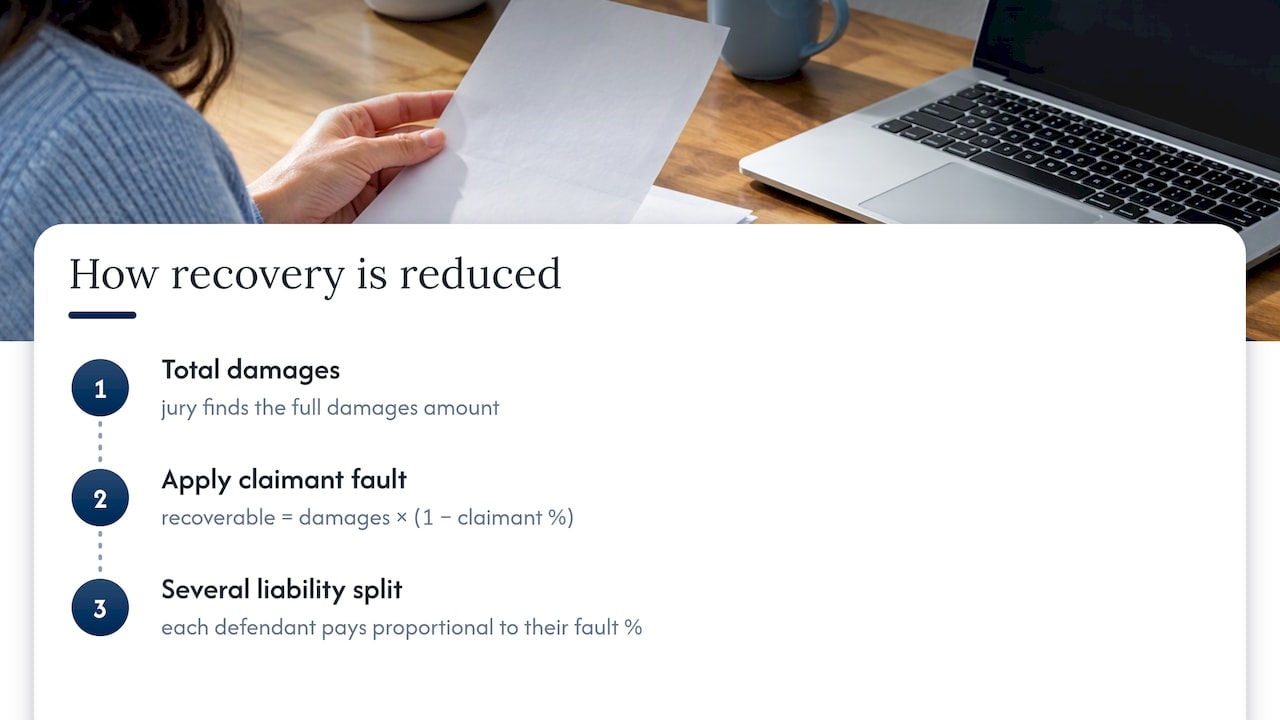
This is different from systems where crossing a fault threshold wipes out the claim entirely. In New Mexico, even a claimant found mostly at fault retains some right to recovery, which changes the calculus for both sides during settlement talks. Defendants and insurers have less incentive to argue for a fault finding above 50%, since it does not end their exposure the way it would in a modified comparative state.
That said, several liability under NMSA §41-3A-1 means the percentage assigned to each defendant also caps what that specific party owes. A defendant found to be a certain percentage at fault owes damages proportional to that percentage of the total award, regardless of whether other defendants can pay their own shares. This makes identifying every responsible party just as important as proving the overall damages figure. Our breakdown of comparative versus contributory negligence covers how these outcomes compare across different legal systems.
Comparative negligence and your insurance claim in New Mexico
Insurance adjusters routinely raise comparative fault early in a claim, often before a lawsuit is ever filed. An adjuster who can convince you to accept a higher fault percentage in a recorded statement or written correspondence reduces what their insured company ultimately has to pay, so early conversations with insurers deserve the same caution as courtroom testimony.
Uninsured and underinsured motorist coverage adds another layer, since a comparative fault finding against you can also reduce what you recover from your own policy when the at-fault driver lacks adequate insurance. Readers dealing with this scenario may find our uninsured motorist coverage guide useful for understanding how those policies respond to shared fault.
Because insurers negotiate with an eye toward the same percentages a jury would eventually assign, documentation gathered early, such as photos, medical records, and witness statements, carries weight in settlement talks long before any formal allocation occurs. A well-supported position going into negotiations often prevents an insurer from assigning you more fault than the facts actually justify, which directly protects your bottom line.

The gap between knowing the rule and using it well
Most people who search for New Mexico’s comparative negligence rule want reassurance that partial fault will not sink their claim, and the pure comparative standard does deliver that. But knowing the rule exists is not the same as knowing how to use it, and that gap is where claimants tend to lose ground.
The conventional advice stops at “you can still recover something.” What it underplays is how much the final number depends on documentation gathered in the first days after an incident and on release language signed weeks or months later. A claimant who accepts an inflated fault percentage in an early insurance statement, or who signs a broad release without understanding its reduction language, can lose far more than any jury would have assigned them.
If you take one thing from this explainer, let it be this: treat evidence preservation and release review as the two moments that matter most. The legal doctrine protects you on paper. Careful action protects you in practice.
— Adam
How 2Keller can help with your New Mexico injury claim
Sorting out fault percentages, several liability, and release language is difficult to do alone, particularly while recovering from an injury. Some personal injury law firms in New Mexico work on a contingency fee basis, meaning clients pay no fee unless the firm wins or settles the case, and may offer free case evaluations.

Some New Mexico personal injury law practices cover car accidents, truck accidents, wrongful death, slip and fall, and other injury claims where comparative fault may be relevant, with attorneys reviewing settlement offers and release language before clients sign agreements that could affect their recoveries. If your case involves a fatal injury, our wrongful death settlement timeline walks through what families can expect during the process.
If you were hurt in New Mexico and are not sure how fault allocation might affect your claim, request a free case evaluation to talk through your options with no obligation.
Primary statutes, key cases, and the official verdict form
Read the several liability statute, the release statute, the Scott v. Rizzo opinion, and the official UJI verdict form for the primary legal text behind New Mexico’s comparative negligence rules.
Sources
- Torts – Negligence – Judicial Adoption of Comparative Negligence in New Mexico (UNM Law Review)
- New Mexico Statutes Section 41-3A-1 (Several liability) (Justia)
- UJI-13-302F New Mexico Approved Jury Instruction (Verdict form) (New Mexico Supreme Court)
FAQ
What states use pure comparative negligence?
A handful of states, including New Mexico, California, and Florida, follow pure comparative negligence, meaning a plaintiff can recover damages regardless of their fault percentage as long as it is under 100%.
What is the hardest injury to prove in a personal injury case?
Injuries without clear objective markers, such as soft tissue damage, chronic pain, or traumatic brain injury, tend to be the hardest to prove because they rely heavily on medical documentation and credible testimony rather than a visible diagnosis. Thorough medical records and consistent treatment history are especially important in these cases.
What are the negligence laws in New Mexico?
New Mexico follows pure comparative negligence, adopted by the state Supreme Court in Scott v. Rizzo, meaning an injured person can recover damages reduced by their own percentage of fault. Liability is also generally several rather than joint under NMSA §41-3A-1, so each defendant typically pays only their allocated share.
What are the four elements needed to prove negligence?
A negligence claim generally requires proof of duty, breach of that duty, causation linking the breach to the harm, and actual damages suffered. Comparative fault allocation only becomes relevant after these four elements are established in a New Mexico claim.