
A third-party work injury claim is a personal injury lawsuit filed against someone other than your employer or a co-worker whose negligence caused your workplace injury. Unlike workers’ compensation, which pays benefits regardless of fault, a third-party claim requires you to prove negligence — but it opens the door to damages that workers’ comp simply does not cover, including pain and suffering and full lost wages.
Here is what you need to know right away:
- You can often pursue both workers’ compensation and a third-party lawsuit at the same time.
- If you do recover money from a third party, your workers’ comp carrier will likely have a subrogation lien — meaning it can seek reimbursement for benefits it paid you.
- Common third parties include equipment manufacturers, property owners, subcontractors, and negligent drivers.
- State rules vary significantly; Texas and Washington each have specific statutes governing how these claims coordinate.
If a non-employer party likely contributed to your injury, a third-party claim deserves serious consideration. The sooner you act, the better your chances of preserving evidence and meeting filing deadlines.
Pro Tip: Even if you are already receiving workers’ comp benefits, that does not close the door on a third-party lawsuit. The two paths run parallel, not in opposition.

Table of Contents
- What exactly is a third-party work injury claim?
- How do third-party claims differ from workers’ compensation?
- Who counts as a “third party” in a workplace injury case?
- What damages can you recover in a third-party workplace claim?
- Can you pursue workers’ comp and a third-party lawsuit at the same time?
- What steps should you take to protect and pursue a third-party claim?
- How is negligence proven in a third-party work injury case?
- When should you contact a lawyer about a third-party work injury?
- Key Takeaways
- Why injured workers often need both a comp attorney and a personal injury lawyer
- Ready to explore your third-party claim options?
- Authoritative sources and further reading
What exactly is a third-party work injury claim?
A third-party work injury claim is a tort-based personal injury action. You, the injured worker, are the plaintiff. The defendant is any person or company — other than your employer or a fellow employee — whose negligence caused or contributed to your injury on the job.
Workers’ compensation is a no-fault system: your employer pays benefits through an insurer without any need to prove who was at fault. A third-party claim operates under entirely different rules. To win, you must prove four elements of negligence:
- Duty — the third party owed you a legal duty of care (a manufacturer must produce safe equipment; a property owner must maintain safe premises).
- Breach — the third party failed to meet that duty (a machine lacked required safety guards; a floor was left dangerously wet).
- Causation — that breach directly caused your injury.
- Damages — you suffered real, quantifiable harm as a result.
As Justia explains, third-party suits can recover non-economic damages that workers’ comp does not touch, which is precisely why they matter.
Short examples of when a third-party claim applies:
- A delivery driver is rear-ended by a negligent motorist while making a work-related stop.
- A construction worker is injured by defective scaffolding manufactured by a company unrelated to the employer.
- A warehouse worker slips on a property owner’s unmarked wet floor during a vendor visit.
- A subcontractor is hurt because a general contractor failed to enforce site safety protocols.
A third-party claim is generally not available when the injury was caused solely by your employer’s negligence and your employer is covered by workers’ comp — most states grant employers immunity from personal injury suits in that scenario. It is also unavailable when no identifiable third party contributed to the harm.
Pro Tip: If you are unsure whether a third party was involved, write down every company, contractor, driver, and piece of equipment present at the scene. That list is where an attorney starts the investigation.
How do third-party claims differ from workers’ compensation?
The core difference comes down to fault and damages. Workers’ comp pays regardless of who caused the injury; a third-party lawsuit pays only if you prove negligence, but it pays more.
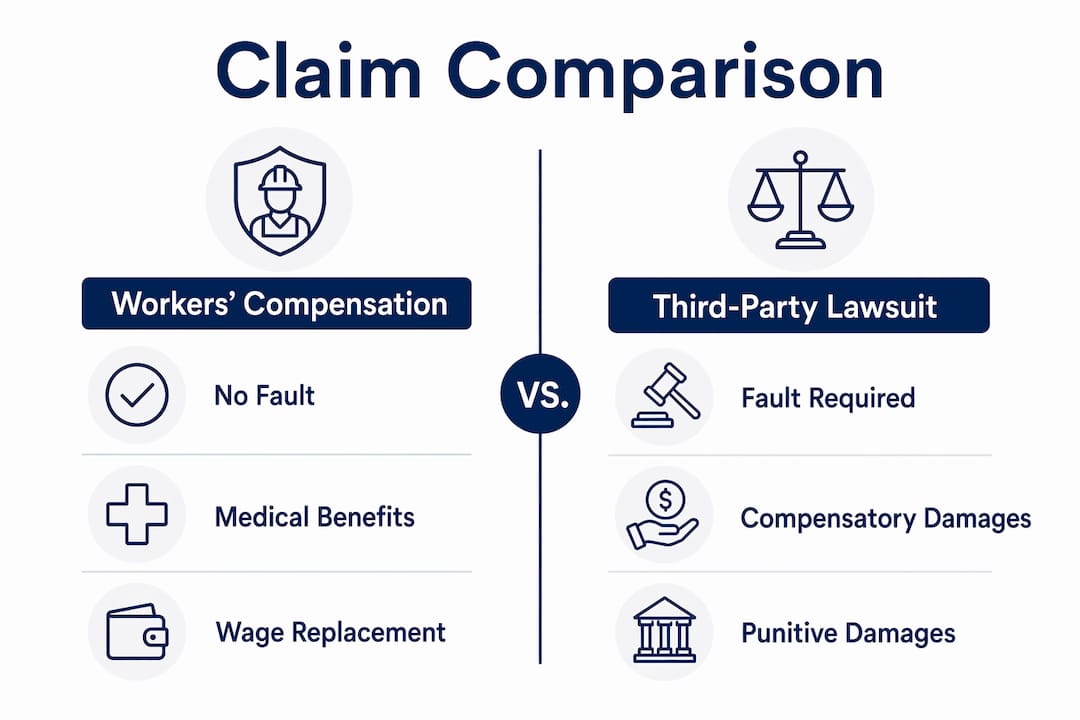
| Factor | Workers’ Compensation | Third-Party Lawsuit |
|---|---|---|
| Fault required? | No (no-fault system) | Yes (must prove negligence) |
| Medical expenses | Covered | Recoverable |
| Lost wages | Partial replacement | Full lost wages recoverable |
| Pain and suffering | Not covered | Recoverable |
| Emotional distress | Not covered | Recoverable |
| Punitive damages | Not available | Possible in egregious cases |
| Filing deadline | Comp claim deadline (varies by state) | Tort statute of limitations (typically 2–3 years) |
| Who pays | Employer’s comp insurer | Negligent third party or their insurer |
The U.S. Department of Labor confirms that workers’ compensation programs provide wage replacement, medical treatment, and rehabilitation — but not damages for pain and suffering. That gap is exactly what a third-party suit addresses.
Procedurally, the two claims also run on different clocks. Workers’ comp requires you to report your injury quickly — California, for example, requires reporting within 30 days or you risk losing benefits. A third-party tort lawsuit operates under the state’s personal injury statute of limitations, which is a separate and often longer deadline, but still finite.
Pro Tip: Do not assume that settling your workers’ comp claim ends your third-party options. The two claims are legally independent, but a poorly timed comp settlement can affect your net recovery if subrogation is not addressed first. Consult an attorney before signing any settlement agreement.
Who counts as a “third party” in a workplace injury case?
Washington State’s Department of Labor & Industries provides one of the clearest official lists of who qualifies as a third party in a work injury context:
- Another driver who caused a motor vehicle collision while you were working
- A property owner who failed to maintain safe premises where you were working
- A general contractor when the injured worker was employed by a subcontractor on the same site
- A product manufacturer whose defective equipment caused the injury
- An animal owner whose animal attacked you during work duties
This matters in practice. Construction sites routinely involve a general contractor, multiple subcontractors, equipment rental companies, and materials suppliers. If a rented crane fails because of a manufacturing defect, both the rental company and the manufacturer may share liability. If a subcontractor’s worker is injured because the general contractor ignored a known hazard, the general contractor becomes a potential defendant even though it is not the injured worker’s direct employer.
Mixed-responsibility scenarios are common. When multiple parties share fault, states apply apportionment rules — some use pure comparative fault, others use modified comparative fault with a threshold. Your attorney will assess how fault is likely to be divided and which defendants are worth pursuing.
What damages can you recover in a third-party workplace claim?
The damages available in a third-party tort suit go well beyond what workers’ comp provides. Here is a breakdown:
Economic damages (quantifiable financial losses):
- Past and future medical expenses
- Full lost wages (not just the partial replacement workers’ comp pays)
- Loss of future earning capacity
- Rehabilitation and vocational retraining costs
- Out-of-pocket expenses related to the injury
Non-economic damages (harder to quantify but legally recoverable):
- Pain and suffering
- Emotional distress
- Loss of enjoyment of life
- Loss of consortium (impact on family relationships)
Punitive damages are available in some states when the third party’s conduct was especially reckless or intentional. They are the exception, not the rule, but they are possible in egregious cases.
| Damage Category | Workers’ Comp | Third-Party Lawsuit |
|---|---|---|
| Medical expenses | Yes | Yes |
| Partial wage replacement | Yes | No (full wages recoverable instead) |
| Full lost wages | No | Yes |
| Future earnings | Limited | Yes |
| Pain and suffering | No | Yes |
| Emotional distress | No | Yes |
| Punitive damages | No | Possible |
The California Division of Workers’ Compensation states plainly that workers’ compensation benefits do not include damages for pain and suffering or punitive damages. A third-party lawsuit is the only legal avenue to recover those losses. For workers with serious injuries, that distinction can represent a substantial difference in total compensation.
Can you pursue workers’ comp and a third-party lawsuit at the same time?
Yes, in most states you can pursue both simultaneously. The two claims are legally independent, but they are financially linked through subrogation.
Subrogation means your workers’ comp carrier has a legal right to be reimbursed from any money you recover in a third-party lawsuit, up to the amount it paid in benefits on your behalf. The carrier essentially steps into your shoes to recover what it spent.
Here is how it typically works:
- You receive workers’ comp benefits while your third-party case proceeds.
- You (or your attorney) settle or win a judgment against the third party.
- Before you receive your net recovery, the comp carrier’s lien must be satisfied or negotiated.
- Whatever remains after the lien and attorney fees is yours.
Texas provides a clear statutory example. Texas Labor Code § 417.001 explicitly allows injured employees to pursue both workers’ compensation benefits and a third-party damages claim. The carrier’s subrogation interest is capped by statute and adjusted for the employer’s percentage of responsibility. Recoveries exceeding the carrier’s interest go to the injured worker.
Washington takes a structured approach. Washington L&I requires workers who identify a potential third party to complete a Third Party Election Form (F249-008-000). The worker chooses Option A (pursue the claim personally) or Option B (assign the claim to L&I). If the worker does not choose, L&I may pursue the action at its own discretion. Either way, L&I must be reimbursed from any recovery.
Pro Tip: Lien negotiation is one of the most valuable things an attorney does in a third-party case. Carriers will often accept a reduced lien amount, especially when liability is disputed or the total recovery is limited. That negotiated reduction goes directly into your pocket.
What steps should you take to protect and pursue a third-party claim?
Acting quickly protects both your workers’ comp benefits and your third-party rights. Follow these steps in order:
- Report the injury to your employer immediately. Most states require prompt reporting to preserve comp eligibility. California requires notice within 30 days.
- Seek medical care and document everything. Tell medical providers the injury is work-related. Keep all records, bills, and treatment notes.
- Preserve the scene and evidence. Photograph the scene, the equipment involved, and any visible hazards before anything is moved or repaired.
- Identify all parties present. Note every company, contractor, vehicle, and piece of equipment at the scene. Get names and contact information for witnesses.
- File your workers’ comp claim. This preserves your no-fault benefits and starts the official record.
- Identify potential third parties. Review who owned the equipment, who controlled the site, and who else may have contributed to the hazard.
- Consult a personal injury attorney. Do this before signing any settlement documents or releases.
- File the third-party lawsuit before the statute of limitations expires. Tort deadlines are separate from comp deadlines and vary by state — typically two to three years from the date of injury, but some states are shorter.
The statute of limitations is a hard deadline. Missing it permanently bars your third-party claim, regardless of how strong the case is. Workers’ comp claim deadlines are separate and often shorter, so both clocks start running on the day of the injury.
For workers in states outside the U.S., procedures differ substantially. Singapore’s Ministry of Manpower, for instance, uses a distinct employer-reporting and medical-assessment process under its Work Injury Compensation Act — a reminder that jurisdiction shapes every procedural detail.
How is negligence proven in a third-party work injury case?
Proving negligence requires evidence tied to each of the four legal elements. Here is what that looks like in practice:
Duty is usually established by law, contract, or industry standards. A manufacturer has a duty to produce safe products. A property owner has a duty to maintain safe premises for foreseeable visitors. Evidence: contracts, safety regulations, OSHA standards, industry codes.
Breach means the third party fell below that standard of care. Evidence: maintenance logs showing ignored repairs, inspection records, OSHA violation citations, expert testimony comparing the defendant’s conduct to industry norms.
Causation connects the breach to your specific injury. Evidence: medical records, accident reconstruction reports, expert opinions, police or incident reports, witness statements.
Damages are documented through medical bills, wage records, employer statements, and expert testimony on future losses.
Common defenses third parties raise:
- Comparative fault — arguing that you, the injured worker, were partly responsible. In states with modified comparative fault, your recovery is reduced by your percentage of fault, and in some states eliminated if your fault exceeds a threshold.
- Assumption of risk — claiming you knowingly accepted the hazard as part of your job. This defense is harder to sustain when safety violations are involved.
- Lack of causation — disputing that their conduct actually caused your injury, often through competing medical or engineering experts.
Understanding these defenses early shapes how your attorney builds the case and what evidence to prioritize.
When should you contact a lawyer about a third-party work injury?
Consult an attorney as soon as possible if any of the following apply:
- Your injury is serious or involves permanent disability.
- Multiple companies or contractors were present at the scene.
- A defective product or piece of equipment was involved.
- Your lost wages are significant or your career has been affected.
- The workers’ comp carrier is disputing your claim or benefits.
- You have received any settlement offer or release to sign.
A personal injury attorney brings specific value to third-party cases that goes beyond what a comp attorney handles. They investigate fault, identify all liable parties, negotiate with the comp carrier’s lien, structure settlements to maximize your net recovery, and file suit when necessary. For a deeper look at the distinctions between first-party and third-party claims, the 2keller guide on first-party vs. third-party claims walks through the legal differences clearly.
What to bring to your first consultation:
- Medical records and bills related to the injury
- Workers’ comp claim paperwork and any correspondence from the carrier
- Photos of the scene, equipment, and injuries
- Names and contact information for witnesses
- The employer’s incident report
- Any contracts, work orders, or site safety documents you have access to
Pro Tip: Most personal injury attorneys handle third-party work injury cases on a contingency fee basis — meaning you pay nothing unless they recover money for you. There is no financial reason to delay a consultation, and every week you wait is a week of evidence that may disappear.
For guidance on when to seek an attorney after a workplace accident, 2keller’s blog covers the timing question in practical detail.
Key Takeaways
A third-party work injury claim is a negligence-based personal injury lawsuit that runs parallel to workers’ compensation and can recover damages — including pain and suffering — that comp never pays.
| Point | Details |
|---|---|
| Two claims, one injury | You can pursue workers’ comp and a third-party lawsuit simultaneously in most states. |
| Negligence is required | Unlike no-fault comp, a third-party suit requires proving duty, breach, causation, and damages. |
| Subrogation affects net recovery | Your comp carrier can seek reimbursement from your third-party recovery; lien negotiation matters. |
| State rules vary | Texas and Washington each have specific statutes governing how concurrent claims coordinate. |
| 2keller can help | 2keller handles third-party work injury cases across Indiana, Michigan, and New Mexico. |
Why injured workers often need both a comp attorney and a personal injury lawyer
The conventional advice to “just file workers’ comp and move on” leaves real money on the table for workers whose injuries involved a third party. Workers’ comp counsel focuses on maximizing benefits within the comp system. A personal injury attorney focuses on the tort claim, the third-party defendants, and the damages that comp cannot touch. Those are genuinely different skill sets, and the coordination between them — particularly around lien negotiation and settlement structure — is where injured workers either protect or lose a significant portion of their recovery.
The practical reality is that gross recovery and net recovery can look very different in a third-party case. A settlement can sound substantial until a comp lien, attorney fees, and litigation costs are applied, reducing the net recovery. An experienced personal injury attorney negotiates the lien down, structures the settlement to allocate damages in a way that minimizes the lien’s reach, and ensures the worker walks away with the largest possible share. That work is invisible to most injured workers until it is done — or not done.
The deeper issue is timing. Evidence disappears. Witnesses move. Equipment gets repaired or replaced. The workers who fare best in third-party cases are the ones who documented the scene on day one and had an attorney involved before any settlement documents were signed. Waiting until the comp case is resolved to think about a third-party claim is one of the most common and costly mistakes in this area of law.
Ready to explore your third-party claim options?
If a third party’s negligence contributed to your workplace injury, you may be entitled to compensation well beyond what workers’ comp provides. 2keller’s personal injury attorneys handle third-party work injury cases across Indiana, Michigan, and New Mexico, helping injured workers identify liable parties, navigate subrogation, and pursue the full damages the law allows.

A case evaluation costs you nothing. 2keller works on a contingency fee basis, so there are no upfront costs and no fees unless you recover. Before your consultation, gather:
- Medical records and treatment bills
- Workers’ comp claim documents and carrier correspondence
- Photos of the accident scene and your injuries
- Witness names and contact information
- Your employer’s incident report
To understand whether your injury qualifies and what a case evaluation involves, visit 2keller’s injury claim case evaluation page. If you are assessing the severity of your injuries, the guide on what qualifies as a serious injury claim is a practical starting point.
This article provides general legal information, not legal advice. Laws vary by state, and your specific situation may differ. Consult a qualified attorney or your state’s workers’ compensation board for guidance on your individual case.
Authoritative sources and further reading
The claims and legal distinctions in this article draw on the following primary sources:
- Washington State Department of Labor & Industries — Third-Party Claims: Covers the Third Party Election Form, L&I reimbursement rules, and examples of qualifying third parties.
- Texas Labor Code § 417.001: The statutory basis for concurrent workers’ comp and third-party claims in Texas, including the carrier subrogation cap.
- U.S. Department of Labor — Workers’ Compensation: Overview of federal and state comp programs and what benefits they cover.
- Justia — Third-Party Liability in Work Injury Lawsuits: Plain-language explanation of negligence elements and the damages available in third-party suits.
- California Division of Workers’ Compensation — Injured Worker Guide: State-level detail on reporting deadlines and what comp benefits do and do not cover.
- 2keller — First Party vs. Third Party Claim: Firm resource explaining the legal distinctions between claim types.
- 2keller — When You Need an Attorney After a Workplace Accident: Practical guidance on timing and what to expect from legal counsel.
For workers outside the U.S., note that procedures differ substantially by jurisdiction. The Scotland injury at work claims process offers a useful point of comparison for how UK-based workers navigate similar third-party scenarios under a different legal framework.