
A car accident settlement is built from your documented losses, adjusted by who was at fault and capped in practice by the insurance money available. The main factors are the severity of your injuries, your medical expenses, your lost income, your pain and suffering, the strength of the evidence, the share of fault assigned to each driver, and the policy limits. Below we explain how each one moves the number, with the New Mexico rules that apply to drivers in Albuquerque and across the state.
TL;DR
- Settlements start with economic damages (medical bills, lost wages, property damage) and add non-economic damages (pain, loss of enjoyment of life).
- In New Mexico, your share of fault reduces what you can recover, but it does not automatically bar your claim.
- Insurance limits often decide how much money is realistically available, so check every policy, including your own UM/UIM coverage.
- Consistent treatment records, photos and prompt, accurate statements support a higher valuation. Gaps and contradictions lower it.
- There is no honest “average payout” for a given injury. The value depends on the facts of your case.
Table of Contents
- How a settlement amount is actually built
- Severity and permanence of your injuries
- Medical expenses, now and in the future
- Lost income and earning capacity
- Pain and suffering and loss of enjoyment
- Fault and New Mexico’s comparative negligence rules
- Insurance policy limits: the practical ceiling
- Evidence and what you do after the crash
- Timing: when to settle and when to wait
- When the claim involves a death
- Our perspective
- How 2keller can help
- FAQ
- Sources
How a settlement amount is actually built
Insurance adjusters, attorneys and juries all start from the same question: what did this crash cost you, and who must pay for it? Legal references describe damages in two groups. Economic damages can include past and future lost wages and loss of earning capacity, alongside medical bills and repair costs. Non-economic damages cover harm that has no receipt, such as pain, anxiety and the loss of activities you used to enjoy.
You may have seen a “formula” online: add up the bills, multiply by a number, then subtract for fault. That shortcut is a rough negotiating tool, not a rule. Adjusters use it, and so do we when we explain a range to a client, but no court applies a fixed multiplier. Two people with the same medical bill can receive very different settlements because the other factors below differ.
Here is a quick map of the factors, in the order we usually examine them.
| Factor | What it affects | What helps your claim |
|---|---|---|
| Injury severity and permanence | Size of both economic and non-economic damages | Clear diagnosis, specialist opinions, documented limits |
| Medical expenses, past and future | Economic damages | Complete bills, treatment plan, cost estimates |
| Lost income and earning capacity | Economic damages | Pay records, employer letters, vocational evidence |
| Pain and suffering | Non-economic damages | Consistent records, a daily impact account |
| Fault | Reduces what you can collect | Police report, photos, witnesses, vehicle data |
| Insurance limits | Caps the money realistically available | Early identification of every policy |
| Evidence and conduct after the crash | Credibility and leverage | Prompt care, preserved proof, careful statements |
Severity and permanence of your injuries
Injury severity is the single largest driver. A bruise that resolves in two weeks and a spinal injury that changes how you work for the rest of your life sit in different categories of value, even if both began in the same intersection.
Adjusters look for three things:
- Diagnosis. Imaging, specialist notes and objective findings carry more weight than a general complaint of pain.
- Duration. Injuries that have stabilized with a permanent restriction are valued differently from injuries still healing.
- Impact on function. Can you lift, drive, sleep, care for your family or return to your job?
People often ask about the “average payout” for a particular injury, such as a whiplash classification. Be careful with those numbers. Grading systems for whiplash come from other legal systems, and in the United States there is no standard grade that sets a dollar figure. What we can say honestly is that a neck or back soft-tissue injury that resolves quickly is usually valued modestly, while one that leads to injections, surgery or permanent restrictions is valued far higher. The only reliable estimate comes from your own records.
Medical expenses, now and in the future
Medical bills are the backbone of the economic claim. They include the ambulance, the emergency room, imaging, surgery, medication, therapy and follow-up visits. Future care counts too: if a surgeon expects you to need injections, a revision procedure or long-term therapy, a credible estimate of that cost belongs in the demand.
A few practical points shape how those bills are valued:
- Who provided the care. Adjusters sometimes discount a claim when most of the charges come from providers other than physicians and hospitals, such as chiropractors and physical therapists. That does not mean you should skip therapy your doctor recommends. It means the records should show why the care was medically necessary and that a physician directed it.
- Gaps in treatment. A three-week gap between visits gives an insurer room to argue that you recovered or that something else caused your pain.
- Following medical advice. Attending appointments and completing prescribed therapy shows that your injury is real and that you are acting reasonably to recover.
So, will physical therapy increase your settlement? Therapy does not raise the value by itself. It documents the injury, shows you mitigated your losses, and produces records that explain your limits. Unnecessary or poorly documented therapy can be challenged, while therapy tied to a doctor’s plan supports your case.
Lost income and earning capacity
Lost wages are the easiest part to prove when you have pay stubs and an employer’s letter showing the days you missed. The harder question is future earning capacity: if your injury limits the work you can do, how much income will you lose over the years ahead?
That part of the claim needs more support than a statement from you. Useful evidence includes your work history, education and training, medical restrictions from your treating physician, and in larger cases a vocational or economic expert. Self-employed people and hourly workers should keep tax returns, invoices and schedules, because their losses are harder to show from a single paycheck.
Pain and suffering and loss of enjoyment
Non-economic damages are the most personal and the most contested part of a settlement. They compensate for physical pain, emotional distress and the loss of the ordinary parts of life: playing with your children, exercising, sleeping through the night, finishing a workday without pain.
Because nothing arrives in an envelope to prove it, this category depends on the credibility of your account and the consistency of your records. We encourage clients to:
- Keep a short, factual daily note of pain levels, missed activities and help needed at home.
- Tell every provider about all symptoms, not only the worst one.
- Keep photos of visible injuries, braces, walkers or other medical equipment, which show your limits more vividly than a summary can.
- Avoid posting about physical activity on social media while your claim is open.
Fault and New Mexico’s comparative negligence rules
Fault affects both whether you can recover and how much. New Mexico follows a comparative fault system. Under NMSA Section 41-3A-1, a defendant who shows that another person’s fault contributed to the injury is responsible only for the portion of damages that matches that defendant’s share of the total fault. In practice, a driver found 20 percent responsible has their recovery reduced by that share, and a driver who was mostly at fault may still recover something. We walk through the rule in detail in our guide on recovering even if you were mostly at fault and in our New Mexico car accident comparative negligence rules article.
The same statute also changes who pays when several parties are involved. Joint and several liability is abolished except in specific cases, such as when a person intentionally inflicts injury, is vicariously liable for another, or is strictly liable for a defective product. When more than one party shares fault, each is generally responsible for its own percentage. This makes it important to identify every responsible party early, including an employer, a vehicle owner or a manufacturer.
Because a few percentage points can change a settlement by thousands of dollars, fault evidence deserves attention from day one:
- The police report and any citations
- Photos and video of the scene, vehicle damage and road conditions
- Witness names and phone numbers
- Traffic camera or business surveillance footage, which is often overwritten within days or weeks
- Vehicle data, which in serious crashes can show speed and braking
Insurance policy limits: the practical ceiling
A claim can be worth more than the money available to pay it. That is why we ask about insurance before we discuss numbers.
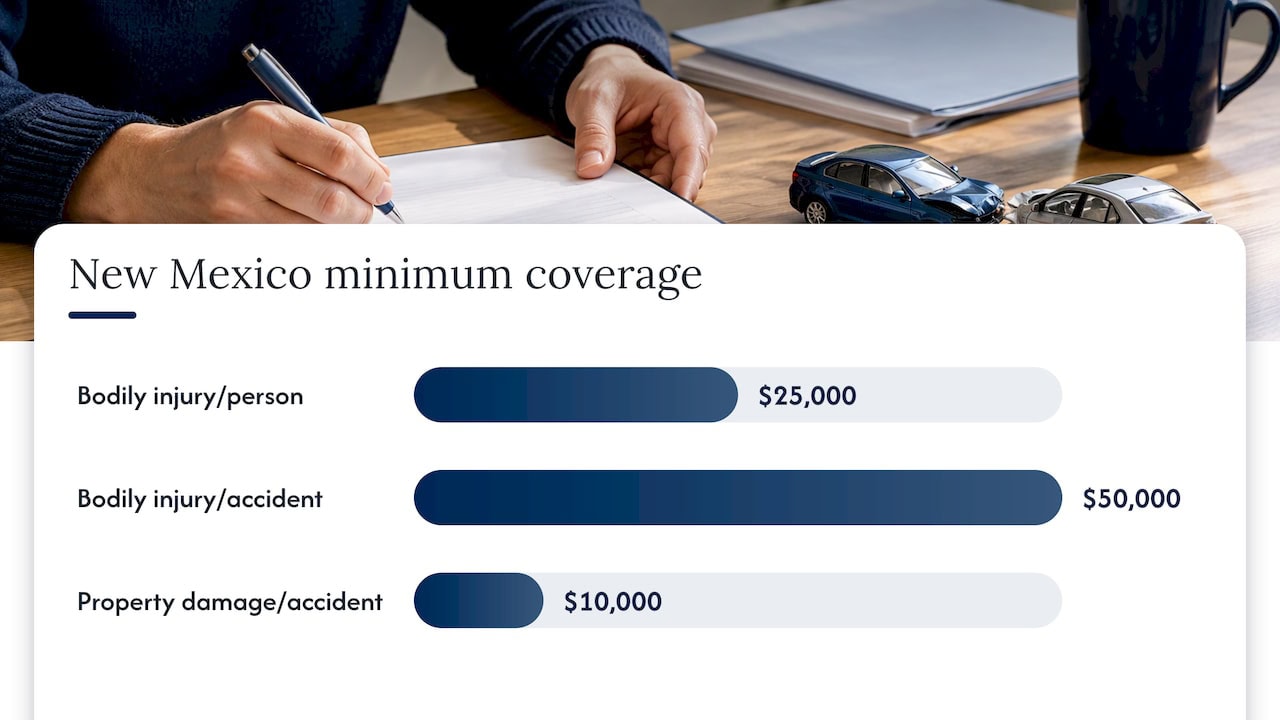
New Mexico requires drivers to carry at least $25,000 per person and $50,000 per accident for bodily injury, and $10,000 per accident for property damage. Those minimums can be exhausted quickly by a hospital stay, and some drivers carry more than the minimum while others carry only that.
This is where your own coverage matters. Uninsured and underinsured motorist (UM/UIM) coverage can fill part of the gap when the at-fault driver has no insurance or too little. New Mexico’s insurance regulator explains that the total payment from UM/UIM coverage is limited to the greater of your UM/UIM limit or the other party’s liability limit, subject to other policy provisions. Our overview of UM/UIM basics for New Mexico drivers and our summary of New Mexico’s car accident insurance laws explain how to read your own declarations page.
Commercial vehicles and trucks
When a delivery van, a company car or a semi truck is involved, more coverage may exist. Federal rules set minimum limits for many for-hire carriers, and the insurance industry itself acknowledges that trucking verdicts and settlements have outpaced the $750,000 MCS-90 minimum in many cases. That is one reason we identify the driver, the employer, the owner and any maintenance or loading company right away: each may carry its own policy.
Evidence and what you do after the crash
Two people with identical injuries can have very different outcomes based on what happened in the first days. Insurers read your claim for consistency, so small details matter.
- Get medical care promptly. A delay lets an insurer argue that the injury came from something else.
- Be accurate and brief with the other side’s insurer. Describe facts, not guesses. Do not speculate about fault or say you are “fine” at the scene.
- Do not sign broad medical releases or accept a quick offer before you know the full extent of your injuries.
- Preserve evidence. Keep damaged clothing, photos, receipts and your own notes.
- Keep a record of every expense, including mileage to appointments and prescriptions.
In some cases a lienholder also matters. Health insurers, Medicare, Medicaid or other payers may have a right to be repaid from your settlement, and the amount you keep depends on how those claims are resolved. Raise the question early, because it affects what a given gross settlement means to you.
Property damage and loss of use are part of the picture as well. If your car was repaired or totaled, the amount you recover for the vehicle and for the time without it is handled separately from your injury claim. Our article on loss of use in New Mexico car accident claims covers that piece.
Timing: when to settle and when to wait
Settling too early is one of the most common mistakes. Once you sign a release, you cannot reopen the claim if your condition worsens. We generally want the treating physician to say that you have reached maximum medical improvement, or at least that your future needs are clear, before a final demand goes out.
There is also a legal clock. New Mexico gives most personal injury plaintiffs three years from the date of injury to file suit, and claims against government entities can carry shorter notice deadlines. Do not wait until the last months to speak with an attorney, because evidence fades long before the deadline arrives.
A second timing point involves medical care itself. If your original injury is later made worse by reasonably required treatment, even treatment that was performed negligently, a proposed 2026 New Mexico jury instruction states that the original wrongdoer may be responsible for the added harm too. It is a proposal, so ask an attorney how courts apply it to your situation.
When the claim involves a death
A wrongful death claim is valued differently from an injury claim. In an injury case, you recover your own losses. In a wrongful death case, the claim is brought for the family, and damages focus on losses such as loss of companionship, funeral expenses and the deceased person’s potential future earnings. Who may file, and how the recovery is divided, depends on state law. If you have lost someone in a crash, we know that numbers are the last thing you want to discuss. Our team handles that conversation gently and at your pace.
Our perspective
We have handled thousands of cases against large insurance companies, and the pattern is consistent: the first offer reflects what the insurer can justify on paper, not what your life has been changed by.
The factors in this article are not a secret formula. They are the questions an adjuster asks, and the work of a good claim is answering each one with documents before the insurer raises a doubt. That means collecting records, finding every policy, and keeping you informed at each step.
Our approach is client-first and family-run. You have direct access to your attorney and paralegal throughout the process, and we explain each decision in plain language. Because we work on a contingency fee, you owe no fee unless we win.
Adam
How 2keller can help
If you were hurt in a crash in Albuquerque or elsewhere in New Mexico, we offer a free case evaluation. We review your injuries, the evidence, the insurance available and the fault issues, and we explain what a realistic path looks like. We handle car, motorcycle and semi truck accidents, wrongful death and other injury cases on a no-win, no-fee basis.

You can start with our free case evaluation at 2keller.com, and you will be able to speak with a team that has experience dealing with major insurers. If you want to read more first, our article on restrictions and limitations in New Mexico auto accident claims is a good next step.
FAQ
Is there an average payout for a car accident injury?
No single figure is reliable, because values depend on injury severity, medical costs, income loss, fault and available insurance. Online averages blend minor and catastrophic cases together. A review of your own records is the only way to get a meaningful range.
Will physical therapy increase my settlement?
Therapy does not add value by itself, but it documents your injury and shows that you followed medical advice. Care that is ordered by your doctor and consistently recorded supports your claim. Adjusters may question care that appears excessive or lacks a medical reason.
Can I still recover if I was partly at fault?
In New Mexico, a finding that you share fault reduces what you recover in proportion to your share rather than automatically ending the claim. The exact result depends on how fault is assigned among everyone involved. An attorney can review the facts and explain how the rule applies to you.
What if the other driver’s insurance is too low?
Start with your own policy and check for UM/UIM coverage, which may apply when the at-fault driver is uninsured or underinsured. Also look for other responsible parties, such as an employer or vehicle owner, who may carry separate coverage. Bring every policy to your consultation.
What should I do with a settlement once I receive it?
Before spending it, confirm that medical bills, liens and attorney costs have been resolved, and ask your attorney for a closing statement showing each deduction. Consider speaking with a financial or tax professional about the best use of the net amount, especially if future care is expected.
Sources
- Car Accident Settlement Formulas and Valuation Software (Nolo)
- How Insurance Companies Determine Injury Settlement Amounts (AllLaw)
- New Mexico Statutes Section 41-3A-1 (2025)
- New Mexico Office of Superintendent of Insurance: auto insurance tip, April 2022
- New Mexico OSI Bulletin 2021-024 on UM/UIM disclosure
- Insurance and Reinsurance, IADC, April 2023
- New Mexico Civil Statute of Limitations Laws (FindLaw)
- Proposed revisions to the Uniform Jury Instructions, New Mexico Supreme Court, 2026
- Damages in Personal Injury and Wrongful Death Cases, Notre Dame, 2023