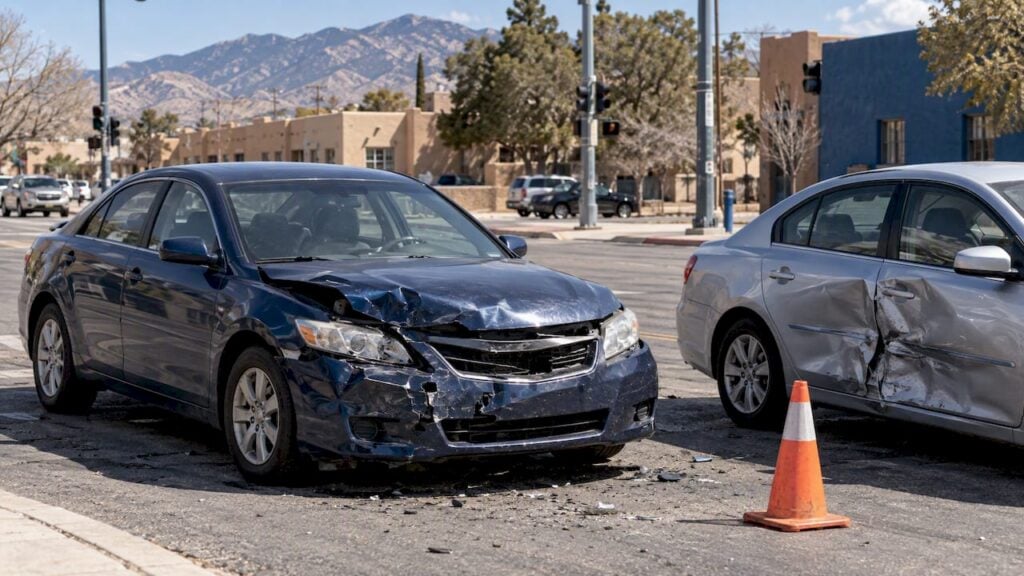
If a drunk driver hurt you or killed someone you love in New Mexico, you can bring a civil claim for compensation that is separate from the criminal DWI case. The claim is usually made against the driver’s insurance, and sometimes against other parties, such as a bar that overserved the driver. The injured person or, in a death case, the personal representative of the estate decides whether to file. A deadline applies, and evidence is easiest to secure early.
This guide explains who can bring a claim, how fault is proven, what compensation may include, how the criminal case relates to your claim, and what to do in the first weeks. It is general information, not advice on your specific facts.
TL;DR
- A civil claim after a drunk-driving crash is separate from the criminal DWI case. The prosecutor decides on charges; you decide whether to bring a claim.
- Injured people file for their own injuries. After a death, only the personal representative of the estate may bring the wrongful-death action for the family.
- The general deadline for a New Mexico personal-injury claim is three years under Section 37-1-8, so do not wait for the criminal case to finish.
- Recoverable losses can include medical care, lost income and pain and suffering. Punitive damages may be available in some circumstances.
- Free consultation, no fee unless we win: you can have us review your case before you decide anything.
Table of Contents
- Criminal DWI case and civil claim: two separate tracks
- Who can bring a claim
- How fault is proven in a drunk-driving claim
- Who else may be responsible besides the driver
- What compensation may include
- The deadline to file
- What to do in the first days after the crash
- Perspective: what we see in these cases
- How we can help
- FAQ
- Sources
Criminal DWI case and civil claim: two separate tracks
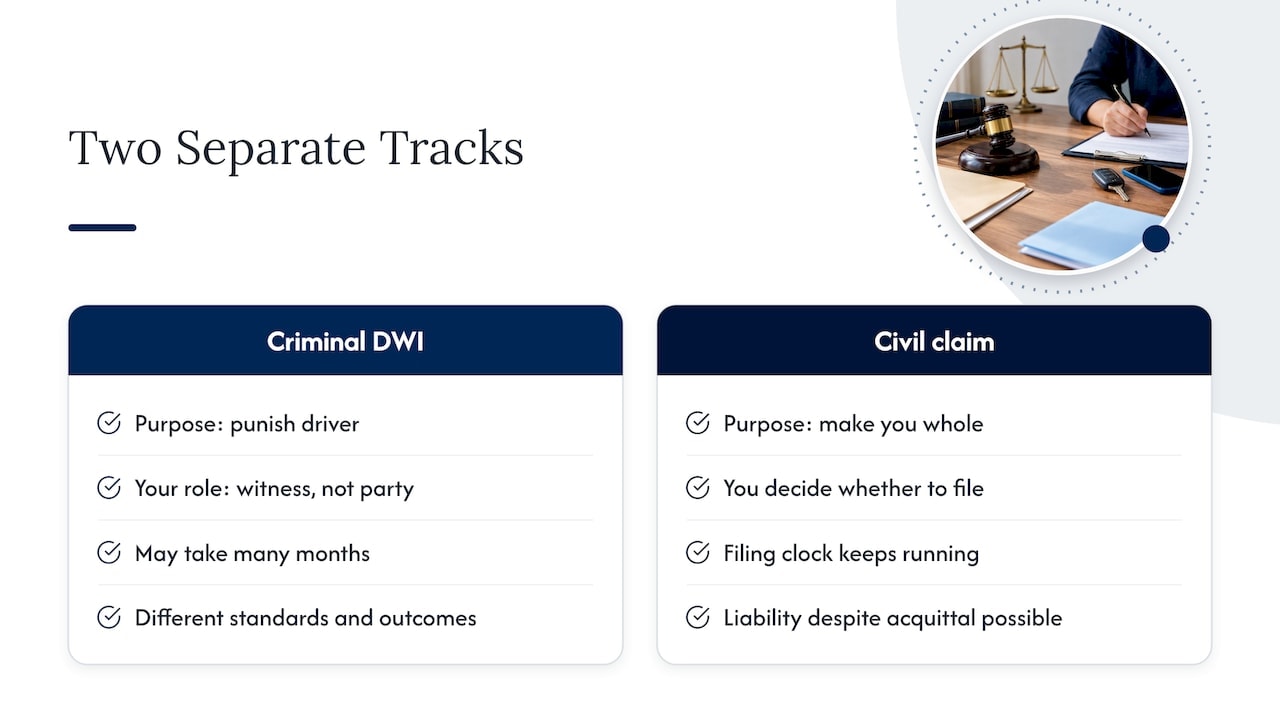
After a crash involving an impaired driver, two things happen in parallel. The State may prosecute the driver for DWI. That case is about punishing the driver. You are a witness, not a party.
Your civil claim is about making you whole. Unlike a criminal prosecution, you decide whether to bring a civil claim against the drunk driver. The two cases use different standards and can end differently. A driver can plead to a lesser charge, or be acquitted, and still be found responsible in a civil case. A conviction, when there is one, helps, but you do not need one to pursue compensation.
The practical consequence is timing. Criminal cases can take many months. The civil clock keeps running while they do.
To see how these cases play out locally, read our report on a man sentenced to prison for a deadly DWI accident in Albuquerque and our coverage of a suspected drunk driver arrested after an accident in Gallup.
Who can bring a claim
Drivers and occupants of other vehicles
Anyone injured because a drunk driver caused a crash can seek compensation: the driver and passengers of another car, motorcyclists, cyclists and pedestrians. In a truck crash, the claim can also reach the trucking company if the driver was working at the time, which often means larger insurance policies and more records to obtain.
Passengers in the drunk driver’s own vehicle
Passengers generally have the same right to compensation as anyone else injured by a drunk driver. There is an exception worth knowing: a passenger hurt while riding with a spouse or relative probably cannot file a liability claim against that driver, because they are likely covered under the same policy. Other coverage, such as your own medical payments or uninsured and underinsured motorist coverage, may still apply.
Insurers also look at what the passenger knew. They may argue you shared blame by knowingly riding with an impaired driver, not wearing a seat belt or distracting the driver, and in some states that can reduce or bar compensation. Our guide to car accident passenger rights in New Mexico walks through these arguments.
Families after a fatal crash
New Mexico limits who files a wrongful-death case. Only the personal representative of the deceased person’s estate may bring the action. That person is often a spouse or adult child named in the will or appointed by the court, and they sue on behalf of the family members who lost their loved one. If no one has been appointed yet, that is an early step, and one we can help you with.
How fault is proven in a drunk-driving claim
Drunk driving does not make a claim automatic. You must show that the driver’s impairment caused or contributed to the crash, and that the insurer’s comparative-fault arguments do not outweigh it. Typical evidence includes:
- Police and crash reports. Officers note observed impairment, field sobriety tests, statements and the scene layout.
- Chemical tests. The state’s DWI Benchbook says chemical-test results may be introduced in any civil or criminal action arising from the alleged conduct.
- Vehicle data. In truck and many car crashes, event data recorders can show speed, braking and throttle position in the seconds before impact.
- Witnesses and video. Other drivers, nearby businesses, traffic cameras and dash cameras can show how the driver was behaving.
- Receipts and bar records. Tabs, timestamps and surveillance footage can show where and how much the driver drank.
- Medical records. These tie your injuries to the crash.
What the law counts as DWI
The Benchbook explains that DWI may be proved either by impaired driving or by a prohibited alcohol concentration under NMSA §66-8-102. In a civil case you are not bound by the criminal rules, but the same evidence often carries over.
Why test timing gets argued
A blood or breath test is usually taken some time after the crash, and defense lawyers know it. In State v. Day, New Mexico courts examined the link between a later alcohol result and the driver’s alcohol concentration while actually driving. That is why we look for corroboration: witness accounts of drinking, receipts, behavior at the scene and the officer’s observations all help fill the gap between the time of driving and the time of the test.
Your own share of fault
Insurers routinely look for ways to assign you part of the blame: speed, lane position, a missing seat belt, a phone. Comparative-fault rules can reduce what you recover. Keeping your statements factual and brief until you have legal advice protects you here. For the broader rules, see our overview of New Mexico auto accident claims, restrictions and limitations.
Who else may be responsible besides the driver
The driver is the obvious defendant, but not the only one.
- Employers and trucking companies. If the drunk driver was on the job, the employer may share liability, and commercial policies are typically larger than personal ones.
- Bars, restaurants and other licensed sellers. New Mexico has a dram shop law, Section 41-11-1, that allows an injured person to hold a licensed alcohol vendor liable when it served someone who was visibly intoxicated or known to be. These claims are demanding. They depend on proving overservice, and the evidence, such as video and point-of-sale records, can disappear quickly.
- Your own insurer. If the driver has no insurance or too little, your uninsured or underinsured motorist coverage may pay.
The courts have been cautious here historically. In Marchiondo v. Roper, the New Mexico Supreme Court affirmed dismissal of a claim for negligent sale of intoxicating liquor and hoped the legislature would address the issue. The legislature later enacted the statute above, so the 1977 outcome is background, not a current bar. Whether a claim against a bar is realistic depends on the evidence in your case.
What compensation may include
Compensation in a drunk-driving case is meant to cover the actual harm. Depending on your injuries, it may include:
| Type of loss | Examples |
|---|---|
| Medical expenses | Emergency care, surgery, rehabilitation, future treatment |
| Lost income | Missed work, reduced earning capacity |
| Pain and suffering | Physical pain, emotional distress, loss of enjoyment of life |
| Property damage | Vehicle repair or replacement |
| Punitive damages | Possible where the conduct justifies them |
Punitive damages deserve a word. They are not about your losses; they respond to especially reckless conduct, and drunk driving is the kind of conduct that can raise the question. New Mexico’s Supreme Court has held, in Stinbrink v. Farmers Insurance Co. of Arizona, that uninsured-motorist coverage can include punitive damages when the claimant is legally entitled to recover them from the uninsured motorist. The court also described that coverage as protecting injured victims from financially irresponsible motorists, not as protecting insurers. Whether punitive damages apply in a given case is a judgment we make after reviewing the facts.
In a wrongful-death case
The personal representative may also recover for the decedent’s conscious pain and suffering and for medical and related care between the injury and death. The family’s own losses, such as lost support and companionship, are part of the case too. A wrongful-death claim is a legal remedy, not a measure of a person’s worth, and we treat it with that in mind.
The deadline to file
For a New Mexico personal-injury claim, the general limit is three years from the injury under Section 37-1-8, and the period generally begins when the injury occurs. Wrongful-death actions are governed by a separate statute, Section 41-2-2, so confirm the exact date for a death case with an attorney early.
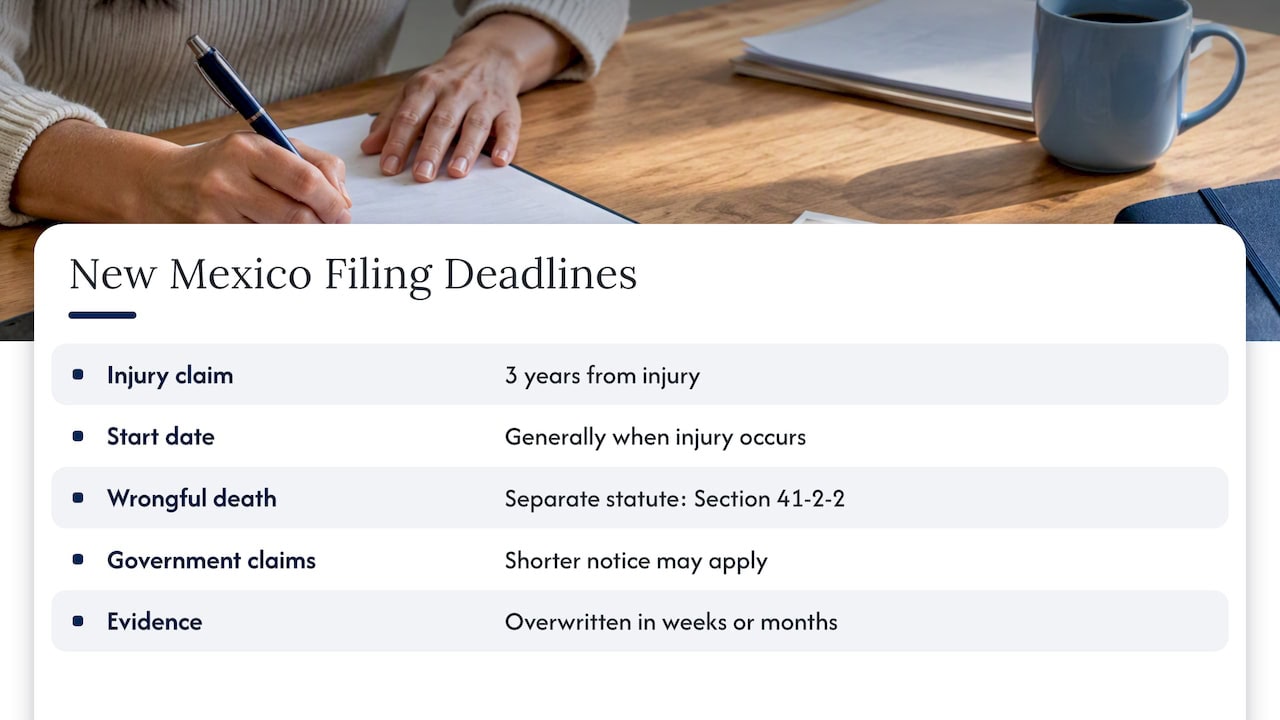
Exceptions and shorter notice requirements can apply, for example when a government vehicle or entity is involved. Three years is also a poor target. Evidence such as bar video, dash-camera footage and vehicle data is routinely overwritten in weeks or months, and witnesses forget. Do not let the deadline set your pace.
What to do in the first days after the crash
- Get medical care. Be seen even if you feel okay. Adrenaline hides injuries, and records link your condition to the crash.
- Call 911 and insist on a report. Ask for the report number and the responding officer’s name.
- Document the scene. Photos of vehicles, injuries, road conditions and any open containers. Collect witness names and numbers.
- Do not give a recorded statement to the other driver’s insurer. Adjusters are trained to find statements that reduce a claim.
- Do not post about the crash. Social media posts get used against injured people.
- Keep records. Bills, pay stubs, mileage and a short daily note about pain and limitations.
- Ask a lawyer to send preservation letters. A written demand to keep evidence, such as video and vehicle data, can matter in a bar or trucking case.
If the other driver left the scene, the steps are similar but the insurance route differs. Our guide to New Mexico hit and run accidents explains it. For how coverage works generally, see New Mexico’s car accident insurance laws. Our immediate steps after an accident library covers more questions.
Perspective: what we see in these cases
Drunk-driving cases look simple from the outside: the other driver was impaired, so they pay. In practice, they are decided on details. We have handled thousands of cases against large insurance companies, and the pattern is consistent: the insurer’s first move is to narrow the case, by questioning the timing of a test, pointing at your own conduct, or offering a quick figure before you know the full cost of your injuries.
We approach these cases the way a family-run firm should. You get direct access to your attorney and paralegals, not a rotating intake line, and we tell you what is happening and why. We also push for the evidence early, because a criminal conviction does not guarantee a civil recovery, and the strongest cases are those where the proof was secured in the first weeks.
One more thing: you do not have to decide anything on the day of the crash. Take care of your health and your family. When you are ready, we will do the legal work.
— Adam
How we can help
We represent injured people and families across New Mexico, including Albuquerque, in car, truck, motorcycle and wrongful-death cases. A case evaluation is free, and we work on a contingency fee, so you owe no fee unless we win. If you are weighing a claim after a drunk-driving crash, contact us for a free case evaluation and we will tell you honestly where you stand. You can also read our earlier article on New Mexico drunk driving accidents.
FAQ
Can a passenger sue a drunk driver?
Yes. Passengers typically have the same right to compensation as anyone else injured by a drunk driver. The main exception is a passenger who is a spouse or relative of the driver and is probably covered under the same policy. Insurers may also argue the passenger shared blame by knowingly riding with an impaired driver.
What if the drunk driver’s insurance is not enough?
If the policy does not cover your losses, or the insurer denies your claim, you can sue the driver personally. Your own uninsured or underinsured motorist coverage may also apply. A lawyer can review every policy that might respond.
Do I need the driver to be convicted of DWI to file a claim?
No. The civil claim is separate from the criminal case, and you choose whether to bring it. A conviction can help as evidence, but your claim does not depend on it. Chemical-test results may be used in civil cases as well as criminal ones.
Who files a wrongful-death claim after a fatal drunk-driving crash?
In New Mexico, only the deceased person’s personal representative may bring the action, on behalf of surviving family members. If no representative has been appointed, that is usually the first legal step.
How long do I have to file?
The general deadline for personal-injury claims is three years from the injury under Section 37-1-8. Wrongful-death claims fall under a different statute, so confirm the date promptly. Acting sooner protects evidence that can disappear.
Sources
- Hit by a drunk driver: legal options (AllLaw)
- I Was Hit by a Drunk Driver (FindLaw)
- New Mexico Courts DWI Benchbook
- State v. Day (2008)
- Marchiondo v. Roper (1977)
- Stinbrink v. Farmers Insurance Co. of Arizona (1990)
- NMSA Section 41-2-1, death by wrongful act
- NMSA Section 37-1-8, actions for injury to person
- Alcohol Serving: Third Party Liability (New Mexico Restaurant Association)