
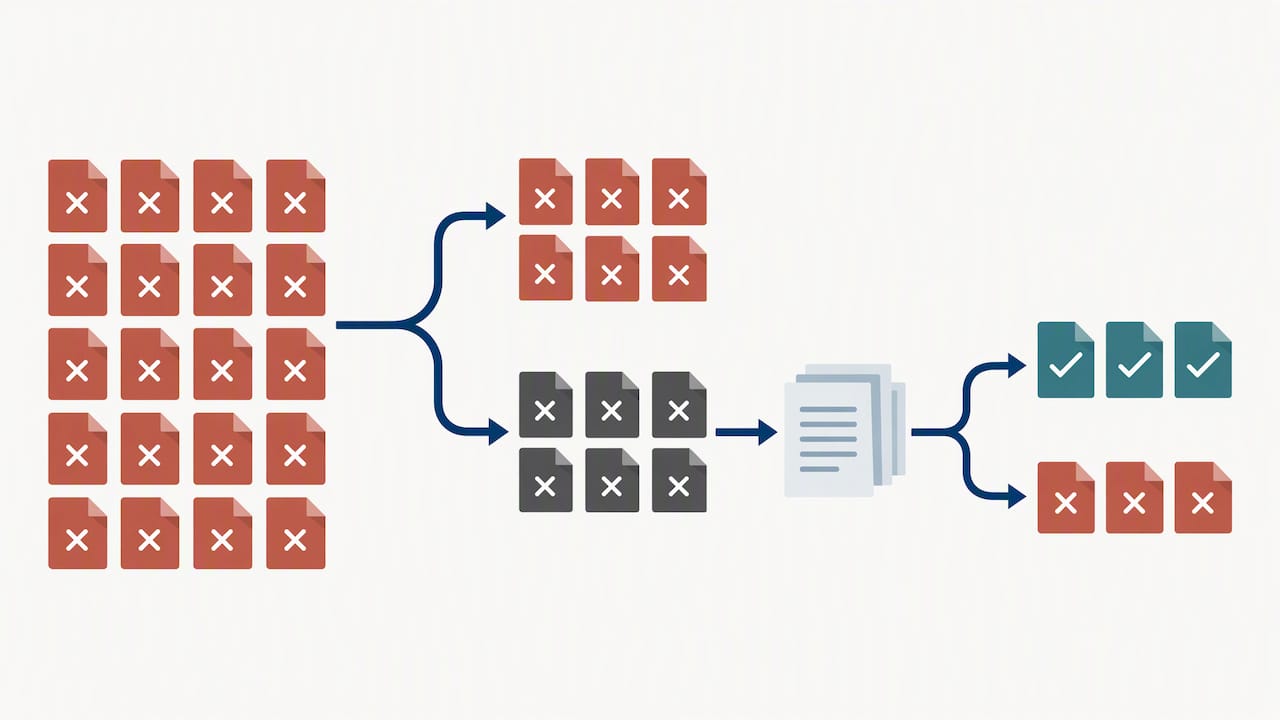
The disability appeal success rate depends on the stage. Reconsideration, the first appeal, succeeds for a small share of claimants. The hearing before an Administrative Law Judge (ALJ) is where most denied claimants who persist actually win. Recent Social Security Administration (SSA) workload figures put approvals at about 36% at initial application, about 16% at reconsideration and about 50% at the hearing level, with very few approvals at the Appeals Council. Those numbers are not a prediction for your case, but they explain why a denial letter is the start of the process rather than the end of it.
Below, we explain what the published rates measure, why they differ so much from stage to stage, which factors move the odds, and what the phrase “disability on the record” means for a claim that never reaches a hearing.
TL;DR
- Approval is lowest early: roughly one in three initial applications is allowed, and reconsideration approves a smaller share of the claims it reviews.
- The ALJ hearing is the strongest stage: about half of hearing decisions in recent SSA data were approvals.
- SSA’s own long-run figures are lower than the headlines suggest: final award rates for disabled-worker claims filed from 2014 through 2023 averaged 29%.
- GAO found that claimants with a representative were allowed at a rate nearly three times higher than those without one.
- “Disability on the record” means a fully favorable decision issued without a hearing because the existing evidence already supports it.
Table of Contents
- The stages of a Social Security disability appeal
- Approval rates at each stage
- What the headline rates actually measure
- Why the same claim can have different outcomes
- Evidence is the lever you control
- How long each stage takes
- What “disability on the record” means
- Our perspective
- Talk to us before your appeal deadline
- Frequently asked questions
- Sources
The stages of a Social Security disability appeal
Before the percentages make sense, it helps to know where each one comes from. A Social Security disability claim moves through up to four decision points after the initial application:
- Initial application. A state agency reviews your medical records and issues a decision on behalf of SSA.
- Reconsideration. A different examiner reviews the same claim, usually adding any new records you submit.
- ALJ hearing. You appear, in person or by video or phone, before an Administrative Law Judge who can hear testimony and question a medical or vocational expert.
- Appeals Council review. The Council decides whether the judge made an error or whether new evidence warrants a second look.
A fifth stage, a lawsuit in federal district court, remains if the Appeals Council denies review. Our own guide to how the SSDI appeals process works walks through the deadlines and paperwork for each level.
The success rate you should care about is the rate at the stage you are entering, not the overall average.
Approval rates at each stage
SSA publishes an annual decision “waterfall” showing how claims are resolved at each level. For fiscal year 2025, the most recent full year, the pattern was consistent with prior years:
| Stage | Approximate approval rate, FY 2025 |
|---|---|
| Initial application | 36% |
| Reconsideration | 16% |
| ALJ hearing | 50% |
| Appeals Council | about 1% |
Two details matter when you read this table.
First, the hearing-level figure counts decisions, and not every hearing request ends in a decision on the merits. Some requests are dismissed, for example when a claimant misses a deadline or withdraws, so the share of decided cases that are approved is not the same as the share of requests that are approved.
Second, the Appeals Council figure looks tiny because its main job is to decline review or send cases back. A remand to the judge is not counted as an approval, even though it often gives a claimant a second chance at the hearing level. Do not read a low Appeals Council number as a sign that the process is hopeless. Our page on help with the Appeals Council explains what that stage can and cannot do.
What the headline rates actually measure
Many articles quote a single approval number, and they are often measuring different things. SSA’s Annual Statistical Report on the Social Security Disability Insurance Program separates two ideas:
- Initial award rate. For disabled-worker claims filed from 2014 through 2023, initial awards ranged from 18% to 21%.
- Final award rate. Counting claims that are eventually allowed on appeal, the same report says final awards averaged 29% over those years.
The report also explains how the award rate is calculated: allowances, minus subsequent denials, divided by applications filed minus pending claims. Rates for the most recent filing years can change as pending claims are decided, so a young cohort will look worse than it eventually will.
There is a reason this differs from the 36% initial figure above. The waterfall counts decisions made in a fiscal year across all claim types, while the award rate follows a group of disabled-worker applicants filed in the same year. Both are accurate. Neither tells you what your chance is.
Why the hearing rate is not “your odds”
The hearing-level approval rate is calculated only from people who persisted. Many denied claimants never appeal, and those who do tend to have more developed medical evidence by the time they reach a judge. A 50% rate among that group does not mean any denied claimant has a 50% chance. It means that among people who stayed in the process and reached a decision, about half won.
Why the same claim can have different outcomes
The averages hide wide variation. The Government Accountability Office (GAO) has studied this in detail, and three findings are worth knowing.
The judge assigned to your case
GAO’s analysis found that allowance rates for a typical claim can vary by as much as 46 percentage points depending on which ALJ hears it. You do not choose your judge, but you can prepare for the way your judge tends to question claimants, and an experienced representative will often know local hearing office patterns.
Representation
In the same report, GAO found that claimants with representatives were allowed benefits at a rate nearly three times higher than claimants without representatives. Part of that gap may reflect which cases attract a representative, and GAO’s number is not a guarantee. Still, a representative does the work that moves a claim: gathering treating-source opinions, identifying gaps in treatment records, and preparing you for questions about daily activities.
Age and education
GAO’s review of fiscal years 2008 through 2019 found that older applicants who appealed were allowed at higher rates than younger ones, and applicants with more education had somewhat higher allowance rates. That is consistent with how SSA’s rules work. Disability is decided through a five-step sequential evaluation covering work activity, severity of impairment, the medical listings, ability to do past work, and ability to adjust to other work. At the last step, age, education and work history shape whether other work is realistic.
Evidence is the lever you control
You cannot change your age or your judge, but you can change the record. In practice, the strongest appeals tend to share a few features:
- Continuous treatment. Gaps in care give a reviewer room to conclude your condition is not severe.
- Functional detail. Records that say what you can and cannot do (how long you can sit, lift, concentrate, or stay on task) carry more weight than a diagnosis alone.
- Consistent statements. What you tell your doctors, what you write on SSA forms, and what you say at the hearing should match.
- Evidence that is on time. At the Appeals Council, additional evidence is considered only if it meets good-cause requirements and is new, material, related to the period on or before the ALJ decision, and reasonably likely to change the outcome. Submitting records before the hearing avoids that hurdle.
Conditions that vary in how they present are often harder to document. SSA’s own guidance on sickle cell disease, for example, acknowledges that its nature and complications vary, which is why the agency looks at listings and, where appropriate, a residual functional capacity assessment. The same principle applies to pain disorders, mental health conditions and episodic illnesses: the more specifically your records describe the limits, the less a decision depends on guesswork.
How long each stage takes
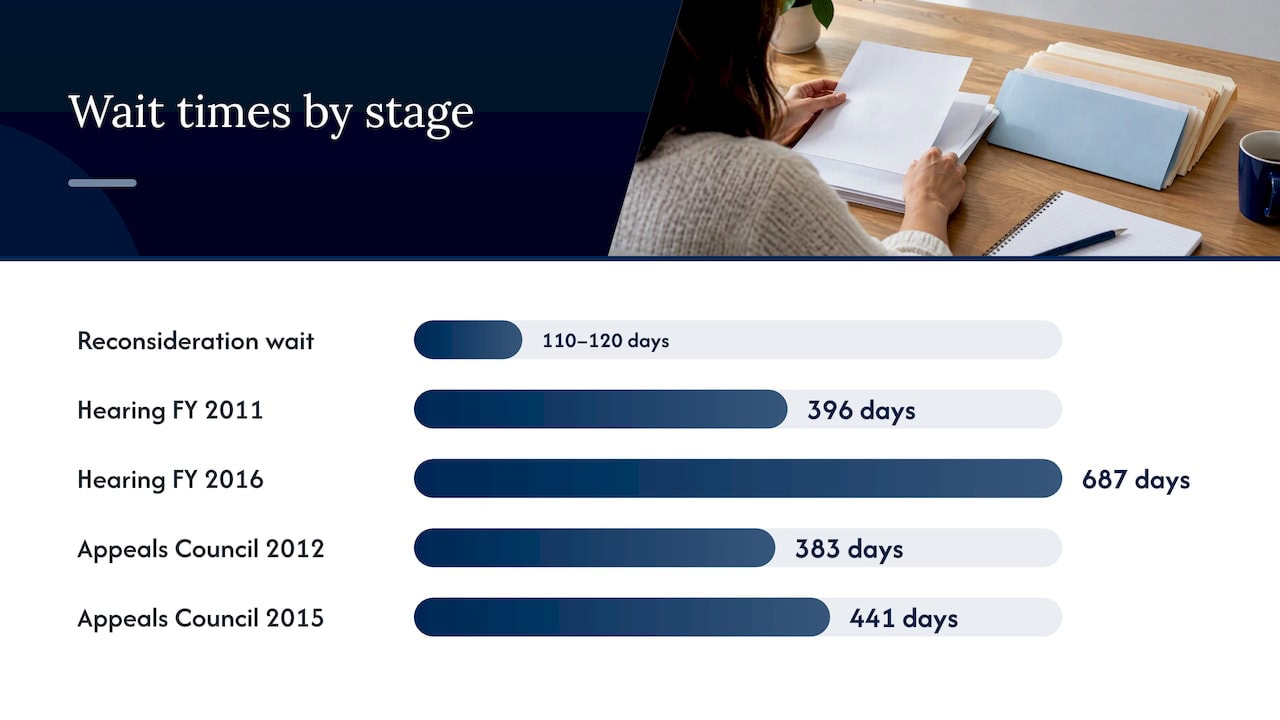
Waiting is part of the success-rate picture, because many people give up before the stage where odds improve. GAO reported that median reconsideration waits were generally 110 to 120 days, while hearing waits rose from 396 days in fiscal year 2011 to 687 days in fiscal year 2016. Appeals Council waits climbed from 383 days in 2012 to 441 days in 2015. Wait times have changed since then, so check SSA’s current published hearing-office averages when you file.
The practical lesson is to keep your deadlines. You generally have 60 days from receiving a denial notice to request the next level, and missing that window can mean starting over. Use the waiting period to keep seeing your doctors, since new records are what a judge will read.
What “disability on the record” means
Some readers arrive here asking about a decision “on the record.” This is an on-the-record (OTR) decision: a favorable ruling made without a hearing because the file already supports it.
According to SSA’s internal manual, an OTR decision lets a National Adjudication Team Attorney Advisor issue a fully favorable decision before the hearing request is assigned to an ALJ when the evidence of record supports it. Cases may be selected for this review when new and material evidence is submitted, when additional evidence may be available, when the law changes, or when an error or other indication suggests a fully favorable decision may be warranted. SSA uses this route to resolve clear cases efficiently and reduce the backlog of pending hearing requests.
A judge can also act at the hearing itself. Under SSA’s regulations, an ALJ may enter a fully favorable oral decision into the record and later incorporate it in a written decision, provided it meets the regulatory criteria.
For you, the takeaway is practical. Once you request a hearing, do not wait for the hearing date to build the file. A well-documented claim with a clear treating-source opinion is the kind of case that can be approved earlier. Often, a request for an on-the-record review is made in writing, supported by the specific medical evidence that shows you meet a listing or cannot do any work.
Our perspective
We handle Social Security Disability claims alongside our personal injury practice, and we read the success-rate statistics the same way every time: they describe a system, not a person. A 36% initial approval rate does not mean your claim is weak. It reflects how many first-round decisions turn on thin records, missed forms or conditions that a first reviewer could not fully assess from paper alone.
What we tell families is that the appeal is usually won in the preparation. The records a judge sees, the treating-source statements and the way you explain a normal bad day decide more than any national average. We also hear from people who were told to “just reapply.” Starting over can cost months of back benefits, and an appeal keeps the original filing date intact in most situations, so we look carefully before advising anyone to drop an appeal.
Our approach is built around direct access: you can reach the attorneys and paralegals handling your claim, and you hear from us before and after each deadline. If you want to understand why representation matters, see why you need a Social Security attorney and what to look for when hiring an attorney who can appeal your case.
— Adam
Talk to us before your appeal deadline
If you have received a denial and the 60-day clock is running, a free case evaluation costs nothing and commits you to nothing. We work on a contingency basis: no win, no fee. We serve clients in Indiana, Michigan and New Mexico, including Social Security Disability claimants who are weighing whether to request reconsideration or a hearing. Request your free case evaluation at 2keller.com and we will review your denial letter, your records and your next deadline.
Frequently asked questions
How likely am I to win a disability appeal?
It depends mostly on the stage. Recent SSA data shows about half of hearing-level decisions are approvals, while reconsideration approves far fewer. Your own odds turn on your age, education, work history, the strength of your medical records and the judge assigned, so treat national percentages as context rather than a forecast.
Is it better to appeal or to file a new application?
In most situations, appealing is better. An appeal preserves your original filing date, which can protect back benefits, and the hearing stage is where approval rates are highest. A new application restarts the clock and can start you again at the lowest-approval stage. Talk to a disability attorney before abandoning a pending appeal.
What percentage of people are approved for disability overall?
SSA’s 2024 statistical report found that initial awards for disabled-worker claims filed from 2014 through 2023 ranged from 18% to 21%, and final awards, including those won on appeal, averaged 29%. The figure is lower than many headlines because it follows groups of applicants rather than counting decisions in one year.
Does a lawyer improve the success rate?
GAO found that claimants with representatives were allowed at a rate nearly three times higher than those without. That comparison does not prove cause alone, but representatives help by organizing evidence, preparing you for the hearing and meeting deadlines. Disability attorneys are paid from a portion of back benefits, so you pay no fee unless you win.
Sources
- SSA Annual Statistical Report on the Social Security Disability Insurance Program, 2024
- GAO-18-37, Social Security Disability: Additional Measures and Evaluation Needed
- GAO-20-641R, Social Security Disability: Information on Wait Times and Appeals
- SSA HALLEX I-3-8-1, Appeals Council evidence
- SSA HALLEX I-5-3-21, On-the-record decisions
- 20 CFR 416.1453, Decision by an administrative law judge