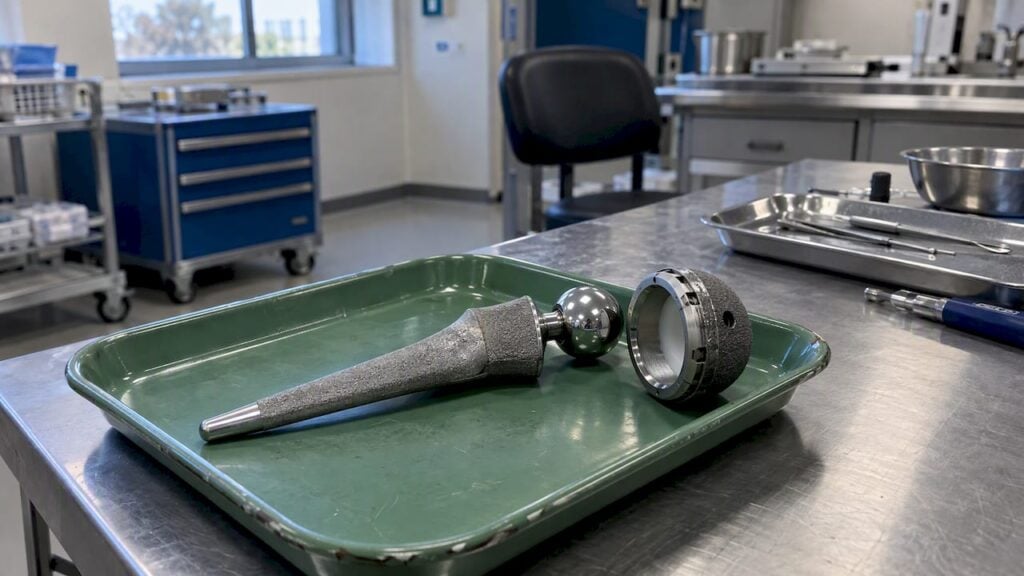
If a hip implant, filter, pump or other medical device has injured you or someone you love, Indiana law may allow you to seek compensation from the companies that made and sold it. These claims fall under Indiana’s product liability statutes, and they are governed by strict deadlines, including a ten-year cutoff that can end a case even when the injury appeared much later. This guide explains how the claims work, what evidence matters and what to do first.
TL;DR
- Indiana product liability claims generally must be filed within two years after the claim accrues, and no later than ten years after the device was delivered to its first user or consumer, subject to a narrow exception in the statute (IC 34-20-3-1).
- The ten-year period can run from the date of implantation, so a late diagnosis does not always save a claim.
- Keep the device, packaging, lot or serial numbers and any explanted hardware. Do not return or discard anything.
- An FDA recall or adverse-event report is a lead, not proof. Medical records and expert analysis connect a defect to your injury.
- More than one company may be responsible, so the investigation should not stop at the brand name.
Table of Contents
- What counts as a defective medical device claim
- The deadline that surprises most people
- Who can be held responsible
- First steps after you suspect a device is defective
- What an FDA report can and cannot do
- What compensation may include
- Single claims and multidistrict litigation
- Our perspective
- Talking to a lawyer about your device
- FAQ
- Sources
What counts as a defective medical device claim
A medical device is far broader than a pacemaker. It includes joint replacements, surgical mesh, insulin pumps, catheters, vena cava filters, spinal hardware and many everyday supplies. When one of these products fails or causes harm it should not have, the injured patient may have a product liability claim.
Indiana’s Product Liability Act defines “fault” for these cases as conduct that is negligent, willful, wanton, reckless or intentional, and the definition lists specific forms (Indiana Code, Title 34). In practice, device claims are usually built on one or more of three theories:
- Manufacturing defect. This particular unit departed from its intended design, for example through a contaminated, weak or mis-sized component.
- Design defect. The design itself is unreasonably dangerous, even when every unit is made exactly to specification.
- Failure to warn. Instructions or warnings did not adequately tell surgeons and patients about known risks.
Indiana law treats these theories differently. A defense article on the topic notes that strict liability under the statute is limited to manufacturing defect claims, while design and warning claims are generally pursued as negligence. We mention it only because it shapes how a case must be pleaded and proved, and a lawyer should review which theory fits your facts.
The deadline that surprises most people
Most people have heard of the two-year statute of limitations. The Indiana Code generally requires a product liability action to be filed within two years after it accrues, and within ten years after the product was delivered to the initial user or consumer. If the claim accrues at least eight but fewer than ten years after delivery, the action may be filed within two years after accrual (IC 34-20-3-1).
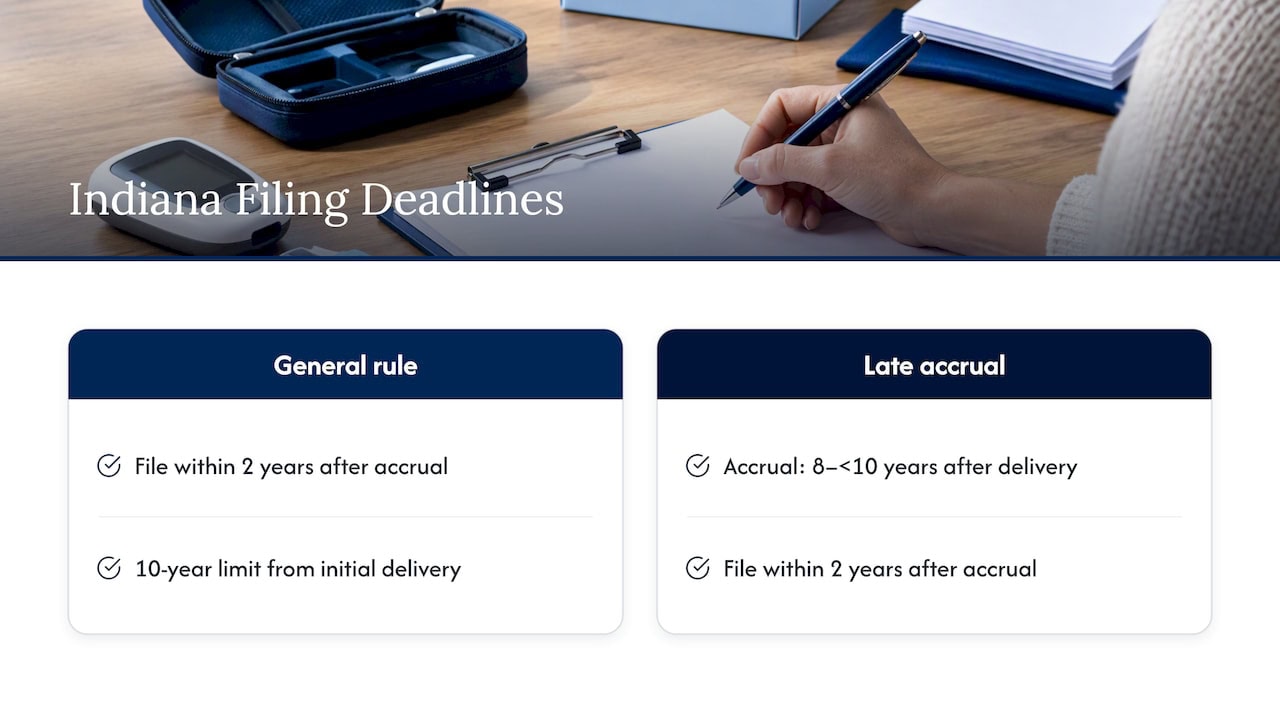
The ten-year limit is a statute of repose. It is measured from delivery, not from when you felt symptoms or learned a device was faulty.
What Shaling v. Biomet shows
In Shaling v. Biomet, decided by the Indiana Court of Appeals on March 11, 2025, a patient received an M2 hip system in 2001 and filed suit in 2019. The court held the claim time-barred. It declined to recognize a general exception for latent injuries from medical devices, apart from the narrow line of asbestos-related cases it discussed.
The lesson is practical. If you have a device that has been in your body for years and you now have pain, revision surgery or abnormal test results, speak with an attorney promptly. Waiting to be certain can cost you the claim. The exact dates, and whether any exception applies, need review by a lawyer who can see your records.
A simple timeline check
| Question | Why it matters |
|---|---|
| When was the device implanted or first delivered to you? | Starts the ten-year repose clock |
| When did you learn, or should you have learned, of the injury? | Starts the two-year limitations clock |
| Was the device revised or replaced? | A replacement may be a new product with its own dates |
| Did the injury lead to a death? | Wrongful-death claims have their own rules and should be reviewed separately |
The replacement question is one an attorney should answer from your records. Do not assume the answer.
Who can be held responsible
People often assume the company on the box is the only defendant. Device cases are rarely that simple. Court filings in the Cook IVC filter litigation in the Southern District of Indiana, for instance, allege defects in design, manufacture, testing, labeling, advertising, promotion and distribution and name several corporate entities. Those pleadings are allegations, not findings, but they illustrate why counsel typically looks separately at:
- the manufacturer of the finished device,
- makers of defective components,
- distributors and sellers,
- and, in some situations, the healthcare providers who selected or implanted the device.
A claim against a provider is a different kind of case, governed by Indiana’s medical malpractice rules. Our overview of Indiana’s Medical Malpractice Act explains how that process differs from a product claim.
First steps after you suspect a device is defective
What you do in the first weeks often decides how strong the evidence is later.
- Get medical care. Tell your treating physician about your symptoms and ask for imaging and records. Your health comes before any claim.
- Do not discard anything. Keep the device if it has been removed, plus packaging, patient cards, instructions and photographs. Ask the surgeon or hospital in writing to preserve explanted hardware rather than send it to a lab or back to the manufacturer.
- Write down identifiers. Brand, model or catalog number, lot or serial number and the date of the procedure. Implant cards and hospital records usually contain them.
- Check FDA information. Look for recalls and safety communications on your device.
- Consider reporting the problem. The FDA encourages patients and caregivers to submit voluntary reports through MedWatch.
- Talk to a product liability attorney before speaking with the manufacturer’s insurer or signing any release.
Our page on how plaintiffs prove a product defect walks through evidence preservation and the four elements in more detail.
What an FDA report can and cannot do
The FDA’s MAUDE database collects adverse-event reports. A typical entry records the brand, common device name, model or catalog number, lot number, event date, reporter, event type and outcome, as in this sample report on a peritoneal dialysis system. Those details help identify a product and spot patterns of similar events.
But a report is not proof that the device caused an injury. Regulatory history can help show that a manufacturer was on notice of a problem. Connecting a defect to your injury usually requires medical records, examination of the device itself and expert engineering and medical testimony (FDA guidance document).

A recall also does not decide your case. Some injured patients have valid claims for devices that were never recalled, and a recall does not guarantee compensation.
What compensation may include
What you can recover depends on proof, causation and where the case stands procedurally. In a successful Indiana device case, recoverable losses can include:
- past and future medical expenses, including revision surgery,
- lost income or reduced earning capacity,
- physical pain and emotional distress,
- and other legally recoverable losses.
When a device causes a death, family members may bring a wrongful-death claim covering the losses recognized by the Indiana wrongful-death statute. Pain and suffering is the least obvious category to price. We explain the factors in how pain and suffering damages are determined in Indiana.
No lawyer can honestly promise an amount or outcome at the start. Anyone who does should make you cautious.
Single claims and multidistrict litigation
When many patients are hurt by the same device, federal courts may consolidate cases into a multidistrict litigation (MDL) for pretrial proceedings. The Cook IVC filter MDL was heard in Indianapolis, and its master complaint describes injuries alleged by patients, including filter tilting, perforation, fracture and migration (master complaint).
Joining an MDL does not extend your filing deadline. Whether your case belongs in a consolidated proceeding or should be filed on its own is a strategic decision that depends on your device, your injuries and your dates.
Our perspective
We see two patterns often enough to warn about them. The first is delay: people live with a failing implant for years, hoping it will settle, and learn later that Indiana’s repose period has already narrowed their options. The second is lost evidence: an explanted device is thrown away, or returned to the manufacturer, before anyone independent has examined it.
Our approach is built around the family-run, client-first philosophy we work by. You should have direct access to your attorneys and paralegals, steady updates, and a plain explanation of where your case stands. Device cases are technical, and we believe you should understand the engineering and legal issues in your own case, not just receive a result.
We also believe in telling people when the clock is the problem. If a claim looks time-barred, we would rather say so early than let you hold false hope. Our firm handles these cases on a contingency fee: no fee unless we win.
— Adam
Talking to a lawyer about your device
We offer a free case evaluation for injured people, with no cost to ask whether you have a claim. Bring your implant card, medical records, any correspondence from the manufacturer and the dates of your procedures. You can learn about our work on the Indiana defective drug and device page, read about Indiana product liability representation, or start a free evaluation with our firm.
If you want an example of a specific device claim, our article on metal-on-metal hip replacement lawsuits shows how these cases are typically investigated.
FAQ
How long do I have to file a defective medical device claim in Indiana?
Under the Indiana Code, a product liability action generally must be filed within two years after it accrues and within ten years after the product was delivered to its first user or consumer. A narrow rule applies if the claim accrues in years eight through ten. Because dates and exceptions are fact-specific, have a lawyer review yours soon.
Does an FDA recall mean I automatically have a case?
No. A recall can help show a known problem, but you must still prove the device was defective and that the defect caused your injury. Medical records and expert analysis are ordinarily needed. A claim may also exist without a recall.
Can I sue if my injury showed up years after surgery?
Possibly, but the ten-year repose period can run from delivery regardless of when you felt symptoms. In Shaling v. Biomet, a hip implant claim filed about 18 years after implantation was held time-barred. That is why waiting is risky.
What should I do with a device that was removed?
Do not discard it, clean it or send it back to the manufacturer. Ask the hospital in writing to preserve it, and keep any packaging and implant records. An independent examination may be important evidence.
How much does it cost to hire a product liability lawyer?
At our firm, the case evaluation is free, and we work on a contingency fee, so you owe a fee only if we win your case. Ask any firm to explain in writing how fees and case costs are handled.
Sources
- Indiana Code § 34-20-3-1 (Justia)
- Indiana Code, Title 34 (Indiana General Assembly)
- Shaling v. Biomet, Indiana Court of Appeals
- Cook IVC Filters master consolidated complaint, S.D. Ind.
- FDA: Medical Device Reporting
- FDA guidance document
- FDA MAUDE sample report