
If a student was hurt at an Indiana public school, you can bring a claim, but the rules differ sharply from an ordinary accident case. The most urgent is a written notice deadline of 180 days under the Indiana Tort Claims Act. Miss it, and a strong case can be barred before anyone evaluates it. This guide explains who can be held responsible, how school immunity works, what you can recover, and what to do now.
TL;DR
- Claims against public schools fall under the Indiana Tort Claims Act (ITCA), which requires formal written notice within 180 days of the injury.
- Schools are not automatically immune. Courts have allowed claims where a school failed to follow its own safety, supervision or transportation procedures.
- Recovery from a governmental entity is capped at $700,000 per person and $5,000,000 per occurrence, and punitive damages are not available.
- Do not spend months negotiating with the school or its insurer before sending notice. Negotiation does not stop the clock.
- Our free case evaluation can tell you quickly whether your deadline is still open.
Table of Contents
- Why a school injury claim is not a typical injury claim
- The 180-day notice rule
- When a school can be held responsible
- School immunity is the exception, not the rule
- What you can recover, and the limits
- Concussions and sports injuries
- Why public records will not give you the full picture
- What to do in the first 30 days
- Our perspective: why we start with the deadline
- How we can help
- FAQ
- Sources
Why a school injury claim is not a typical injury claim
Most people assume that an injury claim in Indiana follows a two-year statute of limitations. For many accidents that is the general rule. A claim against a public school corporation is different, because a school is a governmental entity, and the law treats claims against government as a special category.
Three features set these cases apart:
- A short notice window. Before you can file suit, you must serve a formal written notice of the claim.
- Statutory immunity for certain decisions. The ITCA lists situations where the government cannot be sued at all.
- Damage caps. Even a fully proven claim has a ceiling.
The practical result is that the first weeks after an injury matter more than they would after a car crash or a fall in a store. A family can lose the right to compensation without ever being told that a deadline existed.
The 180-day notice rule
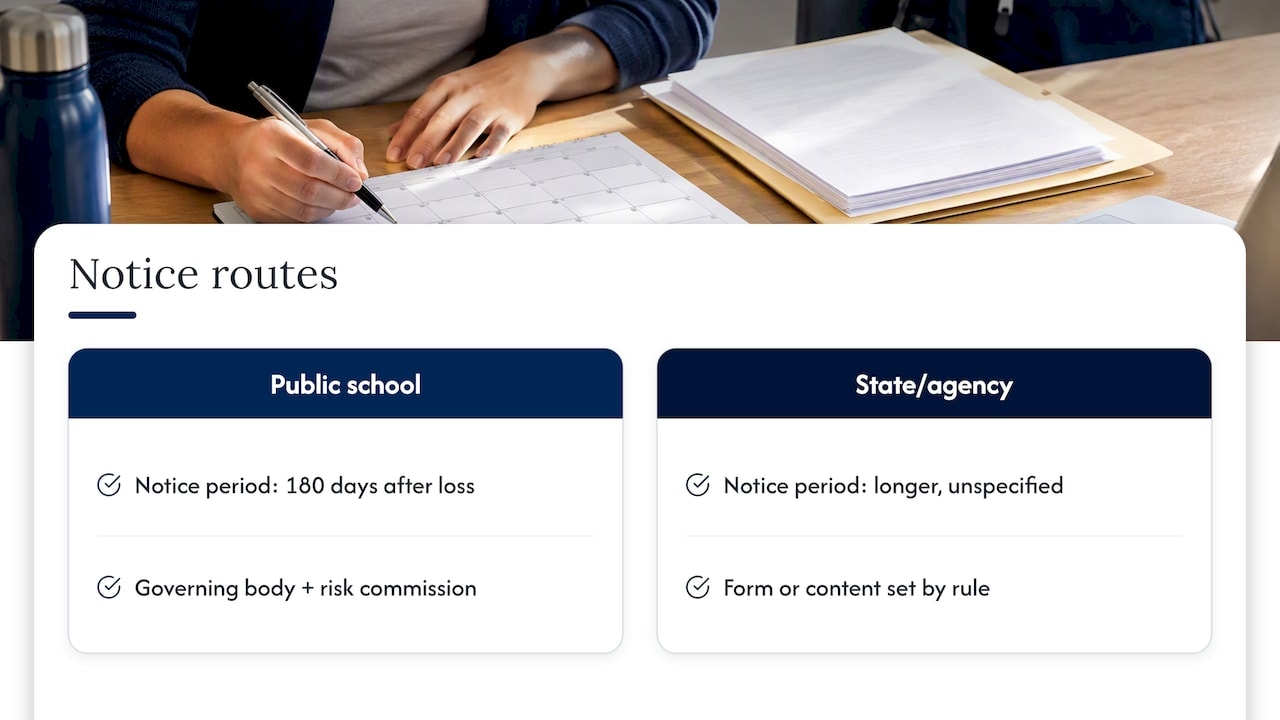
Under the Indiana Tort Claims Act (IC 34-13-3), claims against governmental entities, including public school corporations, require written notice within 180 days after the loss occurs. The notice goes to the governing body of the school corporation and to the Indiana Political Subdivision Risk Management Commission. Failing to give it in that window typically bars the claim entirely.
For comparison, claims against the State or a state agency follow a longer period, and the format of the notice is set by rule. The Indiana Administrative Rules on tort claims against the state describe the required form or written content. Which period applies depends on what kind of entity is responsible, and that is not always obvious. A court has had to decide, for example, whether a commuter transportation district counted as a political subdivision for notice purposes. The answer set the deadline.
We have written a separate walkthrough of the process: how the 180-day rule works and how to file under the Indiana Tort Claims Act.
A note on children
Special tolling rules can apply when the injured person is a minor, and they can change when the clock starts for the child’s own claim. They do not necessarily extend a parent’s separate claim for medical bills. Because these rules interact, do not assume that your child’s age gives you unlimited time. Have an attorney confirm each deadline in writing for your specific situation.
What counts as valid notice
Informal contact does not count. Complaining to the principal, emailing the superintendent, or talking with an insurance adjuster is not the same as serving a compliant notice. Attorneys who handle these cases see the same mistake repeatedly: families believe that an ongoing conversation with the school district keeps the claim alive. The notice requirement is a statutory hurdle, not a guideline, and it can end a case before litigation begins.
A sound notice usually identifies:
- The injured person and, for a child, the parents or guardians
- The date, time and place of the incident
- What happened and why the school or its staff is responsible
- The injuries and the losses claimed
- The contact information for the claimant or the attorney
It must also be delivered in the manner the statute requires, to the correct recipients.
When a school can be held responsible
Indiana courts describe a public school’s duty as exercising ordinary and reasonable care for the safety of the children under its control. Negligence is the governing standard. To succeed, you generally need to show four things: the school owed a duty, it breached that duty, the breach caused the injury, and there are measurable damages.
Situations that commonly lead to claims include:
- Inadequate supervision on playgrounds, in gym class, in hallways or during dismissal
- Bus and transportation failures, including unsafe loading and unloading. See our article on seat belts and school bus accidents in Indiana.
- Unsafe premises, such as broken equipment, wet floors or poorly maintained stairs and bleachers
- Sports injuries, including mishandled concussions
- Student-on-student violence or bullying that the school knew about and did not address
A real Indiana example: the dismissal case
The clearest illustration comes from a published appellate opinion, Hopkins v. Indianapolis Public Schools. The parents of a seven-year-old sued his public elementary school after he was mistakenly told he could leave and walk home. The case turned on whether the school followed its own dismissal procedures.
The lesson reaches well beyond that case. When a school deviates from procedures it wrote for itself, such as bus dismissal rules or a supervision plan, the family has a path to a negligence claim.
School immunity is the exception, not the rule
Many parents hear that you cannot sue the government and stop there. That is not accurate. The ITCA grants immunity for certain categories of conduct, including the adoption or enforcement of a policy under IC 34-13-3-3(8). But in the Indiana decision above, the court made clear that schools are not immune when they fail to follow their own safety or supervision procedures, and the school carries the burden of proving that immunity applies.
The fight usually centers on one distinction:
| Type of act | What it means | Effect on the claim |
|---|---|---|
| Discretionary or policy decision | A judgment about how to allocate resources or what rules to adopt | Often protected by immunity |
| Ministerial or operational duty | Carrying out a rule or procedure the school already has | Generally open to a negligence claim |
So the question is rarely whether a school can be sued. The question is whether the harm came from a protected policy choice or from a failure to carry out an existing duty. Evidence decides that, which is why preserving it early matters.
What you can recover, and the limits
In a successful claim, compensation can cover:
- Past and future medical expenses
- Rehabilitation and therapy costs, including counseling
- Pain, suffering and emotional distress
- Lost income for a parent who had to miss work, where the law allows
The ITCA limits what a governmental entity can pay. According to the published summary of the Act, recovery is capped at $700,000 for an individual claimant and $5,000,000 in the aggregate for a single occurrence. Punitive damages are expressly prohibited in these actions. These are ceilings, not estimates: a claim’s value depends on the injuries, the medical record, and how clearly the school’s failure can be shown.
A settlement involving a child also has its own handling rules, since courts often supervise how a minor’s money is held. Our article on how Indiana law makes it easier for parents to access certain injury settlements for their children covers that.
Concussions and sports injuries
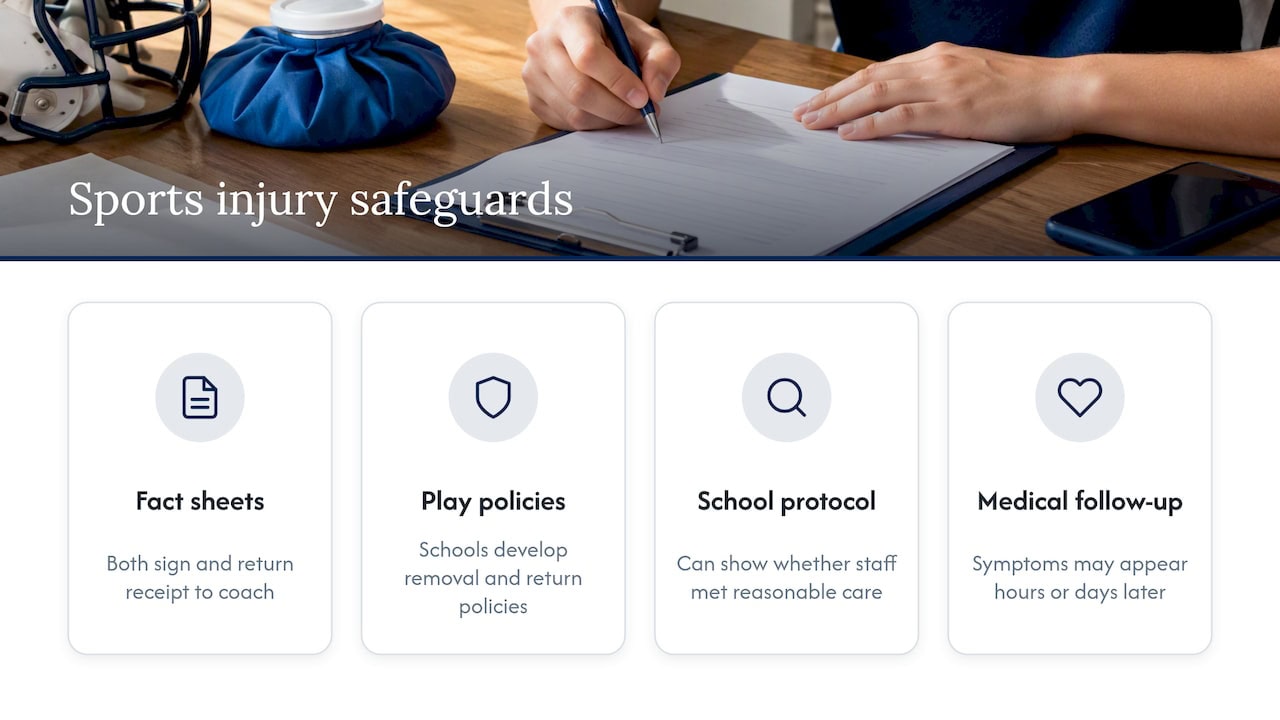
Sports and gym injuries raise a specific question: did the school follow the safeguards the state requires? Under IC 20-34-7, schools must give concussion fact sheets to students and parents, and both must sign and return a form acknowledging receipt to the coach. The Indiana Department of Education also expects schools to develop policies on removing an athlete from play and on return to play.
If a student with a suspected head injury was sent back into a game or practice, the school’s own protocol becomes central evidence. It can show whether staff met the standard of reasonable care. If your child hit their head, also read our overview of concussions and traumatic brain injuries in Indiana. Symptoms can appear hours or days later, so medical follow-up should not wait for the claim.
A separate Indiana law limits liability for schools that open fitness facilities for community use. The Indiana courts’ 2013 legislative review summarizes it. If the injury happened during a community event rather than a school activity, tell your attorney, because different rules may apply.
Why public records will not give you the full picture
Parents often search for data on injuries at a school and expect to find a database of claims. It does not exist in that form. The Indiana Department of Education collects data on employees hurt by students under IC 20-19-3-27.5 and IC 20-26-5-42, but the Employee Injury Data Reporting report is a high-level aggregate for staff, not a record of individual student incidents.
To learn what a school knew about a hazard, such as earlier complaints, maintenance logs, incident reports or supervision schedules, an attorney typically has to obtain them through the discovery process once a case is underway. That is another reason to start with a documented, properly served notice instead of an informal records request alone.
What to do in the first 30 days
- Get medical care and keep following it. Gaps in treatment are used to argue that an injury was minor.
- Report the incident in writing. Ask the school for a copy of its incident report. Date everything.
- Preserve evidence. Photograph the injury, the location, the equipment or bus. Save texts, emails and names of witnesses. Ask the school in writing to keep video footage.
- Write down the school’s own rules. Student handbooks, supervision plans and bus procedures can matter, because a failure to follow them is often the basis of the claim.
- Do not sign anything or give a recorded statement to the school’s insurer without advice.
- Calendar day 180 from the injury date. Treat it as the date by which a compliant notice should already have been served, not as a target.
- Speak with an injury attorney early. Notice served to the wrong party or in the wrong form can cost the claim.
For general guidance on the hours and days after an accident, see our immediate steps after an accident resources.
Our perspective: why we start with the deadline
We meet many families who have spent weeks talking with a school administrator who was kind, sympathetic and reassuring. Nothing in those conversations was dishonest. But kindness does not serve a notice requirement. When we review a school injury, the first thing we do is count days, because everything else we can do for a family depends on that number.
The second thing we look for is what the school promised to do and whether it did it. Schools write detailed procedures for dismissal, supervision, field trips and athletics. When a child is hurt, those documents often tell the story better than any argument could. Our work is to find them, compare them to what happened, and explain the gap in plain terms to the school’s insurer or a court.
We also know these cases carry weight beyond the legal question. A parent whose child was hurt in a place meant to be safe is often angry and unsure. We try to give families direct access to their attorney and paralegal, clear communication, and an honest view of the caps and obstacles before they commit to anything.
— Adam
How we can help
We are a family-run personal injury firm serving clients in Indiana, Michigan and New Mexico. A free case evaluation costs nothing, and we work on a contingency basis: you pay no fee unless we win your case. If you are inside or near the 180-day window, contact us through our site so we can review the facts and the deadline right away.
FAQ
Can I sue an Indiana public school if my child was hurt?
Yes, in many situations. Schools owe students a duty of reasonable care, and immunity is an exception the school must prove. The claim must follow the Indiana Tort Claims Act, including timely written notice.
How long do I have to file a school injury claim in Indiana?
For a public school corporation, formal written notice is generally due within 180 days of the loss. The general personal injury statute of limitations is usually two years, but it does not replace the notice requirement. Rules for minors can change when the clock starts, so confirm your dates with an attorney.
What is the most I can recover from a public school in Indiana?
The ITCA caps recovery at $700,000 for one person and $5,000,000 for a single occurrence, and it bars punitive damages. Your claim may be worth much less than the cap, depending on your documented losses.
Does it matter if the injury happened at a private school?
It can. The ITCA applies to governmental entities, so a private school may not fall under the same notice and cap rules. The deadlines and defenses can differ, so have the school’s status checked early.
Sources
- Local Governments at Risk if Agent Waives Notice Requirement Under the Tort Claims Act
- Hopkins v. Indianapolis Public Schools, Indiana court opinion
- Lowe v. Northern Indiana Commuter Transportation District, Indiana court opinion
- Indiana Administrative Rules, Title 10, Article 3: Tort Claims
- Indiana Department of Education: Concussion
- Indiana Department of Education: Employee Injury Data Reporting SY2025
- Indiana courts: 2013 Legislative Review