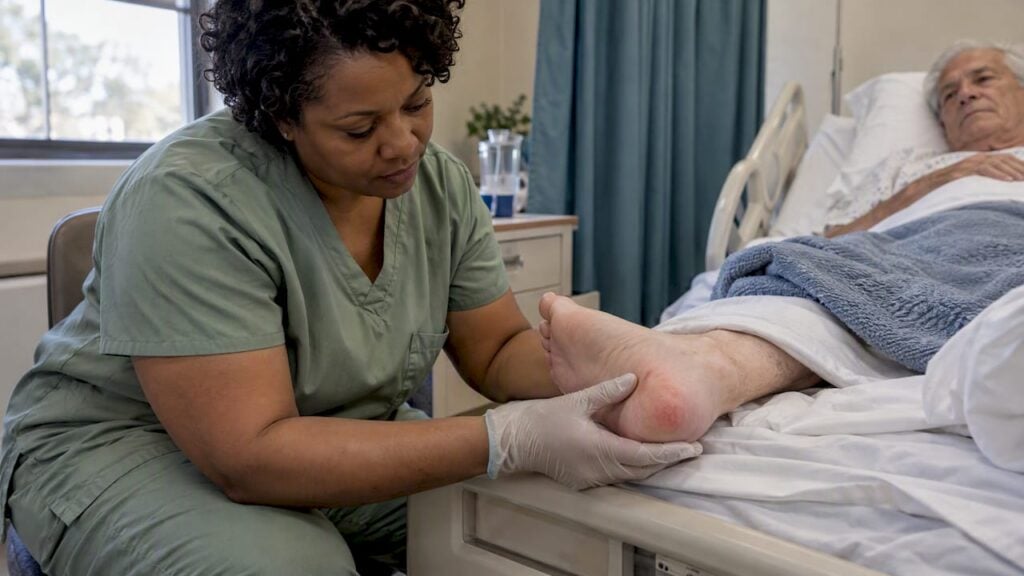
You may have grounds for a pressure ulcer lawsuit when a hospital, nursing home or other care provider failed to prevent, spot or treat a pressure injury that should have been avoided, and the resident was harmed as a result. The wound alone does not make a case. The question is whether the facility followed the standard of care: repositioning, nutrition, skin checks, proper equipment and honest documentation. Deadlines are short, and the records that prove a case can disappear, so acting early matters.
This guide explains how these claims work, who can be sued, what evidence carries weight, and what outcomes in past cases show. It also covers how New Mexico rules affect families in Albuquerque and across the state.
TL;DR
- A pressure ulcer (also called a bedsore or decubitus ulcer) supports a lawsuit when it was preventable and the facility’s care fell below accepted standards, not simply because it exists.
- Hospitals and nursing homes are the most common defendants. In one 2019 analysis of malpractice claims, hospitals were named in 61.7% of cases and nursing homes in 31.2%.
- The care plan, nursing notes and wound measurements are usually the most important evidence. Request them as soon as you notice a problem.
- Filing deadlines are strict. In New Mexico, medical malpractice claims generally carry a three-year limit, counted from the act of negligence, with narrow exceptions.
- Our free case evaluation can tell you whether the records support a claim, and we collect a fee only if you recover compensation.
Table of Contents
- What a pressure ulcer is, and why it can be a legal issue
- When a pressure ulcer becomes a negligence claim
- Who can be sued
- The evidence that decides these cases
- Deadlines: why waiting can end a claim
- What compensation can cover, and New Mexico’s caps
- Wrongful death after a pressure ulcer
- Our perspective: where we see families struggle
- What to do right now if you suspect neglect
- Talk to our team about your case
- FAQ
- Sources
What a pressure ulcer is, and why it can be a legal issue
A pressure ulcer is an area of skin and underlying tissue that breaks down because of pressure that lasts too long and reduces blood flow. They typically form over bony areas such as the hip, tailbone, heel, elbow and shoulder. Residents who cannot shift their own weight are at the greatest risk.
Clinicians classify these wounds in four stages. Stage 1 is reddened skin that does not blanch when pressed. Stage 4 is deep tissue damage that can expose muscle, tendon or bone. Our guide to the four types of bed sores walks through each stage with the warning signs.
These injuries are common. A national study of nursing home residents reports that pressure injuries occur in 10 to 20% of residents. A review of long-term care liability found that more than 20% of residents who stay two or more years develop at least one.
That frequency is exactly why facilities say “these things happen.” Some wounds do develop despite good care, especially in residents with advanced age, poor circulation or very limited mobility. The law does not hold a facility responsible for every wound. It asks whether the wound was preventable and whether the staff did what a reasonably careful facility would have done.
When a pressure ulcer becomes a negligence claim
The heart of most disputes is preventability. Federal nursing home surveyors use the CMS Pressure Ulcer Critical Element Pathway to judge whether a facility put practices in place to identify, evaluate and prevent pressure injuries, and to care for them once they appear. The same questions tend to drive a lawsuit.
Common failures that support a claim include:
- No repositioning schedule, or a schedule that exists on paper but was not followed.
- No pressure-relieving equipment, such as a specialty mattress or heel offloading, when a physician or the care plan called for it.
- Missed skin assessments on admission and at regular intervals afterward.
- Poor nutrition and hydration support, including no dietitian review for a resident losing weight.
- Delayed treatment, such as failing to call a physician when a Stage 1 or 2 wound worsens.
- Inadequate staffing that makes turning and monitoring unrealistic.
- Incomplete or inaccurate charting of the wound’s size, stage and progress.
A missing, outdated care plan is a significant warning sign. Even where a resident has serious health conditions, a plan that does not reflect that person’s specific prevention needs often becomes the anchor of the claim.
If you are unsure what you are seeing at the bedside, our article on how to identify bedsores on a nursing home resident and our list of signs of nursing home neglect can help you describe it accurately to a doctor, an ombudsman or an attorney.
Who can be sued
Different defendants answer for different parts of the care.
| Defendant | Typical basis for a claim |
|---|---|
| Nursing home or long-term care facility | Understaffing, failure to follow the care plan, missed assessments, poor charting |
| Hospital | Pressure injuries that develop or worsen during a stay, especially after surgery or in intensive care |
| Physicians, nurses and other providers | Failure to order or perform preventive care, or to respond to a worsening wound |
| Parent companies and management entities | Corporate staffing and budget decisions that undermine resident care |
The 2019 analysis of malpractice claims found hospitals were the most common defendants, followed by nursing homes. Yet when plaintiffs prevailed against nursing homes, the mean payout was about $4.0 million, compared with about $1.6 million for hospitals. The spread within those figures was very large, so they describe a pattern in a set of reported cases, not what any one claim is worth.
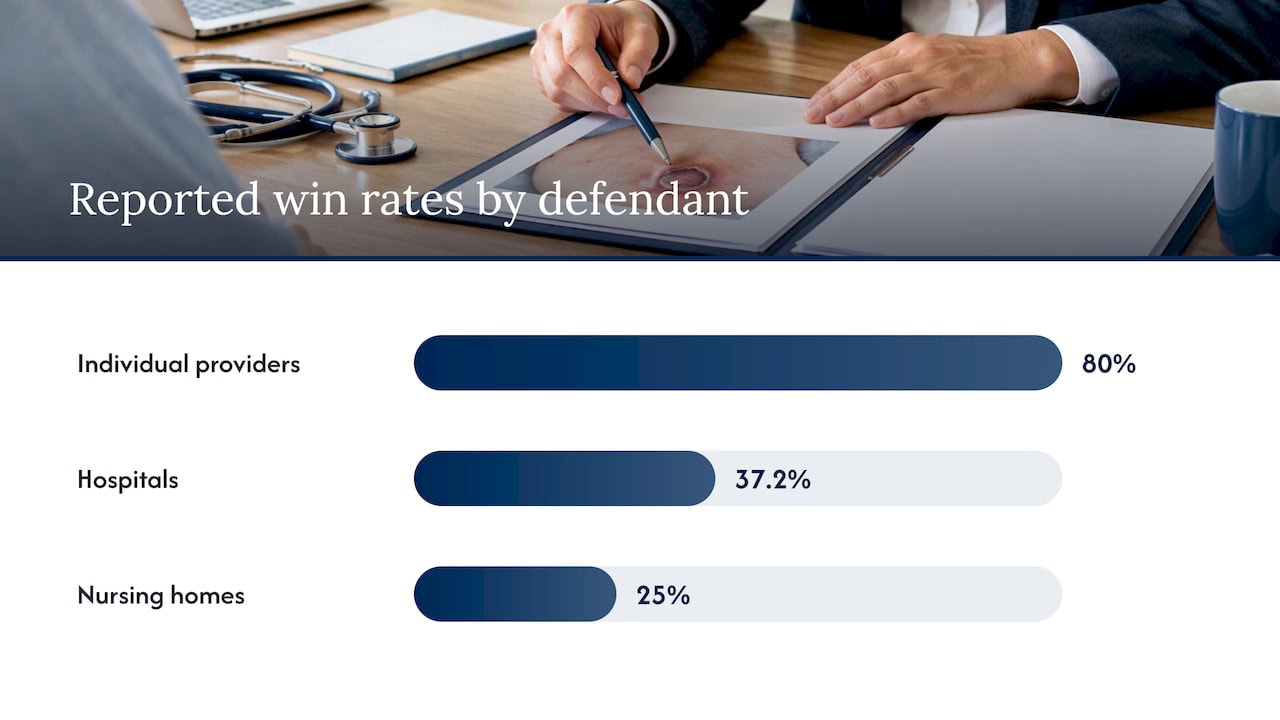
The same researchers reported that individual providers were the least likely to be named but had the highest win rate, at 80%, versus 37.2% for hospitals and 25% for nursing homes. That does not mean individual clinicians are the best targets. In practice, facility-wide failures in protocols, staffing and supervision are often what the evidence shows.
The evidence that decides these cases
Pressure ulcer cases are won or lost on records and medical opinion, not on photographs alone.
Facility records
The comprehensive care plan and the daily nursing notes are often the most important documents. We look for gaps: turning that was ordered but never charted, wound measurements that do not match what the family saw, or a stage that was recorded in a way that understates severity. Do not assume the facility’s own skin assessments are accurate. Independent review by a qualified medical professional often reveals inconsistencies.

Your own documentation
Families can build a strong record while the resident is still in care:
- Photograph the wound with a date visible, each visit if possible.
- Write down what staff tell you, with names and times.
- Request the full chart in writing, including care plans, treatment records, weight logs and incident reports.
- Keep hospital transfer records and discharge summaries.
- Save bills for wound care, hospitalization and surgery.
Medical expert testimony
An expert must explain what the standard of care required and how the facility fell short. In wrongful death cases, the expert must go further and connect the ulcer to the death. The ulcer needs to be shown as a contributing factor, through infection, sepsis or immobility, not only as a condition that happened to be present. That link is difficult to prove without detailed medical review.
Deadlines: why waiting can end a claim
Families often lose strong claims not because the injury was minor, but because they waited. Evidence disappears, staff move on and memories fade, and a filing deadline eventually closes the door.
In New Mexico, the Medical Malpractice Act sets a three-year limitation period for claims against covered health care providers. The clock generally runs from the date of the negligent act, not from the date the resident dies or the family grasps how bad the wound became. Exceptions exist but are narrow, and the courts have been strict about them. See our explainer on the three-year deadline and the 2026 malpractice cap for how this plays out.
Other states set their own rules. Michigan, for example, has its own statute on when a medical malpractice claim accrues and when suit must start. If the care happened outside New Mexico, the deadline that applies depends on where it occurred.
Whether a particular facility is covered by the Act, and exactly which date starts the clock, are questions for an attorney who can review the facts. Do not rely on a general guide for your deadline. If you are within a year or two of the care in question, speak with a lawyer now.
What compensation can cover, and New Mexico’s caps
Damages in a pressure ulcer case can include:
- Medical expenses, including wound care, hospitalization and surgery
- Future medical care
- Pain and suffering
- Loss of dignity and quality of life
- In wrongful death cases, funeral costs and the family’s losses
New Mexico limits recovery in some medical negligence cases. For hospitals, the aggregate recovery limit for an injury or death occurring in 2026 is $6,000,000 per occurrence, excluding punitive damages and past and future medical care and related benefits. The figure is adjusted in later years. This means medical costs sit outside the cap, which matters for residents whose care will continue for years. Our overview of what the 2026 reform could mean for injured patients explains the changes in more detail.
Large verdicts and settlements get headlines, but a result depends on the stage of the wound, the length of suffering, the strength of the records, the defendant and the state’s law. No responsible lawyer can promise an amount at the first meeting.
Wrongful death after a pressure ulcer
Severe pressure injuries can lead to infection, sepsis and a steep decline in health. When a resident dies, the family may bring a wrongful death claim if the neglect contributed to the death. These cases require the closest medical analysis, because defendants will argue that age and underlying illness, not the wound, caused the death.
A careful review looks at the timeline: when the wound first appeared, how it progressed, what treatment was given, and how the resident’s condition changed. It may require autopsy findings, hospital records and expert testimony. We handle these claims for families in Indiana, Michigan and New Mexico.
Our perspective: where we see families struggle
We meet families at a painful time. They have often noticed something wrong weeks earlier, asked a nurse, been reassured and then found a Stage 3 or 4 wound. The most common thing we hear is “I didn’t know it was serious enough to call a lawyer.”
Three points shape how we approach these cases:
- The paperwork tells the story. A wound does not appear overnight. The records of the weeks before it appeared, especially repositioning logs and skin checks, usually show whether the system worked.
- Speed protects options. We would rather review a file that turns out not to support a claim than have a family discover too late that the deadline has passed.
- Families should be told the truth. Some pressure injuries are not the result of negligence. If the records show a facility did its job, we say so. If they show otherwise, we pursue the facility fully, including against large corporate operators and their insurers.
Our approach is family-run and communication-first: clients have direct access to attorneys and paralegals throughout the case, and we work on contingency, so you owe no fee unless we win.
— Adam
What to do right now if you suspect neglect
- Get medical care. If the wound is worsening, ask for a physician evaluation or move the resident to a hospital. Safety comes before the legal case.
- Document everything. Photos, dates, names, and what you were told.
- Request the records in writing. Ask for the complete chart, including the care plan.
- Report your concern. In New Mexico, nursing home injuries are often not reported to the authorities. A report to the state or a long-term care ombudsman creates a record.
- Do not sign releases or arbitration forms presented by the facility without legal advice.
- Speak with an attorney before the facility’s insurer contacts you for a statement.
Talk to our team about your case
We handle nursing home abuse, medical malpractice and wrongful death claims in New Mexico, Indiana and Michigan. A free case evaluation costs nothing, and we are paid only if we recover compensation for you. For an overview of our local work, see our page on Albuquerque medical malpractice claims, and our article on the areas of medical malpractice we see most in New Mexico.
FAQ
Can you sue a nursing home for bedsores?
Yes, when a resident develops a pressure ulcer because of poor care, such as missed repositioning, inadequate nutrition or delayed treatment. The claim is usually based on negligence or medical malpractice. A lawyer will review the records to see whether the wound was preventable.
Are all pressure ulcers the result of negligence?
No. Some develop even with good care, particularly in residents with serious illness or very limited mobility. What matters is whether the facility assessed the risk, wrote and followed a care plan, and responded promptly when the skin began to break down.
How long do I have to file a pressure ulcer lawsuit?
It depends on the state and the defendant. In New Mexico, claims under the Medical Malpractice Act generally must be filed within three years of the negligent act, with limited exceptions. Because the clock may start before you realize the harm, consult an attorney as soon as possible.
What is the average payout for a pressure ulcer lawsuit?
There is no reliable average for an individual case. A 2019 study of reported claims found mean payouts of about $4.0 million against nursing homes and $1.6 million against hospitals when plaintiffs won, with very wide variation. Your case would turn on the wound’s severity, the evidence and the law of your state.
Sources
- Assessment of Malpractice Claims Associated With Pressure Ulcers
- CMS Pressure Ulcer Critical Element Pathway
- MedlinePlus: How to care for pressure sores
- Pressure Injuries in Nursing Homes: Investigating Racial/Ethnic Differences Using National Data
- Long-Term Care Liability for Pressure Ulcers
- New Mexico Statutes Section 41-5-13, Limitations
- New Mexico Statutes Section 41-5-6, Limitation of recovery
- Michigan Compiled Laws Section 600.5838a