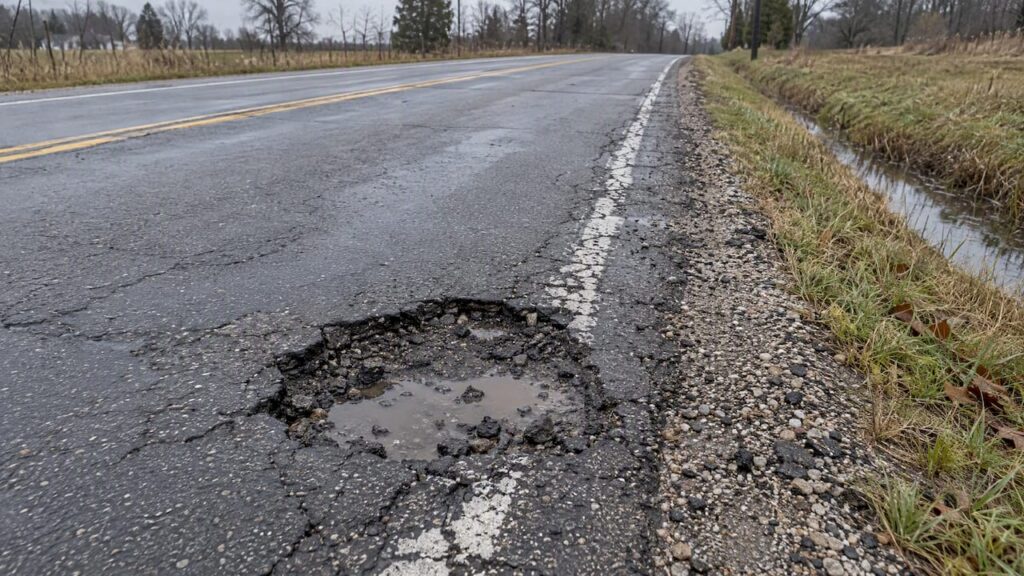
If a pothole, crumbling pavement or another defect on a Michigan road damaged your vehicle or injured you, the claim runs through a narrow legal channel. The agency that controls the road is usually protected by governmental immunity. Michigan’s highway exception lifts that protection only if you meet strict deadlines and prove the agency knew, or should have known, about the defect and failed to fix it. Small vehicle-damage claims follow one path. Injury claims and damage claims of $1,000 or more follow another.
This guide explains which agency to contact, what the statutes require, how Michigan’s no-fault system fits in, and when it makes sense to bring in a lawyer.
TL;DR
- Find out who owns the road first. State trunklines (I, M and US routes) belong to MDOT. Other roads belong to a county road agency or a city, and each has its own claim process.
- The 120-day notice is the deadline that ends most injury claims. Written notice of the defect, the injury and any witnesses must reach the agency within 120 days of the injury.
- The 30-day rule is the main hurdle. The law presumes an agency knew of a defect only if it was apparent to an ordinarily observant person for 30 days or longer.
- Vehicle damage alone is often a collision-coverage matter. In a no-fault state, your own policy pays for your car only if you bought collision coverage.
- Injuries change everything. If you were hurt, talk with an attorney before the notice window closes.
Table of Contents
- Who is responsible for the road you were driving on
- The two rules that decide most road defect claims
- Vehicle damage only: the MDOT claim and your own insurance
- When a road defect causes injuries
- Why these claims are hard to win
- Our perspective on road defect cases
- Getting a free case evaluation
- FAQ
- Sources
Who is responsible for the road you were driving on
Michigan law puts the duty to repair on the government body with jurisdiction over the road. Under MCL 691.1402, each agency having jurisdiction over a highway must keep it in reasonable repair so that it is reasonably safe and convenient for public travel. A person who is injured or whose property is damaged because the agency failed that duty may recover damages from it.
That is the exception. The general rule is immunity, and the exception applies only when its conditions are met. So the first practical question is which agency owns the road where you were hurt.
| Road type | Typical owner | Where the claim goes |
|---|---|---|
| Interstates (I), Michigan routes (M), US routes | State, through MDOT | MDOT damage claim process, or a lawsuit in the Court of Claims for larger or injury claims |
| County primary and local roads | County road commission or road department | That county’s claim process |
| City and village streets | The municipality | The city or village clerk or its designated office |
This matters because the wrong address costs time. MDOT states that highway defect claims, including potholes, should go to it only if the damage occurred on a state trunkline, not on local or county roads. Wayne County’s guidance tells drivers to contact the city, county or state owner of the road, depending on where it happened.
How far the road agency’s space extends
A common question is how many feet off the road the public owns. For local and primary roads, the right-of-way is typically 66 feet wide, according to the Michigan County Road Association. It includes the roadbed, shoulders and drainage ditches, and county road agencies hold an easement to manage that space for safety and drainage. A defect on the shoulder or in a ditch line can therefore still belong to the road agency, even where a private owner holds the land underneath.
Note that the duty in the statute concerns the part of the highway designed for vehicle travel. A fall on a roadside strip or a hazard on the shoulder may be analyzed differently, which is one more reason to get the facts reviewed.
The two rules that decide most road defect claims
The 120-day written notice
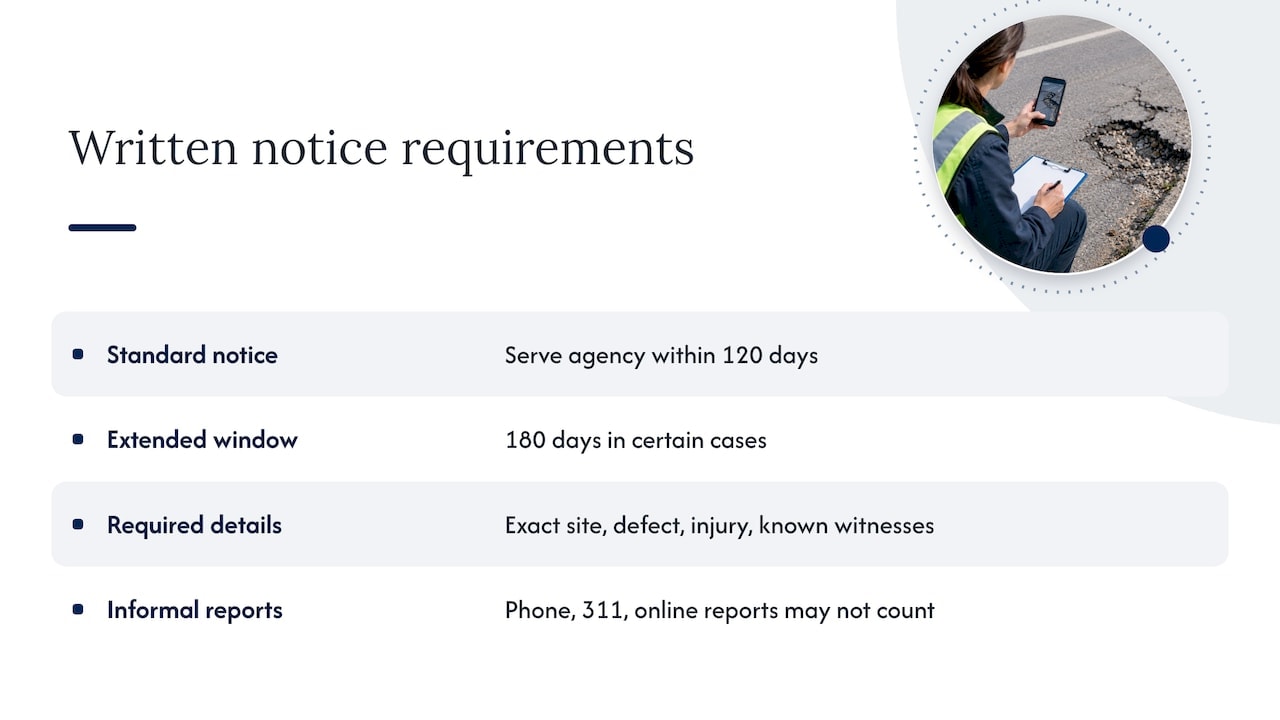
Under MCL 691.1404, an injured person must serve notice of the injury and the defect on the responsible agency within 120 days of the injury as a condition to recovery. The notice must specify the exact location and nature of the defect, the injury sustained and the names of known witnesses. The statute extends the window to 180 days in certain cases, such as when the injured person is under 18 or is physically or mentally incapable of giving notice, as the statute text reproduced by a Michigan legal resource shows.
Courts have taken this deadline seriously. In Rowland v. Washtenaw County Road Commission, the Michigan Supreme Court considered whether the highway notice provision should be enforced as written. Do not assume that a phone call, a 311 report or an online pothole report counts. A report tells the agency about a hole. It is not the formal notice the statute describes.
We see the same deadline logic in other premises cases, and it is worth reading how a 120-day notice can bar a Michigan premises liability claim if your injury happened on government property that is not a road.
The 30-day rule
Notice from you is one issue. Notice to the agency about the defect is another. MCL 691.1403 provides that no agency is liable for injuries or damages caused by defective highways unless it knew, or in the exercise of reasonable diligence should have known, of the defect and had a reasonable time to repair it. Knowledge is conclusively presumed when the defect was readily apparent to an ordinarily observant person for 30 days or longer before the injury.
That creates an evidence problem. A pothole you hit this morning may have appeared three days ago, and a freeze-thaw cycle can open one overnight. To win, you generally need proof of how long the defect existed or proof the agency had actual notice, such as earlier complaints, work orders or inspection records.
Vehicle damage only: the MDOT claim and your own insurance
If your only loss is a bent rim or a blown tire, there are two routes to consider.
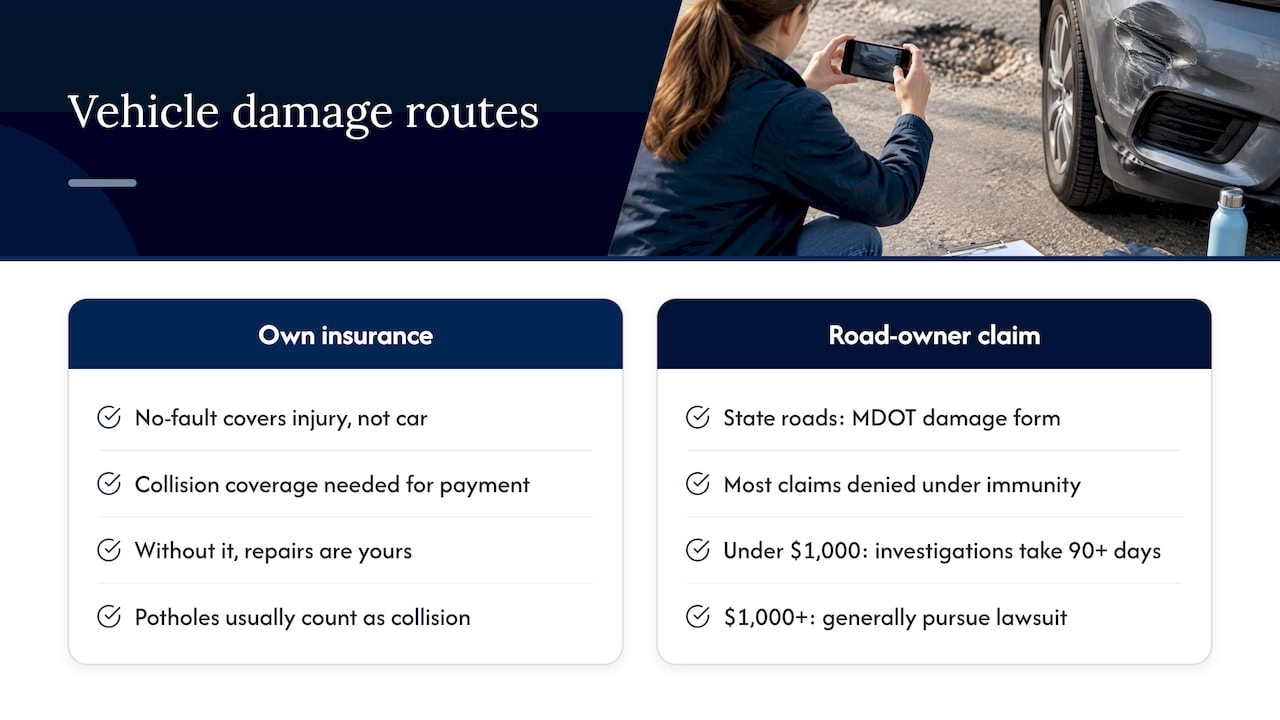
Route one: your own insurer. Michigan is a no-fault state, but that system covers medical and related personal injury benefits. For damage to your car, the state’s insurance guidance says that you must buy optional collision coverage if you want your insurer to pay for damage to your car in an accident. Without it, repair costs fall to you. Hitting a pothole is usually treated as a collision loss, so check your policy and your deductible before anything else.
Route two: a claim against the road owner. For state roads, MDOT has a damage claim form. Its page warns that the majority of damage claims are denied under governmental immunity. MDOT also says that for damage of $1,000 or more, the viable path is generally a lawsuit rather than an administrative claim. Local news coverage of the program, published in March 2026, reports that MDOT investigates claims under $1,000 and that those investigations usually take at least 90 days.
Two details help with paperwork. MDOT encourages notarizing your claim, because any claim it recommends for payment must be notarized before processing is finished. And the form should go to the agency that actually owns the road.
What to keep for a vehicle-damage claim
- Photos of the defect with something for scale, such as a tape measure or a shoe
- The exact location: road, nearest cross street, mile marker or GPS pin
- Date and time of the incident
- Repair estimates and receipts, plus photos of the damaged tire and wheel
- Any record of earlier complaints about the same defect
When a road defect causes injuries
A pothole can do more than damage a rim. A driver who swerves may leave the lane or hit another vehicle. A motorcyclist or cyclist can be thrown. A pedestrian can fall on a broken crosswalk. These cases are worth a different level of attention, because the losses can include medical bills, lost income and long-term care.
How no-fault and a road defect claim fit together
If you were hurt in a motor vehicle crash, your first source of medical coverage is typically no-fault personal injury protection (PIP), whoever caused the crash or whatever the cause was. Our guide to Michigan no-fault insurance and what injured drivers must do walks through that process, and the order of priority for who pays your bills explains which policy applies. PIP claims have their own filing window, covered in our article on the one-year no-fault deadline.
A road defect claim against a government agency is a separate matter. It is the route to pursue damages beyond what no-fault pays, but only if you satisfy the 120-day notice and the 30-day knowledge rules. These clocks run at the same time, so a missed deadline in one area does not rescue you in another.
Steps to take in the first weeks
- Get medical care and follow it. Your health comes first, and records tie your injuries to the date of the incident.
- Document the defect before it is repaired. Agencies often patch a hole quickly after a crash. Photograph and measure it, and note lighting, weather and traffic signs.
- Identify the owner. Look at the road designation and ask the county road commission or MDOT if you are unsure.
- Find witnesses. The statutory notice asks for their names.
- Calendar the 120th day counting from the date of injury, and treat it as the last day, not the target.
- Preserve your vehicle and the damaged parts. In a crash, vehicle data and physical damage can show what happened.
- Speak with a lawyer before you send any notice. Errors in the notice can end the claim.
Why these claims are hard to win
To sum up the obstacles, a successful claim usually requires you to show:
- The road was under the agency’s jurisdiction.
- The defect was in the traveled portion of the road and made it not reasonably safe.
- The agency knew or should have known, with the 30-day presumption as the clearest path.
- The agency had a reasonable time to repair it and did not.
- You gave timely, complete written notice.
- The defect caused your injury or loss.
Michigan courts have also dealt with design and maintenance disputes for decades. For example, the Michigan Supreme Court addressed claims about highway design and maintenance in Peters v. Department of State Highways, and more recently considered a state transportation case in Champine v. Department of Transportation. The details of those cases turn on their facts, and we would not apply them to your situation without reviewing it.
Our perspective on road defect cases
We approach these claims knowing that the deck is stacked toward the agency, and that this is exactly why early help matters. The people who come to us after a road defect injury have usually done the sensible things: they called the road commission, filed an online report and waited. Weeks later they learn that none of that satisfied the notice statute.
Our view is plain. If you were hurt, treat the first 120 days as the case. The legal arguments about knowledge and reasonable time can be developed later, but a missed notice cannot be repaired. Evidence of how long a defect existed is also perishable: road crews patch holes, snow covers them and memories fade. Collecting photos, neighbor accounts, prior complaints and maintenance records early is often what separates a viable claim from a closed one.
We also try to be honest about outcomes. Some road defect cases are not worth bringing, and when that is true we say so in the first conversation instead of letting a client wait. Our firm is family run, and clients speak directly with attorneys and paralegals throughout. A free evaluation costs nothing, and we work on a contingency fee, so there is no fee unless we win.
— Adam
Getting a free case evaluation
If a road defect in Michigan injured you or a family member, 2keller offers a free case evaluation. We handle car accident, motorcycle, wrongful death and other injury cases in Michigan, Indiana and New Mexico on a contingency fee basis, meaning we collect a fee only if there is a recovery. Bring what you have: photos, medical records, the location and the date. We will tell you which agency is likely responsible and how many days remain.
FAQ
Is Michigan an at-fault state for car accidents?
Michigan uses a no-fault system for medical and certain other benefits, so your own insurer generally pays those regardless of who caused the crash. Fault still matters for claims beyond no-fault benefits. See our no-fault explanation for how the two fit together.
How can I get reimbursed for pothole damage in Michigan?
First check whether your auto policy has collision coverage, since that is often the fastest route. You can also file a claim with the agency that owns the road. MDOT warns that most such claims are denied under governmental immunity, so keep expectations modest.
Who is responsible for fixing roads in Michigan?
The agency with jurisdiction: MDOT for state trunklines such as I, M and US routes, and county road agencies or cities for other roads. Under MCL 691.1402, that agency must keep the highway in reasonable repair.
What is the deadline to give notice of a road defect injury?
Generally 120 days from the injury, with a longer 180-day period in limited situations such as injuries to minors, according to MCL 691.1404. The notice must describe the location, the defect, the injury and any witnesses. Do not wait for a repair or for your medical treatment to finish.
Sources
- MDOT: Damage claim
- MCL 691.1402, Michigan Legislature
- MCL 691.1403, Michigan Legislature
- MCL 691.1404, Michigan Legislature
- MCL 691.1404 text and notice requirements, Michigan Legal Center
- Rowland v. Washtenaw County Road Commission, FindLaw
- Peters v. Department of State Highways, Justia
- Champine v. Department of Transportation, Michigan Supreme Court
- Michigan’s Auto Insurance Law Has Changed, DIFS
- File a Damage Claim, Wayne County
- Permit Information, Michigan County Road Association
- Hit a pothole in Michigan? How to submit a damage claim, ClickOnDetroit