
If you were hurt because of an unsafe condition on someone else’s property in New Mexico, the owner or occupant may be legally responsible for your injuries. The law asks one central question: did the property owner use ordinary care to keep the premises reasonably safe for visitors? This guide explains how that standard works, what you must prove, which deadlines apply, and why a claim against a city, county or state agency follows very different rules.
TL;DR
- New Mexico requires owners and occupants to use ordinary care to keep their property safe for visitors, and the court-approved jury instruction applies whether or not the hazard was open and obvious.
- Most private-property injury claims carry a three-year filing deadline, but claims against government entities require written notice within 90 days.
- Fault is shared. If a third party, such as a criminal attacker, caused the harm, the owner can still be held responsible for its own share of fault.
- Workplace falls usually go through workers’ compensation, not a premises liability claim.
- Photos, incident reports and prompt medical care in the first days shape how strong a claim becomes.
Table of Contents
- What premises liability means in New Mexico
- What you have to prove
- Open and obvious hazards are not an automatic defense
- Common premises liability situations in New Mexico
- When a criminal act injures you on someone’s property
- Comparative fault: what happens if you share the blame
- Deadlines you cannot afford to miss
- Injured on public property? Special rules apply
- When it is a workers’ compensation case instead
- What to do after an injury on someone’s property
- Our perspective
- Getting help with a New Mexico premises claim
- Frequently asked questions
- Sources
What premises liability means in New Mexico
Premises liability is the area of personal injury law that deals with injuries caused by dangerous conditions on property. It covers a wide range of events: a customer who slips on a wet floor in an Albuquerque grocery store, a tenant hurt by a broken stair, a guest injured by a collapsing railing, or a visitor assaulted in a poorly lit parking lot.
New Mexico does not build this law around a single statute. Instead, it rests on negligence principles and on the jury instructions the state Supreme Court approves for trial courts. The key instruction, UJI-CIVIL 13-1318, states that an owner or occupant owes a visitor the duty to exercise ordinary care to keep the premises safe for the visitor’s use.
Two features of that standard matter to injured people:
- It is one duty, not a ladder of categories. Many states sort visitors into invitees, licensees and trespassers and give each a different level of protection. The New Mexico instruction speaks of a duty owed to visitors generally, which keeps the focus on what the owner actually did.
- It is judged by reasonableness. The question is whether the owner acted as a reasonable person would, considering how likely an injury was, how serious it could be, and how burdensome it would have been to prevent.
What you have to prove
A premises claim is a negligence claim. The New Mexico Court of Appeals describes the usual elements: a duty owed to the plaintiff, a breach of that duty, and an injury caused by the breach. In practical terms, we organize the evidence around four questions.
- Was there a dangerous condition? A spill, a cracked walkway, missing handrails, broken lighting, an unsecured dog, a defective gate.
- Did the owner or occupant control the property? This is not always the person whose name is on the deed. Tenants, property managers, security contractors and maintenance companies can each share responsibility.
- Did the owner fail to act reasonably? This can mean failing to inspect, failing to repair, failing to warn, or ignoring earlier complaints.
- Did that failure cause your injuries, and what are your damages? Medical bills, lost income, pain and the long-term effects of the injury all count.
Foreseeability belongs to the jury
Owners often argue that nothing like this ever happened before, so they could not have known. New Mexico’s high court answered part of that argument in Rodriguez v. Del Sol Shopping Center Associates. The court held that foreseeability is not a factor for judges when deciding whether a duty exists. It is a fact question that a jury weighs when deciding breach and legal cause.
The practical effect: a lack of prior incidents does not by itself erase an owner’s duty. It becomes one piece of evidence, alongside inspection records, maintenance logs, complaints and the layout of the property.
Open and obvious hazards are not an automatic defense
Insurance adjusters often say, “The hazard was plain to see, so you should have avoided it.” Under the current jury instruction, that is not a complete answer. The instruction, effective December 31, 2025, says the duty of ordinary care applies whether or not a dangerous condition is open and obvious.
That does not mean obviousness is irrelevant. A jury can still consider whether you were careless, and New Mexico uses comparative fault to account for it (more on that below). But the owner cannot simply point at the hazard and walk away from the claim. The inquiry shifts to whether the owner used reasonable care in light of all the circumstances: could the owner have fixed it, blocked it off, lit it better or posted a warning?
Common premises liability situations in New Mexico
The details differ, but most cases fall into a few families.
| Situation | What we look for |
|---|---|
| Slip, trip and fall | Wet floors, uneven flooring, torn carpet, debris, poor lighting, missing mats, how long the hazard existed |
| Negligent security | Prior crimes nearby, broken locks, dark lots, absent guards or cameras |
| Dog bites | Ownership, prior aggression, fencing, leash practices |
| Inadequate maintenance | Collapsed stairs, loose railings, falling objects, failed balconies |
| Swimming pools and recreation areas | Missing fences, gates, drain covers, lifeguards or warnings |
| Apartment and rental properties | Repair requests ignored, code violations, common-area hazards |
If your fall is the issue, our page on New Mexico slip and fall injuries walks through the specifics of those claims.
When a criminal act injures you on someone’s property
Some of the most serious premises cases involve violence: an assault in an apartment complex stairwell, a robbery in a poorly secured parking structure. A common defense is that the criminal is the only one to blame.
New Mexico’s UJI-CIVIL 13-1320 addresses this. When an owner breaches the duty of ordinary care and a third person’s act then harms a visitor, the owner’s negligence is compared with the fault of the third party and of the visitor. The owner does not get to shift every bit of responsibility to the wrongdoer. A jury weighs the owner’s failure to prevent foreseeable harm against the perpetrator’s direct conduct.
These cases often turn on evidence the owner controls: security contracts, incident logs, camera systems, lighting plans and complaint records. Requesting that an owner preserve that evidence early is one of the first steps we take.
Comparative fault: what happens if you share the blame
New Mexico applies comparative fault. A jury assigns percentages to everyone whose negligence contributed, including you if the evidence supports it. Your recovery is reduced by your share, but you are not shut out simply because you bear some responsibility. Our page on New Mexico comparative negligence explains how the reduction works, and our article on comparative negligence in car accidents shows the same principle in another setting.
A simple illustration, with invented numbers: if a jury finds your damages total $100,000 and assigns you 20 percent of the fault, your award is reduced by $20,000. Insurers know this and try to inflate your percentage. That is why how you describe the incident, what you were doing and what you were wearing or carrying can matter.
Deadlines you cannot afford to miss
Private property owners
For general negligence and premises claims against private parties, the commonly cited limit is three years from the date of injury under NMSA 1978, § 37-1-8. Courts have in some situations allowed the clock to start later when an injury could not reasonably have been discovered, but you should never plan around an exception.
Government property
Cities, counties, school districts and the state can be responsible for dangerous property too, but the rules change sharply. According to a New Mexico Legislative Finance Committee report, claims under the Tort Claims Act require written notice to the responsible agency within 90 days of the incident, and lawsuits must be filed within a two-year limitations period. Failing to give proper notice to the correct agency can bar an otherwise valid claim.
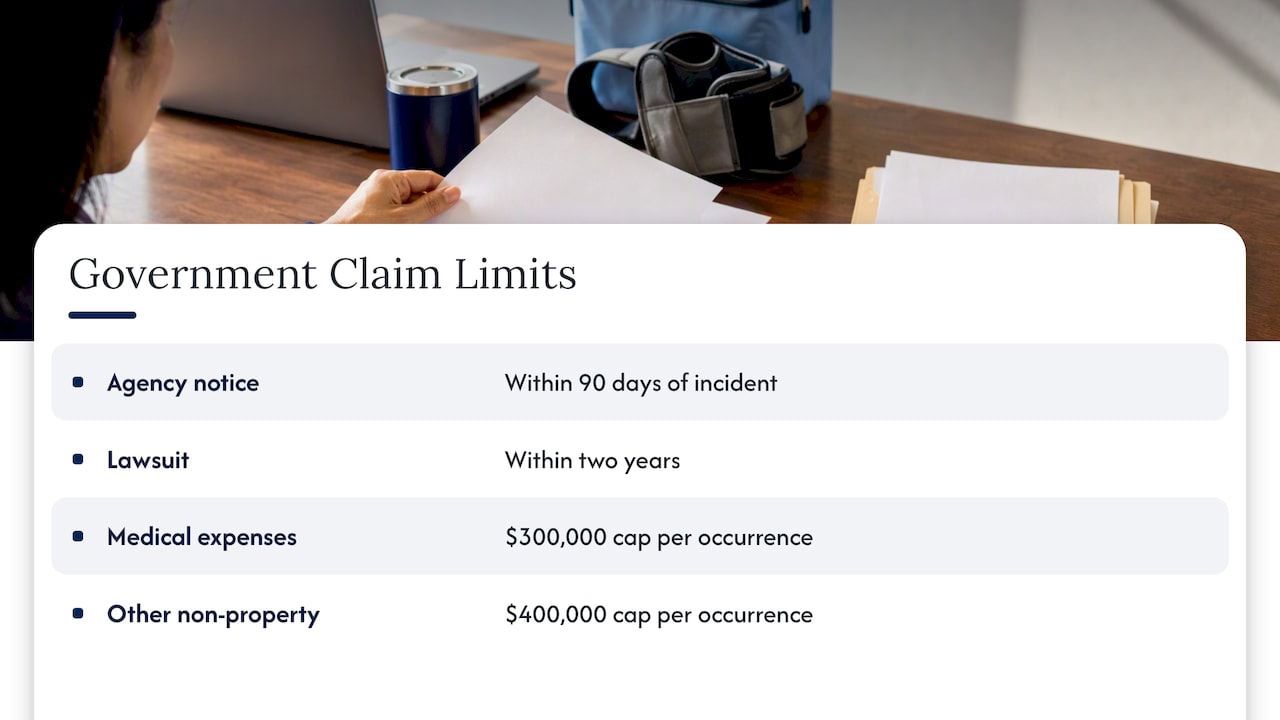
The same report describes damage caps for these claims as of its 2023 review: $300,000 for medical-related expenses and $400,000 for other non-property damages per occurrence. Private owners do not have those statutory caps.
Deadlines like these can change, so confirm the current rules with an attorney before relying on any of them.
Injured on public property? Special rules apply
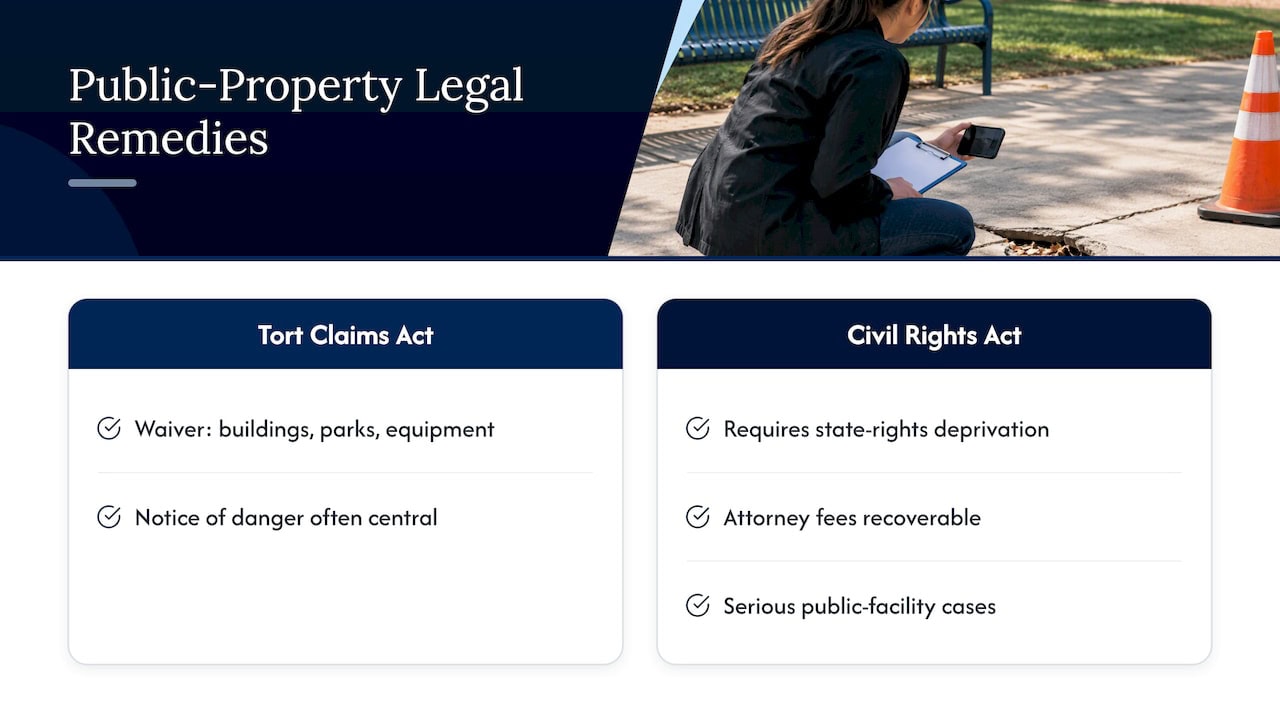
New Mexico generally protects governments from lawsuits through sovereign immunity, then waives that protection in specific situations. One waiver covers the operation or maintenance of buildings, public parks, machinery, equipment and furnishings, found in NMSA § 41-4-6.
Courts have interpreted this waiver broadly. A University of New Mexico Law Review article on Encinias and the expansion of the Tort Claims Act discusses how the building waiver has been extended beyond the physical walls of government property. Practitioners note that showing the entity had notice of a dangerous condition is often central to these cases.
The 2021 New Mexico Civil Rights Act provides a separate remedy when a public body deprives someone of rights under the state Bill of Rights. Unlike the Tort Claims Act, it allows recovery of attorney fees. It will not fit most slip-and-fall cases, but it can matter in serious cases involving public facilities. For more on the notice process, see our guide to the New Mexico Tort Claims Act.
When it is a workers’ compensation case instead
If you fell while working, the claim usually goes through workers’ compensation rather than a premises liability lawsuit. Workers’ comp pays medical bills and lost wages without requiring you to prove fault. There can be exceptions when a third party who is not your employer, such as a contractor or the owner of a different property, caused the hazard. If you are unsure which route applies, that is a question worth asking before you sign anything with an insurer.
What to do after an injury on someone’s property
The evidence in a premises case is often temporary. Floors get mopped, lights get fixed and cameras overwrite footage. These steps protect your claim:
- Get medical care right away. Your health comes first, and prompt records connect your injuries to the incident.
- Report the incident. Ask the manager, landlord or property representative to make a written report and request a copy.
- Photograph everything. The hazard, the surrounding area, lighting, warning signs or the lack of them, and your injuries.
- Collect names. Witnesses, employees and anyone who saw the condition before you were hurt.
- Keep your shoes and clothing as they were, without cleaning or discarding them.
- Be careful with insurers. Avoid recorded statements and quick settlement offers before you know the full extent of your injuries.
- Mind the deadlines. If a government property is involved, the 90-day notice clock is already running.
Our immediate steps after an accident collection covers more of what to do in the first days.
Our perspective
In our experience, premises cases are rarely lost because the law is unclear. They are lost because the evidence disappeared or because the injured person was talked into an early statement. Property owners and their insurers know within hours that a claim may follow. Injured people, understandably, are focused on pain, bills and getting back to work.
That gap is why we believe in direct communication from the start. We are a family-run firm, and we think clients should be able to reach the attorneys and paralegals handling their case, not wonder who is working on it. We have handled thousands of cases against large insurance companies, and that experience tells us what adjusters look for: gaps in treatment, inconsistent descriptions and any suggestion that the hazard was obvious.
New Mexico law gives injured visitors real tools, including the rule that an obvious hazard does not erase the owner’s duty, and the rule that owners cannot hand every bit of blame to a criminal third party. Using those tools well means gathering the right proof early, whether that is maintenance records, security footage or prior complaints.
— Adam
Getting help with a New Mexico premises claim
We represent injured people in Albuquerque and across New Mexico on a contingency fee basis: you pay no fee unless we win or settle your case. Your first case evaluation is free, so you can learn where you stand before making any decision. To talk through your situation, visit 2keller.com and request your free case evaluation. You can also read how legal fees work in our guide to the cost of hiring an injury attorney in New Mexico.
Frequently asked questions
Do I have a premises liability claim if the hazard was obvious?
Possibly. Under New Mexico’s jury instruction, the owner’s duty of ordinary care applies even if the dangerous condition was open and obvious. A jury may still assign you part of the fault, which reduces your recovery but does not automatically eliminate it.
How long do I have to file a premises liability lawsuit in New Mexico?
For most claims against private owners, the commonly cited deadline is three years from the injury date. Claims against government entities require written notice within 90 days and a lawsuit within two years. Because exceptions exist, speak with an attorney as soon as possible.
Can I sue if I was attacked on someone’s property?
Yes, in some cases. If the owner failed to use ordinary care, such as by ignoring known security problems, a jury can assign the owner a share of fault even though a criminal committed the attack. The owner’s responsibility is compared with the attacker’s, not automatically erased.
What if I was hurt on city or state property?
The Tort Claims Act governs. You must send written notice to the correct agency within 90 days, and damages are capped by statute. Missing the notice can permanently bar the claim, so act quickly.
What if I was injured at work?
Workplace falls typically go through workers’ compensation, which pays medical bills and lost wages without proof of fault. If someone other than your employer created the hazard, you may have a separate claim, so ask an attorney to review the facts.
Sources
- UJI-CIVIL 13-1318, Slip and fall
- UJI-CIVIL 13-1320, Duty to visitor; acts of third persons
- Rodriguez v. Del Sol Shopping Center Associates (FindLaw)
- Chavez v. Convergys Corp., New Mexico Court of Appeals
- Program Evaluation: Major Risk Funds of the Risk Management Division
- NMSA § 41-4-6, buildings, public parks, machinery, equipment and furnishings
- Encinias and the Expansion of the New Mexico Tort Claims Act
- Personal Injury Laws in New Mexico: Deadlines, Fault Rules and Damages