If you were hurt in a bar fight in Indiana, the person who hit you is almost always liable, and the bar itself is liable only in narrower circumstances. A bar can be pulled into a claim in two main ways: it served alcohol to someone it knew was visibly intoxicated, or it failed to protect you from a danger it had real reason to see coming. Indiana law makes both routes hard, which is why the first days after the injury matter so much.
This guide explains how those rules work, what evidence changes a case, how your own conduct can end a claim, and what deadlines apply. It is general information, not advice on your specific facts.
TL;DR
- The person who attacked you can be sued for assault and battery, whether or not he or she has been criminally charged. The bar is a separate question, and a harder one.
- Under Indiana’s Dram Shop Act, a bar that served the aggressor must have had actual knowledge that he or she was visibly intoxicated. “Should have known” is not enough.
- A premises claim depends on foreseeability, which Indiana courts decide as a question of law. Sudden, unexpected fights often fail.
- If you are found more than 50% at fault, Indiana law bars recovery entirely.
- The general deadline is two years. Preserve video, witnesses and medical records now.
Table of Contents
- Who can be held liable after a bar fight
- The Dram Shop Act: what you must prove
- Premises liability: the foreseeability hurdle
- When your own conduct ends the claim
- Deadlines that protect the claim
- What to do in the first days
- What compensation can cover
- Our perspective
- Talk to us before the evidence disappears
- FAQ
- Sources
Who can be held liable after a bar fight
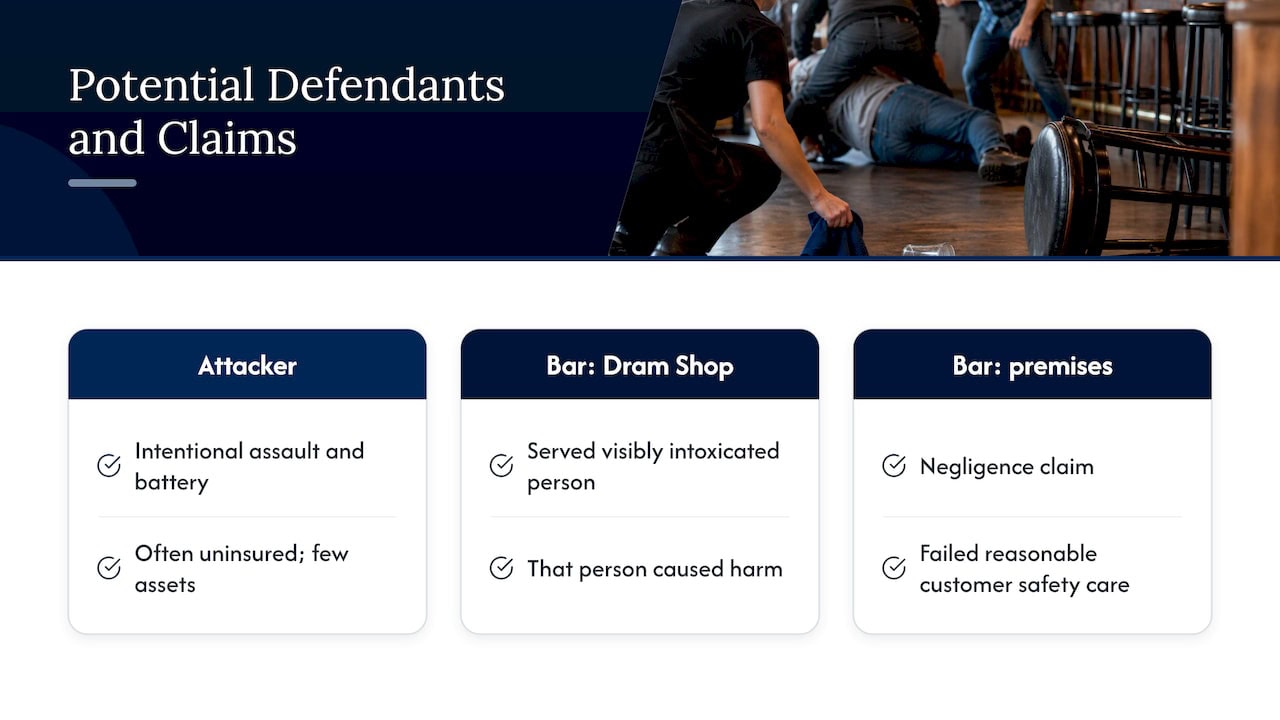
A bar fight claim can involve up to three kinds of defendants, and each rests on a different legal theory.
The attacker. Assault and battery are intentional torts. If someone struck you, you can bring a civil claim against that person for medical bills, lost income and pain and suffering. The practical problem is collection: many attackers have no insurance that covers intentional acts and few assets. That is often why attention turns to the bar.
The bar, under the Dram Shop Act. This is a statutory claim based on serving alcohol to someone who was already visibly intoxicated, and who then caused harm.
The bar or property owner, under premises liability. This is a negligence claim: the business owed you a duty to take reasonable care for your safety as a customer and did not.
These claims can be pleaded together. They do not share the same elements, and the evidence that supports one often does nothing for the other.
The Dram Shop Act: what you must prove
Indiana’s civil liability statute for furnishing alcohol is IC 7.1-5-10-15.5. In plain terms, a person who furnishes an alcoholic beverage is not liable for damages caused by the impairment of the person served, unless two things are shown:
- The provider had actual knowledge that the person was visibly intoxicated when the drink was furnished.
- The intoxication was a proximate cause of the injury, meaning the harm followed from it in a legally meaningful way.
The phrase that decides most of these cases is “actual knowledge.” A claim that a bartender or server should have known the patron was drunk does not meet the statute. The Indiana Supreme Court discussed the statute’s history and requirements in WEOC, Inc. v. Adair, a case that explains why the term “dram shop” persists even though the unit it refers to is centuries old.
What evidence shows actual knowledge
Proof that someone drank a lot is not the same as proof that staff saw obvious signs of intoxication at the moment of the last drink. Evidence that tends to matter includes:
- Testimony from other patrons or staff that the person was slurring, stumbling or loud and belligerent when served.
- Point-of-sale records showing the number and timing of drinks, including rounds bought by others.
- Security or bar-camera footage of the last service.
- Statements by the server or bartender, including any prior comments about cutting someone off.
- Toxicology or arrest records for the aggressor, which help with intoxication but do not alone prove what staff knew.
Records like these are held by the business and are routinely overwritten. Video systems often keep footage for days or weeks, not months.
Premises liability: the foreseeability hurdle
Even when alcohol is not the issue, you may argue that the bar failed to keep you reasonably safe. A business owes its customers, whom the law calls invitees, a duty of reasonable care. But Indiana does not make a bar the guarantor of every patron’s safety.
Whether a duty exists to protect against a criminal attack turns on foreseeability. Indiana courts analyze it by asking about the broad type of plaintiff and the broad type of harm, and they treat the question as one for the judge rather than a jury. In Goodwin v. Yeakle’s Sports Bar & Grill, patrons hurt in a shooting sued a neighborhood bar, and the Indiana Supreme Court addressed whether the bar owed a duty under that framework.
The practical effect is that many of these cases are decided at summary judgment, before any jury hears them. The judge decides there was no duty, and the case ends.
The Cavanaugh’s decision
The most useful case for understanding the limits is Cavanaugh’s Sports Bar & Eatery v. Porterfield, decided by the Indiana Supreme Court in 2020. A patron was grievously injured in a sudden fight in the bar’s parking lot at closing time. The Court held the attack was unforeseeable, so the bar’s duty did not reach that scenario, and it directed entry of summary judgment for the bar. The court reasoned that the plaintiff showed no reason the bar had to believe the fight would occur. A dissent argued that the majority had raised the bar for foreseeability in the duty analysis.
The lesson is not that bars are never liable. It is that a generally rowdy reputation does not carry a case on its own.
What can create a duty
Courts look for specific warning signs the business saw and ignored. Examples of the kind of facts that matter:
- An escalating argument between the same people that staff watched for some time.
- A prior altercation between the same individuals earlier that night.
- Staff who saw a weapon or heard a threat and did not intervene or call police.
- A documented history of similar violence that management had notice of and did nothing to address.
The BoJak’s Bar and Grille v. Henry appeal is one example of a bar contesting, through an interlocutory appeal, a trial court’s finding that it owed a patron a duty of care against an unforeseen attack. Reading cases like this shows how fact-specific the analysis is.
When your own conduct ends the claim
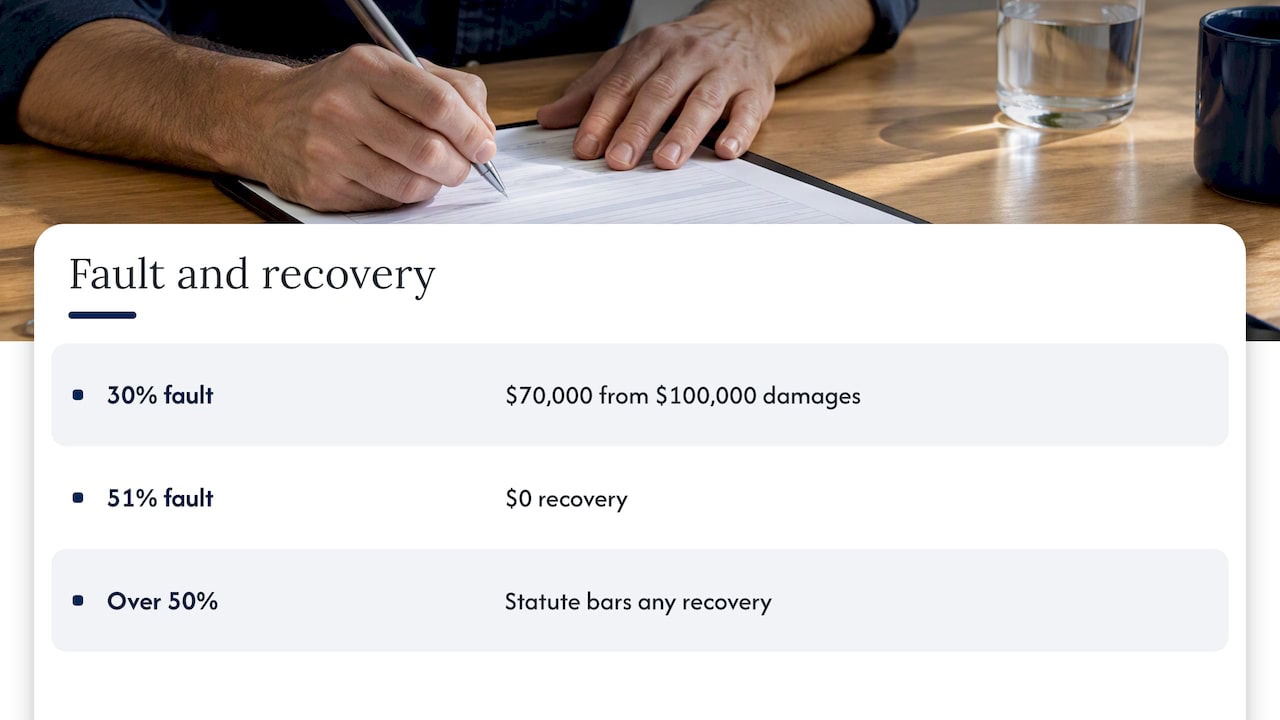
Indiana follows a modified comparative fault rule. Your damages are reduced by your percentage of fault, and if a jury finds you were more than 50% at fault, the statute bars any recovery. We explain how this works for other injury claims in our guide to Indiana’s comparative fault law.
In bar fight cases, the defense will look for anything suggesting you started or escalated the confrontation: a shove, a threat, an insult that preceded a punch, a decision to follow someone outside. Be honest with your attorney about what happened. A fact that looks damaging is far easier to handle when we hear it first from you, and much harder when it surfaces in a video or a deposition.
An example of how percentages can play out, using round numbers for illustration only: if a jury found total damages of $100,000 and you were 30% at fault, your recovery would be reduced to $70,000. At 51%, it would be zero.
Deadlines that protect the claim
Personal injury claims in Indiana generally must be filed within two years of the date the claim accrues under IC 34-11-2-4. Our page on the two-year filing deadline in Indiana covers how that clock works, though it is written around car accidents.
Two caveats matter here:
- If the bar is operated by or on land owned by a government body, such as a public venue, short notice requirements can apply. See our explanation of the Indiana Tort Claims Act, where notice can be due far sooner than two years.
- A wrongful death claim after a fatal fight has its own rules, and a family should speak with an attorney quickly. The case WEOC, Inc. v. Neibauer was a wrongful death suit against two establishments, and shows these claims can involve alcohol-service allegations.
The two-year limit is a ceiling, not a target. Evidence disappears long before it expires.
What to do in the first days
The steps below are the ones that most often decide whether a claim has evidence behind it.
- Get medical care and follow through. Tell the provider how you were hurt. Consistent records link the injury to the fight.
- Report the incident. Ask police for the report number. If the bar has an incident log, ask that it be preserved.
- Write down names. Record the bartender, server, bouncer, friends and anyone who saw the fight, while memories are fresh.
- Identify cameras. Note bar cameras, nearby businesses and doorbell cameras. Footage is the first thing lost.
- Photograph your injuries at the start and as they heal, and save torn or bloody clothing.
- Keep receipts. Your own tab or card statement can show what you and the aggressor were served and when.
- Do not post about it. Social media posts can be read as admissions about your role in the fight.
- Be cautious with insurers. Do not give a recorded statement to the bar’s insurer before you understand your rights.
Our page on immediate steps after an accident covers more of this ground.
What compensation can cover
If a claim succeeds, damages in a personal injury case can include medical expenses, future treatment, lost wages and earning capacity, and pain and suffering. Severe fight injuries, such as facial fractures, eye injuries, traumatic brain injury and spinal trauma, can carry long recoveries, which is why accurate medical documentation matters from day one.
The bar’s liquor liability or general liability insurance is typically the main source of recovery from a business defendant. What it covers depends on the policy, and insurers examine fight claims closely.
Our perspective
We will be direct with you: bar fight cases in Indiana are among the harder claims in premises liability. The courts have set a high bar on foreseeability, and the Dram Shop Act’s actual knowledge requirement leaves little room for arguments built on assumption. Anyone who tells you that a bar is automatically responsible for a fight on its property is not describing Indiana law.
That is exactly why we spend the early part of a case on facts rather than theories. We ask what the staff saw, when they saw it and what they did. We look for video before it is erased. We find the other patrons who watched the argument build. And we talk to you honestly about your own role in the events, because Indiana’s 50% rule can end a case that is otherwise strong.
Our approach is family-run and client-first. You have direct access to the attorneys and paralegals working on your case, and we keep you informed rather than leaving you to wonder. We have handled thousands of cases against large insurance companies, and we know how defense teams build an unforeseeable-attack argument. If your case does not meet the legal standard, we will tell you plainly, so you can make decisions without false hope. If it does, we will pursue every responsible party.
— Adam
Talk to us before the evidence disappears
If you or a family member was hurt in a fight at an Indiana bar, restaurant or nightclub, we offer a free case evaluation, and we work on a contingency fee basis: no fee unless we win. You can read more about how we approach premises liability in Indiana, or start with a free consultation through 2keller.com. The sooner we know about the cameras and witnesses, the more we can preserve.
FAQ
Can I sue a bar in Indiana if I was hurt in a fight there?
Sometimes. You would need to show either that the bar served the aggressor while having actual knowledge he or she was visibly intoxicated, or that the fight was foreseeable enough to create a duty to protect you. A sudden fight with no warning signs is difficult to win on, as the Cavanaugh’s decision shows. You can always pursue the person who attacked you.
What does visibly intoxicated mean under the Dram Shop Act?
The statute does not turn on how many drinks someone had. It asks whether the server had actual knowledge that the person was visibly intoxicated at the time of service, as set out in IC 7.1-5-10-15.5. Witness accounts of slurred speech, stumbling or obvious impairment, along with video, are the kind of proof that can help.
What if I threw the first punch?
Your claim may be reduced or barred. Indiana’s comparative fault statute bars recovery if you are found more than 50% at fault. Whether you are viewed as the instigator is a fact question, so tell your attorney everything early.
How long do I have to file?
Most Indiana personal injury claims must be filed within two years under IC 34-11-2-4. Claims involving a government entity can require notice much sooner, so do not wait to get legal advice.
Does the attacker’s criminal case affect my civil claim?
They are separate. A civil claim does not depend on a criminal conviction, and a criminal case that ends without a conviction does not by itself end your right to sue. Police reports and criminal case records can, however, supply useful evidence.
Sources
- Indiana Code, Title 34, Article 11, Chapter 2 (2026)
- Indiana Code, Title 34, Article 51, Chapter 2 (2026)
- Indiana Code § 7.1-5-10-15.5 (Justia)
- WEOC, Inc. v. Adair (Indiana Supreme Court)
- Goodwin v. Yeakle’s Sports Bar & Grill (Indiana Supreme Court, 2016)
- Cavanaugh’s Sports Bar & Eatery v. Porterfield (Indiana Supreme Court, 2020)
- BoJak’s Bar and Grille v. Henry (Indiana Court of Appeals)
- WEOC, Inc. v. Neibauer (Indiana Court of Appeals, 2023)