
Yes, the Indiana Tort Claims Act lets you pursue certain tort claims against state and local governments, but strict notice rules, immunities, and damage caps make immediate, correct filing essential. If a government entity or employee injured you, identify whether the defendant is the state or a political subdivision, then send a written Notice of Tort Claim by certified mail within the required time, typically a few months, depending on the government entity. Keep every receipt and copy, and talk to an Indiana personal injury attorney before your deadline runs.
TL;DR:
- Filing a valid Indiana Tort Claim requires submitting notice within 180 days for local governments and 270 days for state agencies, or the claim is barred.
- Properly identifying the defendant as the government entity or employee within scope of employment is crucial, as misclassification can invalidate the claim.
- Immunities covering natural property conditions or discretionary functions can block claims, especially if the injury resulted from policy decisions or property conditions outside government control.
- The notice must include specific details such as incident date, description, damages sought, and supporting documents, delivered via certified mail with receipts kept.
- Working with an experienced attorney ensures correct filing, evidence gathering, and understanding of damage caps, increasing the chances of a successful claim.
Table of Contents
- What the Indiana Tort Claims Act covers
- Government immunities that can block your claim
- Notice deadlines: 180 days vs. 270 days
- How to file your Notice of Tort Claim
- What happens after you file, and what to do if you’re denied
- Why work with an Indiana personal injury attorney
- An editorial take on filing it right the first time
- Sources
What the Indiana Tort Claims Act covers
The Indiana Tort Claims Act, codified at Indiana Code Title 34, Article 13, Chapter 3, authorizes tort claims against the state, its agencies, political subdivisions, certain commissions, school corporations, and public employees acting within the scope of their employment. That last phrase matters: if a government employee caused your injury while doing their job, the entity itself is typically the proper defendant.
Some governmental bodies, like a park board or a utility commission, must be sued as the entity rather than by naming individual board members, unless an employee stepped outside their job duties. A car accident caused by a snowplow driver during a normal shift points to the county or municipality. A slip and fall at a state park points to a state agency. An assault by an off-duty officer acting on personal motives may fall outside the Act entirely and proceed as an ordinary negligence claim against that person.
Government immunities that can block your claim
Before you assume you have a case, understand what the government is not liable for. IC 34-13-3-3 lists broad categories of immunity, and courts apply them strictly.
Common immunities include:
- Injuries caused by the natural condition of unimproved property, such as a wooded area in a state forest.
- Losses from discretionary governmental functions, meaning policy decisions rather than day-to-day operational mistakes.
- Claims arising from the initiation of a judicial or administrative proceeding.
- Design or construction defects in public works, within certain time limits after completion.
- Failure to enforce a law, unless the failure amounts to something the statute treats differently.
Recovery often still exists when the employee acted outside the scope of employment, engaged in criminal or malicious conduct, or when the facts show something closer to willful or wanton misconduct rather than a discretionary policy choice. A city that never repaired a marked crosswalk after repeated complaints looks like an operational failure, not a protected policy decision. An officer who assaults someone for personal reasons removes the case from the Act’s immunity shield.
Notice deadlines: 180 days vs. 270 days
Timing decides most tort claims in Indiana before the facts ever matter. Claims against the state require notice to the Attorney General or the relevant state agency within 270 days of the loss. Claims against a political subdivision, meaning a city, county, township, or school corporation, require notice within 180 days under IC 34-13-3-8. Miss either window and the claim is typically barred, regardless of how strong the underlying negligence case is.
These notice deadlines run separately from, and much shorter than, Indiana’s general two-year statute of limitations for personal injury suits under Ind. Code § 34-11-2-4, according to Nolo’s summary of Indiana’s injury deadlines. You still have two years to file suit, but you lose that right entirely if you never sent a compliant notice first.
| Defendant type | Notice deadline | Where to file | Statute |
|---|---|---|---|
| State agency or employee | 270 days | Indiana Attorney General or the involved state agency | IC 34-13-3-6 |
| Political subdivision (city, county, school corp.) | 180 days | Governing body of the subdivision | IC 34-13-3-8 |
How to file your Notice of Tort Claim
For state claims, use the Attorney General’s State Form 54668, which the Tort Claim Investigations division administers. For claims against a political subdivision, follow the content requirements in IC 34-13-3-10 and check your city or county’s own filing page, since Indianapolis’s tort claim process is a useful model for what local governments typically expect.
Your notice needs to include:
- Your full name, address, and contact information.
- The date, time, and location of the incident.
- A description of the circumstances causing the loss.
- A general description of your injuries or property damage.
- Names of any known witnesses.
- The amount claimed, if your local subdivision requires it.
- Your signature and the date.
Deliver the notice in person or by certified or registered mail, and keep your mailing receipt along with copies of everything you send. Attach photos, police or incident reports, repair estimates or paid receipts, and medical records if you have them.
Pro Tip: Confirm early whether the entity you’re dealing with carries coverage through a risk management fund or pool. Many Indiana cities and counties self-insure through shared risk pools, and knowing that up front helps your attorney anticipate how the claim will actually be adjusted.
What happens after you file, and what to do if you’re denied
Once your notice is filed, the government generally has 90 days to investigate and respond. If the entity neither settles nor formally denies the claim within that window, the law generally treats the lack of response as a denial, which allows you to move forward with a lawsuit.
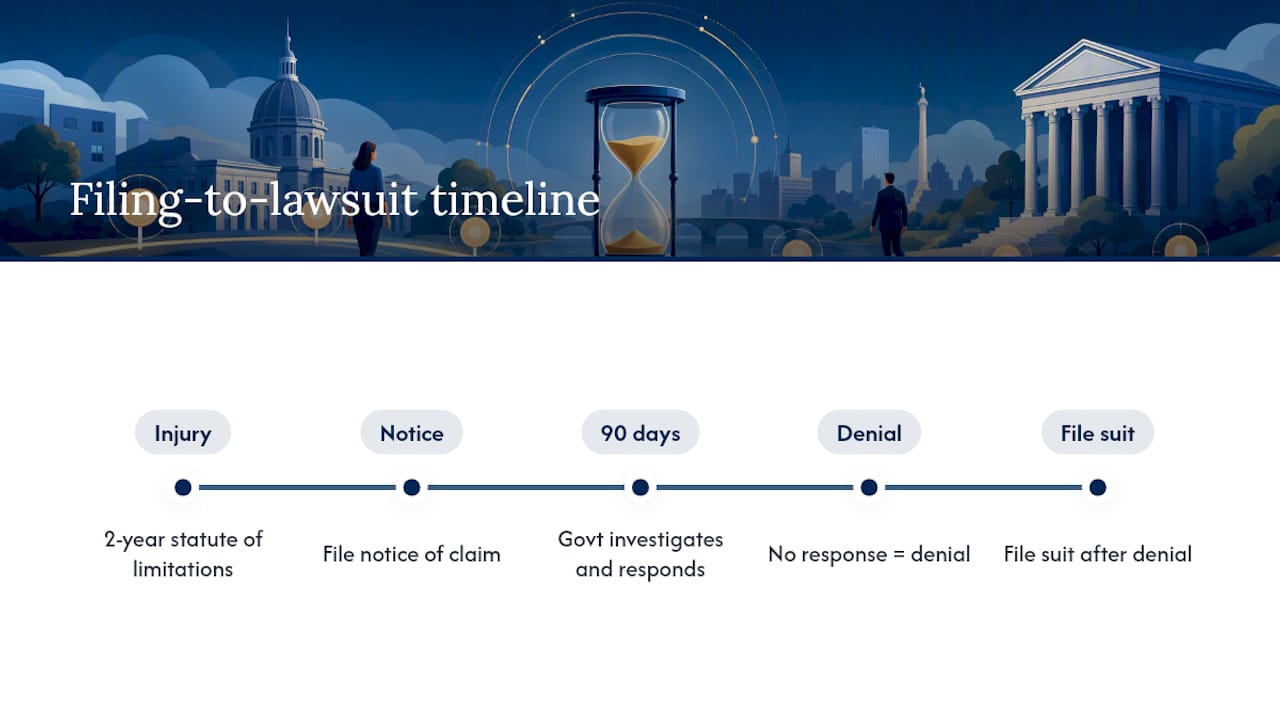
After denial, you can file suit in court, subject to the two-year statute of limitations that started running on the date of injury, not the date of denial. If the government later claims its employee acted outside the scope of employment, you may need to amend your complaint to add that employee individually, so tracking these developments closely matters. Preserve every piece of evidence now. Don’t wait for a lawyer to tell you to start, and don’t rely on the government’s own staff for procedural guidance. The Attorney General’s office and municipal clerks can tell you where to send a form, but they will not tell you how to build your case.
Why work with an Indiana personal injury attorney
Notice requirements look simple on paper, but a single missing detail, wrong mailing address, or misjudged deadline can end a valid claim before it starts. An experienced attorney drafts the notice correctly, gathers the evidence needed to overcome the immunities discussed above, and calculates what your case is actually worth given the $700,000 per-person and $5,000,000 per-occurrence caps under IC 34-13-3-4, which also bars punitive damages against government defendants entirely.
2keller has represented injured Hoosiers across Indiana for years, and our team regularly handles the negotiation and litigation that follows a tort claim denial. That work includes building the negligence record your case needs, as explained in our guide to proving negligence in an Indiana car accident, and accounting for factors like Indiana’s comparative fault law when damages are calculated. If your injuries are serious or the facts are contested, a free consultation costs nothing and can clarify your deadline before it becomes a problem.
An editorial take on filing it right the first time
Most articles about Indiana’s tort claims process spend too much time explaining what the law is and not enough time telling you what to do in the next 48 hours. That’s backwards. The statute itself is not complicated once you read it, but the deadlines are unforgiving, and unforgiving deadlines deserve urgency, not another explainer.
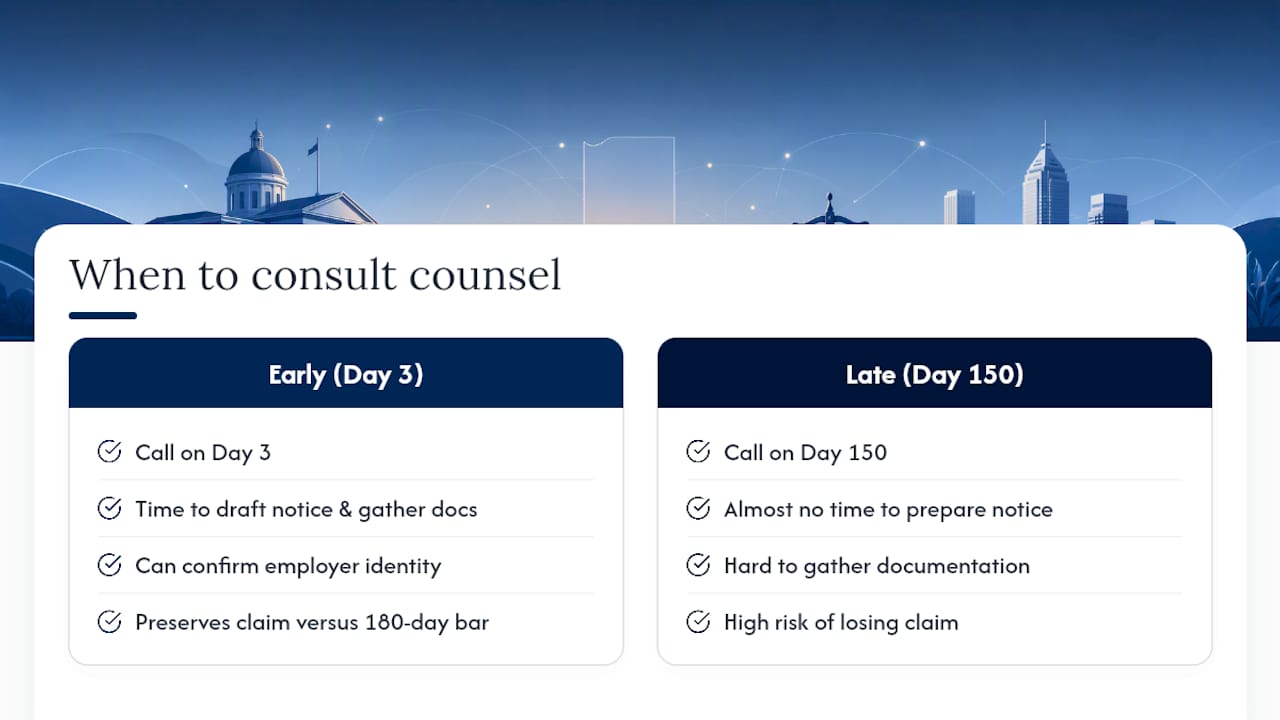
The conventional advice, “consult an attorney,” is correct but incomplete. What matters more is when you consult one. Waiting until day 150 of a 180-day window to call a lawyer leaves almost no time to draft a notice that will survive scrutiny, gather documentation, or confirm which entity actually employed the person who hurt you. I’d rather see someone call an attorney on day three with an incomplete picture than wait for perfect clarity and lose the claim entirely.
The other overlooked point is that immunity fights, not the notice deadline, are where most ITCA claims actually die. Claimants fixate on getting the paperwork in on time, which is necessary, then discover the injury falls under a discretionary-function or unimproved-property immunity they never anticipated. Read the immunity list before you assume you have a case, not after.
Adam
This article is general information, not a substitute for advice from a qualified lawyer. Consult a qualified legal professional about your own circumstances before acting on anything here.
Sources
- IC 34-13-3-3, Immunity of governmental entity or employee (Justia)
- Indiana Code, Title 34, Article 13, Chapter 3 (IGA PDF)
- State Form 54668 (Notice of Tort Claim), Indiana Forms
- File a Tort Claim, Indianapolis official site