If you were in a crash in New Mexico and one of the drivers lives somewhere else, the short answer is this: a New Mexico crash is ordinarily governed by New Mexico law, no matter where each driver is licensed or insured. New Mexico is an at-fault state, you generally have three years to file a lawsuit, and the other driver’s home-state insurance policy still has to respond. What changes is the paperwork, the logistics and the pressure from insurers hundreds of miles away.
This guide is for two readers: the visitor or commuter injured on a New Mexico road, and the New Mexico resident hit by a driver with out-of-state plates. We explain what to do at the scene, which law applies, how insurance works across state lines and which deadlines to protect.
TL;DR
- A crash in New Mexico is ordinarily governed by New Mexico law for the injury claim, even if the at-fault driver is from another state.
- New Mexico is an at-fault state with pure comparative negligence: your compensation is reduced by your share of fault, not erased.
- The general deadline for a personal injury lawsuit is three years from the date of injury, and claims against a government entity can require written notice within 90 days.
- Document the scene, get the other driver’s license and insurance details, and notify your own insurer promptly.
- Insurance for out-of-state drivers can be more complicated, so speaking with a New Mexico attorney early helps protect your claim.
Table of Contents
- What to do at the scene of a New Mexico crash
- Which state’s laws apply?
- New Mexico is an at-fault state
- How insurance works when drivers come from different states
- Where can you bring a claim?
- Deadlines you cannot miss
- What compensation can cover
- A practical checklist for visitors and residents
- Our perspective
- Free help after an accident in Albuquerque or anywhere in New Mexico
- FAQ
- Sources
What to do at the scene of a New Mexico crash
The first hour is the same whether the other driver is from Albuquerque or Ohio, but the stakes of missing a detail are higher when the other party will soon be in another state. Follow AAA’s post-crash guidance: check for injuries and hazards, call 911 when anyone is hurt or the road is unsafe, and move to a safe place if the vehicle can be driven.
Then collect the information you will need later. The New Mexico Office of the Superintendent of Insurance lists what to exchange and record:
- Names, addresses and driver’s license numbers of everyone involved.
- Each driver’s insurance company and policy details.
- Vehicle information, including the license plate and its issuing state.
- Contact details for witnesses.
- The responding officer’s name and the crash report number.
- The time, date and exact location.
Photograph the vehicles, the damage, the road, any skid marks and the surrounding intersection. The same OSI guidance says to report the crash to your insurer promptly, because some policies require notice within 24 hours.
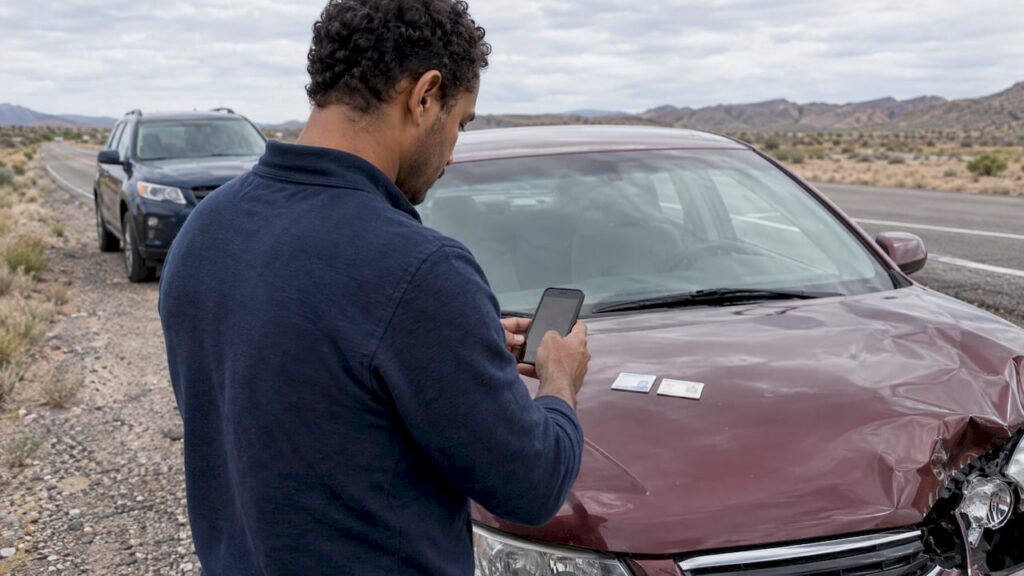
Two habits matter especially with an out-of-state driver. First, photograph the other driver’s license and insurance card, since a driver who leaves the state is harder to track down later. Second, avoid admitting fault or agreeing to an informal cash settlement at the roadside. AAA’s guidance also advises against blaming anyone at the scene, and you may not yet know the full extent of your injuries.
Seek medical care the same day
Adrenaline hides pain. Neck, back and head injuries often show up hours or days later. Get examined, follow the treatment plan and keep every bill, record and receipt. AAA’s guidance also recommends tracking medical expenses from the start, and those records become the backbone of your claim.
Which state’s laws apply?
This is the question that worries most out-of-state drivers, and the answer is more reassuring than people expect. According to a federal court decision applying New Mexico law, New Mexico generally applies the law of the place where the accident occurred to the underlying injury claim. A crash on I-25 or I-40 is therefore ordinarily governed by New Mexico law.
The New Mexico Court of Appeals draws the same line in Wilkeson v. State Farm: the law of the accident location ordinarily governs the injured person’s right to recover from the negligent driver, while the law of the place where the insurance contract was made governs how the policy is interpreted.
In practice that means two layers:
- The injury claim: New Mexico’s negligence rules, fault standard and deadlines.
- The insurance policy: The terms of the policy written in the other driver’s home state, which may be read under that state’s law, subject to exceptions such as public policy.
If you live in another state and were hurt here, your own home-state insurance may also come into play, for example through medical payments or uninsured motorist coverage. That is one reason to have the policies reviewed before you accept any offer.
New Mexico is an at-fault state
New Mexico is not a no-fault state. The driver who caused the crash, and that driver’s liability insurer, is responsible for the resulting losses. Fault is determined from the police report, physical evidence, photographs, witness statements and, in serious cases, vehicle data and accident reconstruction.
New Mexico follows pure comparative negligence. According to a summary of New Mexico personal injury law, your damages are reduced by your percentage of fault, but you can still recover even if you were mostly to blame. A professional state summary adds that each concurrent wrongdoer is responsible for its own percentage of fault.
A simple example: if a jury finds your damages total $100,000 and assigns you 20% of the fault, your recovery is reduced to $80,000. Insurers know this, which is why they work to push a percentage of blame onto you. We explain how that plays out in our guides to New Mexico’s comparative negligence rules and car accident comparative negligence.
Out-of-state drivers sometimes assume their home-state rules follow them. If the other driver comes from a no-fault state, that does not turn a New Mexico crash into a no-fault claim against you. Do not let an adjuster tell you otherwise without checking.
How insurance works when drivers come from different states
Most drivers carry coverage that travels with them. Progressive explains that a standard auto policy typically covers out-of-state driving in all 50 states, with liability covering injuries or property damage you cause and collision covering damage to your own car.
New Mexico’s published personal auto policy form goes further: when a crash happens outside the state where the vehicle is principally garaged, the policy may provide the higher limit required by the accident state’s financial-responsibility law, subject to its terms. Policy wording varies by insurer, so read yours.
New Mexico’s minimum limits
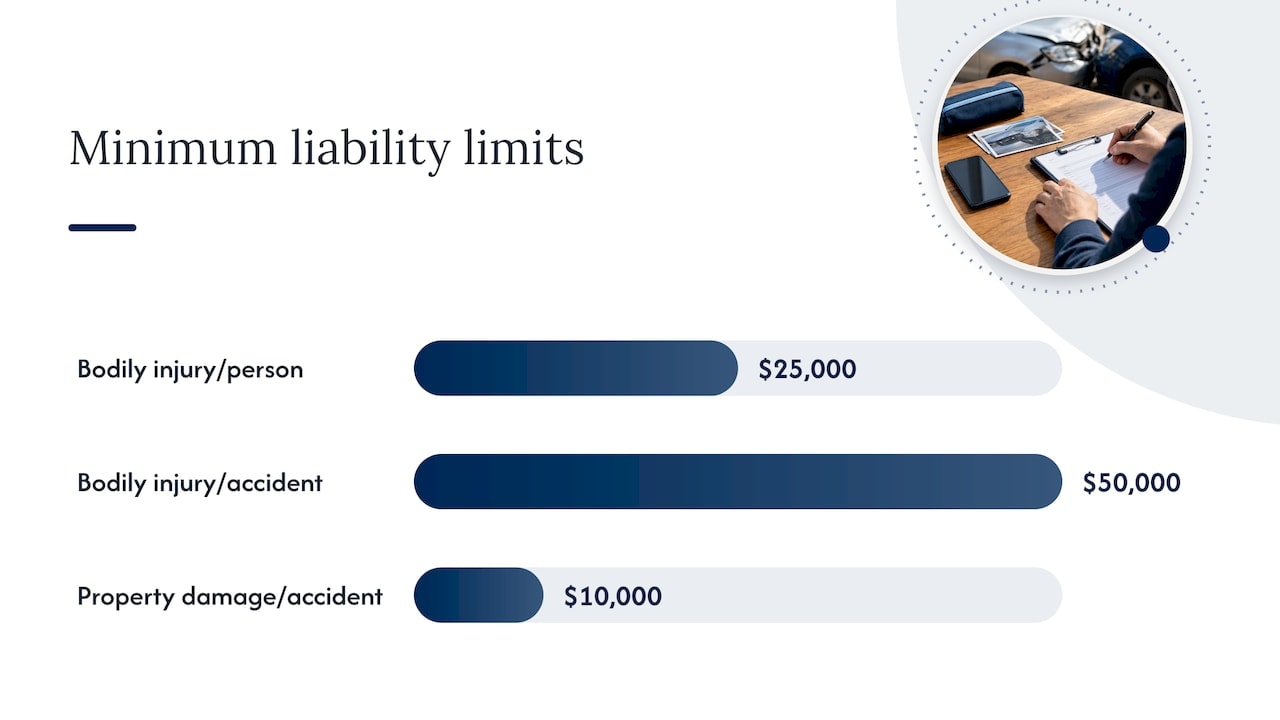
The OSI states that New Mexico’s minimum liability limits are $25,000 for bodily injury per person, $50,000 per accident and $10,000 for property damage per accident. Those numbers are low compared with the cost of a serious injury, and a driver from another state may carry limits that are higher or lower than New Mexico’s. When the at-fault driver’s limits are not enough, your own coverage becomes important.
Uninsured and underinsured motorist coverage
The OSI explains that uninsured-motorist coverage can protect you and your passengers when a legally responsible driver has no insurance, and it identifies a $250 deductible for that coverage in New Mexico. According to a 2026 summary, New Mexico law as of January 1, 2026 generally requires auto policies to include uninsured and underinsured motorist coverage. That summary also notes the rules have changed recently, so confirm current requirements with the OSI.
This matters in out-of-state crashes because an out-of-state driver’s policy might be thin, lapsed or hard to verify. Our article on why you should carry uninsured and underinsured coverage walks through how that protection works, and our overview of New Mexico’s car accident insurance laws covers the basics for Albuquerque drivers.
Where can you bring a claim?
When the crash happened in New Mexico, the usual path is a claim or lawsuit in New Mexico. Nolo’s overview of how to file a personal injury lawsuit in New Mexico outlines the process of starting a case in the state’s courts. Whether a New Mexico court can hear a case against a driver who lives elsewhere depends on the facts, and a crash in the state is a strong connection to it. The right forum for your case is a legal judgment we make with you after reviewing the details, including where the defendant lives, where the insurer operates and where you received treatment.
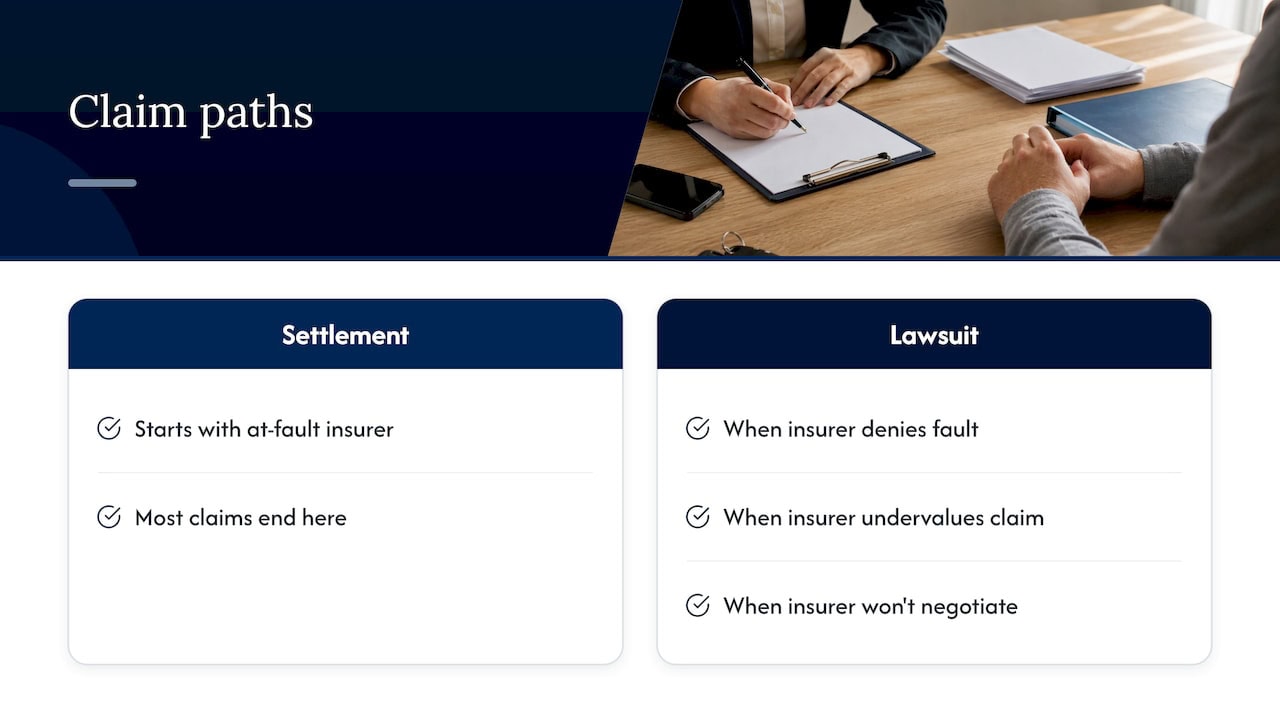
Most injured people never reach a courtroom. The majority of claims begin with the at-fault driver’s insurance company and end in a negotiated settlement. A lawsuit is the path when the insurer denies fault, undervalues the claim or will not negotiate in good faith.
Deadlines you cannot miss
Three years for most injury lawsuits
The statute of limitations for most personal injury lawsuits in New Mexico is three years from the date of injury, under NMSA § 37-1-8. Waiting is risky even inside that window, because evidence disappears. Surveillance video gets overwritten, witnesses move, and vehicle data can be lost when a car is repaired or sold.
If the other driver lives in another state, delay has an added cost: it takes longer to locate the person, identify the insurer and gather records. Starting early keeps the options open.
90 days if a government entity is involved
Sometimes a crash involves a city bus, a state vehicle or a dangerous road condition. In those cases, you generally must give written notice of the time, place and circumstances of the injury within 90 days. Nolo’s summary adds that this notice is not the same as filing a lawsuit. If a government vehicle or road might be involved, speak with an attorney right away.
What compensation can cover
A New Mexico injury claim can seek economic losses such as medical bills, lost income and vehicle repair, along with non-economic losses such as pain and suffering. According to the same state summary, New Mexico does not cap non-economic damages in most ordinary personal injury cases, though exceptions exist for specific claim types such as medical malpractice or certain government-related cases.
For a visitor, the practical losses add up quickly: a flight home, missed work in your home state, follow-up care back home and a rental car. Keep records of all of them.
A practical checklist for visitors and residents
- Get the crash report number and ask how to obtain the report once it is filed.
- Keep your plates and photos: capture the other vehicle’s plate and state.
- Notify your own insurer quickly, as some policies set short notice windows.
- Keep treatment records from both New Mexico and your home state.
- Do not give a recorded statement to the other driver’s insurer before you understand your rights.
- Do not sign a release until you know the full scope of your injuries.
- Talk to a New Mexico injury attorney before settling.
Our perspective
Out-of-state crashes feel overwhelming because everything seems to be somewhere else: the other driver, the insurer, your doctors and your job. The good news is that the legal core of the claim is local. The crash happened on a New Mexico road, so New Mexico’s fault rules and deadlines are the starting point.
At Keller & Keller, we are a family-run firm, and we built our practice around clear communication and direct access to attorneys and paralegals throughout the process. We have handled thousands of cases against large insurance companies, and we know how they respond when a claimant lives far away: they hope distance will make you tired, quiet or willing to take less.
Our advice is to document everything early, get treated and talk to a lawyer before you give a statement or accept an offer. We handle cases on a contingency fee, so there is no fee unless we win, and the first evaluation is free.
Adam
Free help after an accident in Albuquerque or anywhere in New Mexico
If you or a family member was hurt in a crash involving an out-of-state driver, we can review what happened, explain how New Mexico law applies and tell you what to do next. Our case evaluation is free, and our contingency fee means you pay nothing unless we win your case. We also work with clients who have returned to another state after the crash.

Request your free case evaluation and tell us about your crash. You can also read our guide to New Mexico auto accident claims before you call.
FAQ
Is New Mexico a no-fault state for car insurance?
No. New Mexico is an at-fault state, so the driver who caused the crash is responsible for the resulting losses. Under pure comparative negligence, your compensation is reduced by your own percentage of fault, but you can still recover when you share blame.
What happens if I am in an accident in another state?
The law of the state where the crash occurred ordinarily governs the injury claim. Your own policy typically still covers you across the country, and you should report the crash to your insurer promptly. Document the scene, get treatment and consider speaking with a local attorney.
What is the statute of limitations for a car accident in New Mexico?
For most personal injury lawsuits it is three years from the date of injury. If a government agency may be responsible, written notice is generally required within 90 days. Because these deadlines can be strict, speak with an attorney as soon as you can.
Can I file a claim in New Mexico if the other driver lives in another state?
Often, yes. A crash in New Mexico is a strong connection to the state, and the injury claim is ordinarily governed by New Mexico law. The best place to proceed depends on the specific facts, which an attorney can review with you.
Sources
- What to Do After a Car Accident, AAA Insurance
- New Mexico Office of the Superintendent of Insurance, auto insurance tip of the month (April 2022)
- Valencia v. Colorado Casualty Insurance, U.S. District Court for the District of New Mexico
- Wilkeson v. State Farm Mutual Automobile Insurance, New Mexico Court of Appeals
- Personal Injury Laws in New Mexico: Deadlines, Fault Rules
- New Mexico state summary, ALFA International
- Multi-State Car Insurance: Out-of-State Coverage, Progressive
- Form 05-NM Personal Car Policy (March 2026)
- New Mexico Car Accident Statute of Limitations, Nolo
- New Mexico Personal Injury Laws and Deadlines to File a Case, Nolo