
Indiana property owners can be held liable for an injury on their land when the injured person qualifies as an invitee or licensee, the owner had actual or constructive notice of the hazard, and the danger was reasonably foreseeable. Indiana also follows a comparative fault rule that can reduce or completely bar your recovery if you share responsibility, with recovery barred if your fault exceeds half the total fault. If you were hurt on someone else’s property, preserve evidence immediately and confirm your filing deadline before it passes.
TL;DR:
- Property owners are liable only if they knew or should have known about the hazard and could have reasonably fixed or warned about it.
- Evidence such as timestamped photos, witness contact information, and surveillance footage preservation requests are crucial to proving notice and fault.
- Indiana law reduces damages if the injured person’s fault exceeds 50 percent, making timely evidence collection essential for a strong claim.
- The duty owed varies by visitor type: invitees receive the highest care, while trespassers, especially children, have limited protection.
- The most common defenses include the hazard being open and obvious, lack of notice, and the injured person’s comparative fault.
Table of Contents
- Visitor Categories and the Duty a Property Owner Owes You
- How You Prove a Premises Liability Claim in Indiana
- Common Defenses and What Indiana Case Law Shows
- Damages You Can Recover and Indiana’s Filing Deadlines
- What to Do Right After a Premises Injury
- Why This Guide Reflects Real Indiana Practice
- The Part of This Law Most People Get Wrong
- How Keller & Keller Can Help With Your Indiana Claim
- Statutes and Court Opinions Cited in This Guide
- Sources
- FAQ
Visitor Categories and the Duty a Property Owner Owes You
Indiana law sorts injured visitors into three categories, and your category largely decides what the property owner owed you. An invitee, someone like a store shopper or a customer at a restaurant, is owed the highest duty: reasonable care to keep the premises safe. A licensee, such as a social guest invited into a home, is owed a duty to be warned of known dangers. A trespasser generally receives the least protection, though Indiana law carves out a meaningful exception for children.
The controlling standard comes from Burrell v. Meads, which holds that a possessor of land is liable to an invitee only when the possessor knew or, through reasonable care, would have discovered the condition, should have recognized it as an unreasonable risk, should have expected the invitee would not discover or protect against it, and then failed to act reasonably.
Two statutory wrinkles matter here:
- Nonprofit religious organizations can carry a narrower duty when the premises are used mainly for worship, which limits some claims against churches.
- Indiana’s attractive nuisance exception can extend a landowner’s duty to child trespassers when a hazard is likely to draw a child’s attention, even though adult trespassers receive far less protection.
How You Prove a Premises Liability Claim in Indiana
Winning a premises case means proving five connected elements, and each one needs its own supporting evidence.
- Control or possession: the defendant must have controlled the area where you were hurt, since a landlord, tenant, or contractor may each bear responsibility depending on who managed that space.
- Notice: you need either actual notice, meaning documented prior complaints or repair requests, or constructive notice, meaning the hazard existed long enough that a reasonable inspection should have caught it.
- Foreseeability: the danger has to be one the owner should have anticipated, which ties directly into their duty to inspect and correct known risks.
- Unreasonable danger: the condition must have posed a risk beyond what a visitor would reasonably expect.
- Causation and damages: the hazard has to be the actual cause of your specific injury and losses.
Indiana courts frequently decide these cases on the notice element alone. In the Griffin v. Menard matter, courts examined whether the store had actual or constructive knowledge of the hazard, and a lack of that evidence is often what defeats a claim at summary judgment.
Start gathering proof the same day: date-stamped photos of the hazard, names and phone numbers of witnesses, any maintenance logs you can request, a written surveillance preservation request sent to the property, and your medical records documenting the injury.
Pro Tip: Send a written request asking the property owner to preserve surveillance footage within days of the incident. Many systems overwrite footage automatically within a few weeks.

Common Defenses and What Indiana Case Law Shows
Property owners rarely concede fault outright, and three defenses show up repeatedly in Indiana premises cases.
- Open and obvious danger: the defense argues the hazard was so apparent that you should have avoided it, but Indiana courts have pushed back when the danger was foreseeable despite being visible, since the law centers on the landowner’s duty to anticipate risk rather than a visitor’s duty to scan for every hazard.
- Comparative fault: Indiana assigns a fault percentage to each party, and Indiana Code IC 34-51-2 reduces your award by your percentage of fault and bars recovery entirely once your fault exceeds 50%.
- Lack of notice: as discussed above, the absence of documented prior complaints or a short exposure time for the hazard often wins the case for the defense.
Indiana courts have recognized that res ipsa loquitur can apply in premises cases when the injuring instrumentality, such as a fixture, was under the defendant’s exclusive control and the incident would not typically happen without negligence, as discussed in Isgrig v. Trustees of Indiana University. This doctrine gives injured visitors a narrow but real path forward even without direct proof the owner knew about the defect beforehand.
Damages You Can Recover and Indiana’s Filing Deadlines
A successful premises claim can recover several categories of loss, and the mix depends on the severity of your injury.
- Medical expenses, both past bills and projected future treatment.
- Lost wages and diminished earning capacity if the injury affects your ability to work.
- Pain and suffering and other noneconomic harm.
- Punitive damages, though these are reserved for cases involving particularly reckless or intentional conduct rather than ordinary negligence.
Indiana’s personal injury statute of limitations gives most claimants a limited window from the date of injury, and missing it typically ends your case regardless of how strong the underlying facts are. Remember that comparative fault under IC 34-51-2 reduces your recovery proportionally, and any fault finding above 50% eliminates your award entirely.
What to Do Right After a Premises Injury
The steps you take in the first days after an injury often determine whether a claim survives.
- Get medical care first and keep every record and bill, since these documents anchor your damages claim later.
- Document the scene immediately: take timestamped photos, get names and numbers from witnesses, and hold onto the shoes or clothing you were wearing, since these can matter for a slip and fall injury.
- Ask for an incident report and request that surveillance footage be preserved, and write down exactly what a manager or staff member told you while it is fresh.
- Bring your evidence to a free case evaluation and ask direct questions: What is my filing deadline? What defenses will the property owner likely raise? What is a realistic damages range? What evidence is missing from my file? What are the next steps? How does your fee structure work?
Pro Tip: Write down conversations with staff or management as soon as you can. Memory fades fast, and a contemporaneous note carries far more weight than a recollection made months later.
Why This Guide Reflects Real Indiana Practice
Keller & Keller is a personal injury firm serving Indiana, Michigan, and New Mexico, and premises liability, including slip and fall cases, is one of the practice areas the firm handles directly. The firm’s Indiana slip and fall resources and related posts on attractive display hazards and parking garage injuries reflect the fact patterns attorneys see repeatedly: notice disputes, contested fault percentages, and evidence that goes missing without a preservation request. None of this guarantees an outcome in any individual case, but it grounds the explanations above in how these claims actually get litigated in Indiana.
The Part of This Law Most People Get Wrong
The biggest misconception about Indiana premises liability is that visible danger automatically defeats a claim. Readers assume that if a hazard was obvious, they have no case, and property owners lean on that assumption constantly. Indiana law does not work that way. The real question is whether the danger was foreseeable and whether the owner had a reasonable chance to fix or warn about it, not whether a photograph after the fact makes the hazard look easy to spot.
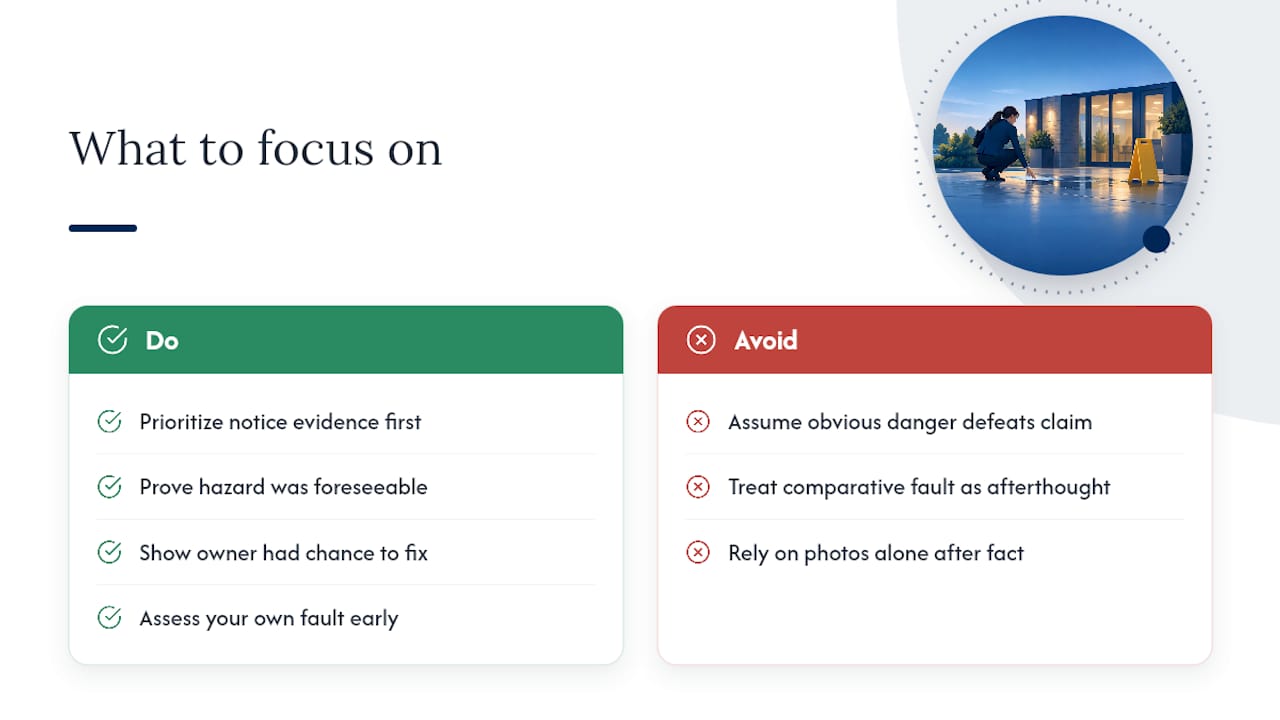
The second mistake is treating comparative fault as an afterthought. Many injured people focus entirely on proving the property owner’s negligence and never consider how their own conduct will be scored, yet that percentage can eliminate an otherwise solid claim once it crosses the halfway mark.
If you take one thing from this guide, prioritize the notice question before anything else. Whether the owner knew or should have known about the hazard decides more Indiana premises cases than any other single fact, and it is the first thing worth nailing down with real evidence, not assumptions.
— Adam
How Keller & Keller Can Help With Your Indiana Claim
The firm handles Indiana premises liability claims on a contingency basis, meaning there is no fee unless compensation is recovered. A free case evaluation can help you understand where your claim stands and what evidence is relevant, such as photos of the hazard, medical records, incident reports, and witness information.

Attorneys and paralegals work directly with clients throughout the process, drawing on experience handling cases against insurance companies. If you were hurt on someone else’s property in Indiana, you can start with a free case evaluation to find out where you stand.
Statutes and Court Opinions Cited in This Guide
- Indiana Code IC 34-51-2: comparative fault and the rule barring recovery above 50% fault.
- Burrell v. Meads / Griffin v. Menard opinion: duty owed to invitees and the role of notice.
- Isgrig v. Trustees of Indiana University: res ipsa loquitur in fixture cases.
- IC 34-31-11-3: trespasser duties and the attractive nuisance exception.
- Cornell Law Wex, invitee definition: plain-language visitor classification reference.
This article is general information, not a substitute for advice from a qualified lawyer. Consult a qualified legal professional about your own circumstances before acting on anything here.
Sources
- Indiana Code — Title 34, Article 51, Chapter 2 (2026)
- Indiana Code Title 34 § 34-31-11-3 — FindLaw
- Walter and Candus Griffin v. Menard, Inc. — Indiana courts opinion (discussing Burrell duty and notice evidence)
- Isgrig v. Trustees of Indiana University — res ipsa loquitur in premises liability (2025)
- Invitee — Wex Legal Dictionary, Cornell Law
FAQ
What does premises liability cover?
Premises liability covers injuries caused by a dangerous condition on someone else’s property, such as a wet floor, broken stairway, or poor lighting that leads to an attack or fall. It applies to commercial, residential, and public properties, and liability depends on the owner’s knowledge of the hazard and your status as a visitor.
Is a premises a liability?
A premises itself is not a liability. Premises liability is the legal theory that holds a property owner responsible when a dangerous condition they knew about, or should have discovered, causes an injury to a visitor.
What are some examples of premises liability cases?
Common examples include slip and fall accidents from spills or ice, injuries from inadequate security in apartment complexes or parking structures, dog bites on the owner’s property, and injuries from unmarked hazards in stores or restaurants. Cases involving parking garages often turn on lighting, maintenance, and security decisions the property manager made.
What’s the difference between premises liability and general liability?
Premises liability is a specific legal claim about an injury caused by a dangerous property condition. General liability, by contrast, refers to a broader category of business insurance coverage that may or may not respond to a premises claim depending on the policy terms and who is being sued.