
Yes, a missed or delayed diagnosis can support a medical malpractice lawsuit, but only when you can prove four things: the doctor owed you a duty of care, breached that duty, caused your harm, and left you with real damages. Causation, showing that an earlier diagnosis would have changed your outcome, is usually the hardest piece to prove. If you suspect a missed diagnosis hurt you or a family member, secure your complete medical records now, write down your symptoms and timeline while they’re fresh, and talk to a malpractice attorney before any deadline passes.
TL;DR:
- Proven causation is the most difficult element to establish and often determines the success of a missed diagnosis malpractice case.
- Timeliness is crucial, especially for conditions like stroke or sepsis, where hours can mean the difference between full recovery and permanent damage.
- Gathering complete medical records and expert opinions on standard care and causation are essential steps to build a strong case.
- Most malpractice claims fall apart if causation is not convincingly proved, as defenses focus on arguing that diagnosis delay wouldn’t have changed the outcome.
- State-specific deadlines and procedural requirements, such as expert affidavits or review panels, can dismiss a case if overlooked or missed.
Table of Contents
- What Legally Counts as a Missed Diagnosis Lawsuit Claim
- Duty, Breach, Causation, Damages: The Four-Part Test
- Deadlines That Can Kill Your Malpractice Claim Before It Starts
- The Evidence You Need to Prove Your Case
- How Damages and Settlement Values Get Calculated
- Conditions That Drive the Most Failure-to-Diagnose Claims
- What Happens After You File: The Legal Process, Step by Step
- Choosing the Right Attorney and What to Bring to Your First Meeting
- 2keller’s Experience Handling Missed Diagnosis Claims
- The Part of This Process Most Guides Get Wrong
- Get a Free Case Review From 2keller
- Sources
What Legally Counts as a Missed Diagnosis Lawsuit Claim
Not every bad outcome is malpractice, and not every diagnostic mistake gives you grounds for a missed diagnosis lawsuit. Doctors misjudge ambiguous symptoms sometimes even when they’ve done everything a competent physician should do. The law only steps in when a reasonably careful clinician, faced with the same information, would have diagnosed the condition and acted differently.
Diagnostic errors generally fall into three categories, and the distinctions matter for how a case gets built:
- Misdiagnosis happens when a doctor identifies the wrong condition entirely, treating a heart attack as acid reflux, for example.
- Delayed diagnosis means the correct diagnosis eventually gets made, but too late to prevent avoidable harm.
- Failure to diagnose occurs when a condition is missed altogether, often surfacing only after a patient seeks care elsewhere.
Diagnostic errors are far more common than most people assume. Roughly 12 million adults experience a diagnostic error in outpatient care every year in the United States, and errors in emergency departments alone contribute to an estimated 250,000 or more deaths annually. That scale doesn’t mean every error is actionable, but it does mean the legal system has had to draw careful lines around which mistakes qualify. Timing changes everything for conditions like stroke, sepsis, or a heart attack, where a few hours can separate a full recovery from permanent damage.
Duty, Breach, Causation, Damages: The Four-Part Test
Every failure to diagnose lawsuit rests on the same legal skeleton, and skipping any one piece sinks the case.
- Duty: A doctor-patient relationship establishes the physician’s legal obligation to provide competent care. This part is rarely contested once treatment has begun.
- Breach: This is where the file gets built. Ordering the wrong tests, ignoring an abnormal lab value, or failing to refer a patient to a specialist can all show a deviation from the accepted standard of care.
- Causation: You must show the delay or error actually made things worse, not just that it happened. Some states apply the “lost-chance” doctrine, allowing recovery when negligence reduced your odds of a better outcome, even if a perfect diagnosis wasn’t guaranteed to save you.
- Damages: Medical bills, lost income, and future care costs count as economic damages. Pain, suffering, and diminished quality of life count as non-economic damages.
Statistic Callout: Proving malpractice legally requires evidence across all four elements, and nearly every failure-to-diagnose case leans on expert testimony to establish that breach and causation actually occurred.
Deadlines That Can Kill Your Malpractice Claim Before It Starts
Every state sets its own statute of limitations for medical malpractice, and most windows run somewhere between one and three years from the date of injury. Delayed-diagnosis cases complicate that timeline, because patients often don’t realize they were harmed until well after the original appointment. That’s where the discovery rule comes in: it can start the clock from when you reasonably discovered the injury rather than when it happened.
A few procedural traps catch injured patients off guard every year:
- Statutes of repose set an absolute outer deadline, sometimes regardless of when you discovered the harm, and they override the discovery rule in many states.
- Certificate-of-merit requirements apply in roughly half of U.S. states, forcing plaintiffs to file an expert affidavit confirming the claim has medical merit before the case proceeds.
- Pre-suit notice or medical review panels require certain administrative steps, like Indiana’s, before a lawsuit can move forward in court.
Because these rules vary sharply by state, including deadlines specific to jurisdictions like Michigan, checking your state’s exact requirements immediately is not optional. Miss one, and your case can be dismissed regardless of how strong the underlying facts are.
The Evidence You Need to Prove Your Case
Building a missed diagnosis lawsuit comes down to reconstructing exactly what your doctors knew, and when. That means gathering a specific set of documents and testimony, in this order:
- Complete medical records from every provider you saw, not just the one you’re focused on. Primary care, urgent care, and specialist visits all matter.
- Imaging and lab reports, including the raw results, not just the summary notes attached to them.
- Referral notes and portal messages, which often reveal whether a doctor recognized a red flag and failed to act on it.
- A qualified medical expert’s opinion on both the standard of care and causation. Without this, causation is nearly impossible to prove in court.
Gaps in the record aren’t always bad news. Missing documentation can actually work in your favor, since it sometimes points to a provider who skipped steps they should have taken.
Pro Tip: Request your records in writing and keep a copy of every request. If a provider drags its feet or a file mysteriously goes missing, that delay itself can become relevant evidence, sometimes called a spoliation issue, in your case.
How Damages and Settlement Values Get Calculated
Damages in a missed diagnosis case split into two buckets. Economic damages cover past and future medical bills, lost wages, and the cost of any additional treatment your delayed diagnosis made necessary. Non-economic damages cover pain, suffering, and the loss of enjoyment of life, harder to quantify, but no less real.
In lost-chance jurisdictions, damages get adjusted proportionally. If a jury finds that an earlier diagnosis would have given you a 40% better chance of survival, your recovery may reflect that percentage rather than the full value of the harm.
- Settlement ranges vary enormously by severity and state law, but reported outcomes commonly span from low six figures to multi-million dollar verdicts in the most severe cases.
Statistic Callout: That wide range exists because a missed early-stage cancer diagnosis and a missed diagnosis that led to permanent disability produce very different damages calculations, even when the underlying negligence looks similar on paper.
Conditions That Drive the Most Failure-to-Diagnose Claims
Certain conditions show up again and again in diagnostic-error litigation, largely because timing has an outsized effect on outcomes.
- Cancer cases often turn on staging. A tumor caught at Stage 1 versus Stage 3 can mean the difference between a curative treatment plan and a terminal prognosis.
- Heart attacks and strokes depend on narrow intervention windows, sometimes just a few hours, where clot-busting or surgical treatment can prevent permanent damage.
- Sepsis and serious infections can progress from treatable to life-threatening within hours, making rapid recognition critical.
- Radiology and pathology errors, a missed nodule on a scan or a mislabeled biopsy sample, often represent a breakdown in the diagnostic chain rather than a single doctor’s judgment call.
What Happens After You File: The Legal Process, Step by Step
Once you retain an attorney, a missed diagnosis lawsuit typically follows a predictable sequence, even though timelines vary by state and case complexity.
- Intake and records collection. Your attorney gathers every relevant medical record and often consults a medical expert early to assess whether the case has merit.
- Pre-suit requirements. Depending on your state, this may include a certificate of merit, expert affidavit, or a mandatory review panel before filing in court.
- Filing and discovery. Both sides exchange evidence, take depositions of treating physicians, and retain expert witnesses to testify on standard of care and causation.
- Settlement negotiations or mediation. Most malpractice claims resolve before trial, often after both sides see the strength of expert testimony.
- Trial, if no settlement is reached. Malpractice trials can take a year or more to reach a verdict, layered on top of the months or years discovery already consumed.
Full resolution, from initial filing to settlement or verdict, commonly takes one to three years, longer in complex cases involving multiple defendants.
Choosing the Right Attorney and What to Bring to Your First Meeting
Not every personal injury lawyer handles failure-to-diagnose claims well. Look for trial experience specifically in diagnostic-error cases and a track record of working with credible medical experts, since your entire case hinges on that testimony.
- Ask directly about contingency fee structure, expected timeline, and how the firm handles expert witness costs.
- Bring every medical record you can access, itemized medical bills, employment and pay records showing lost income, and a written symptom journal if you kept one.
- Watch for red flags: any attorney who guarantees a specific outcome before reviewing your records, or who can’t name a medical expert they’ve worked with, is not being straight with you.
Pro Tip: Bring your records to the first consultation even if the firm offers to request them. Attorneys can often spot a promising breach-of-duty issue within minutes of seeing raw lab or imaging results.
2keller’s Experience Handling Missed Diagnosis Claims
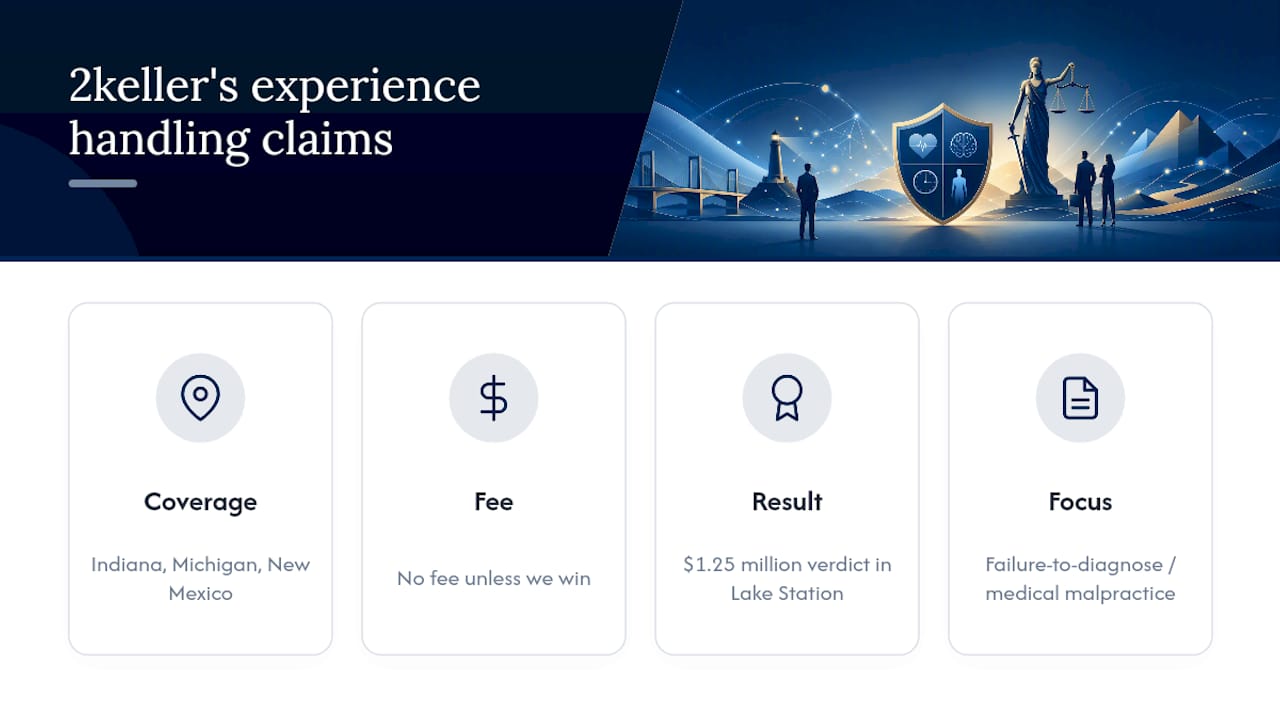
2keller has represented injured patients and families across Indiana, Michigan, and New Mexico on a contingency-fee basis, meaning no fee unless we win your case. Our team has secured results in serious medical malpractice matters, including a $1.25 million verdict in a Lake Station case involving preventable medical harm. For more on how diagnostic errors play out legally, see our breakdown of failure-to-diagnose claims.
The Part of This Process Most Guides Get Wrong

Most guides on this topic treat causation as a formality, a box to check after establishing breach. That’s backward. In failure-to-diagnose cases, causation is usually the entire fight. A hospital’s defense team will rarely argue their doctor followed perfect protocol; they’ll argue that even a timely diagnosis wouldn’t have changed your outcome. That argument wins more often than injured patients expect.
The conventional advice to “gather your records and call a lawyer” is correct but incomplete. Records matter less for what they show happened than for what they reveal about timing, specifically, how long a red flag sat unaddressed before someone acted. If you’re evaluating whether you have a case, spend less energy trying to prove the doctor was wrong and more energy pinning down exactly when they had the information to be right. That single distinction, more than any statistic about verdict size, determines whether a claim survives expert review.
Adam
Get a Free Case Review From 2keller
If a missed or delayed diagnosis harmed you or someone you love, 2keller offers a free case review with no upfront cost and no fee unless we recover compensation for you. We handle missed diagnosis lawsuits and other medical malpractice claims across Indiana, Michigan, and New Mexico on a contingency basis, so pursuing accountability doesn’t add financial risk to an already difficult situation.

Bring what you have: medical records, billing statements, and any notes you kept on symptoms or timelines. If you’re missing records, our team can help track them down. Learn more about what qualifies as a serious injury claim and how compensation gets calculated, or reach out directly to start your free consultation and find out where your case stands.
Sources
Diagnostic-error frequency and causation standards referenced above come from peer-reviewed analyses on outpatient and ER diagnostic errors and malpractice causation. Condition-specific facts on heart disease draw from CDC data. Always confirm your state’s specific statute of limitations and pre-suit requirements with a licensed attorney before relying on general guidance.
This article is general information, not a substitute for advice from a qualified lawyer. Consult a qualified legal professional about your own circumstances before acting on anything here.