
At your SSDI hearing, an Administrative Law Judge will focus on three areas: your personal background, your medical condition and treatment, and how your daily functioning affects your ability to work. Most hearings run 30 to 60 minutes. New evidence generally needs to reach the file several days beforehand. Answer with specifics, stay consistent with your medical records, and you put yourself in a strong position.
TL;DR:
- Providing concrete details such as exact distances, times, and medication effects strengthens your credibility and aligns your testimony with medical records.
- Answering with specific numbers and honest variability helps the judge accurately assess your residual functional capacity and daily limitations.
- Submitting new evidence at least five business days before the hearing improves its chances of being considered and prevents delays or exclusion.
- Consistency between your oral testimony and medical records is critical, and contradictions can weaken your case even if unintentional.
- Practice describing daily activities out loud using a structured format to deliver clear, measurable testimony that supports your claim effectively.
Table of Contents
- Ssdi Hearing Questions Judges Ask Most Often
- How To Answer SSDI Hearing Questions With Confidence
- Hearing Logistics, Deadlines, And What To Bring
- Credibility Pitfalls That Can Sink An Otherwise Strong Case
- ALJ Questions Versus Vocational Expert Questions
- Tricky Questions That Catch Claimants Off Guard
- Preparing For Your Hearing Without Overrehearsing
- Your Rights To Pause, Clarify, Or Take A Break
- Sample Answers You Can Adapt To Your Own Case
- Submitting New Evidence During Or Before The Hearing
- What We See In Hearing Prep That Actually Moves The Needle
- How Keller & Keller Prepares Clients For SSDI Hearings
- Where To Verify These Rules Yourself
- Sources
Ssdi Hearing Questions Judges Ask Most Often
Every ALJ runs the hearing a little differently, but the underlying structure rarely changes. Judges organize their questions into three buckets: who you are, what’s medically wrong with you, and how that translates into daily limits. Understanding this structure ahead of time turns a nerve-wracking unknown into something you can actually rehearse.
Personal background and identity questions come first, almost like a warmup. They feel simple, but the judge is also listening for your baseline clarity and memory.
- Please state your full name, date of birth, and Social Security number for the record.
- What is your current height and weight?
- Who do you live with, and do you own or rent your home?
- Do you currently hold a valid driver’s license, and do you still drive?
- How far did you go in school, and did you complete any vocational training?
Medical condition and treatment questions make up the core of the hearing. The judge already has your file, so these questions test whether your testimony lines up with what your doctors documented.
- What conditions do you believe prevent you from working?
- When were you first diagnosed, and by which doctor?
- Have you been hospitalized for this condition, and if so, when and for how long?
- What medications do you currently take, and what side effects do you experience?
- Do you attend all scheduled appointments, and if you’ve missed any, why?
That last question matters more than claimants expect. Gaps in treatment without a good explanation, like lack of insurance or a medication that worked, can undercut an otherwise strong case.
Daily activities questions ask you to walk through an ordinary day in granular detail. This is where vague answers hurt claimants the most.
- Walk me through how you get dressed and bathe in the morning.
- Who does the grocery shopping, cooking, and cleaning in your household?
- Describe a good day versus a bad day. How often does each happen in a typical week?
- Do you use a cane, walker, or other assistive device, and was it prescribed?
- How long can you sit, stand, or walk before you need to stop or change position?
Work history questions establish what you used to be capable of and why that’s no longer true. The judge is building toward a residual functional capacity, or RFC, finding, which is the legal term for what you can still physically and mentally do despite your impairments.
- What was your job title, and what were your main duties day to day?
- How much did you typically lift, and how often did you stand versus sit?
- Why did you stop working, and when was your last day?
- Have you attempted to return to work since then, even part time?
- What specific tasks from your old job do you believe you could no longer perform?
These four categories drive nearly every question you’ll hear, and they tie directly back to how the judge measures consistency between your testimony and your medical record.
How To Answer SSDI Hearing Questions With Confidence
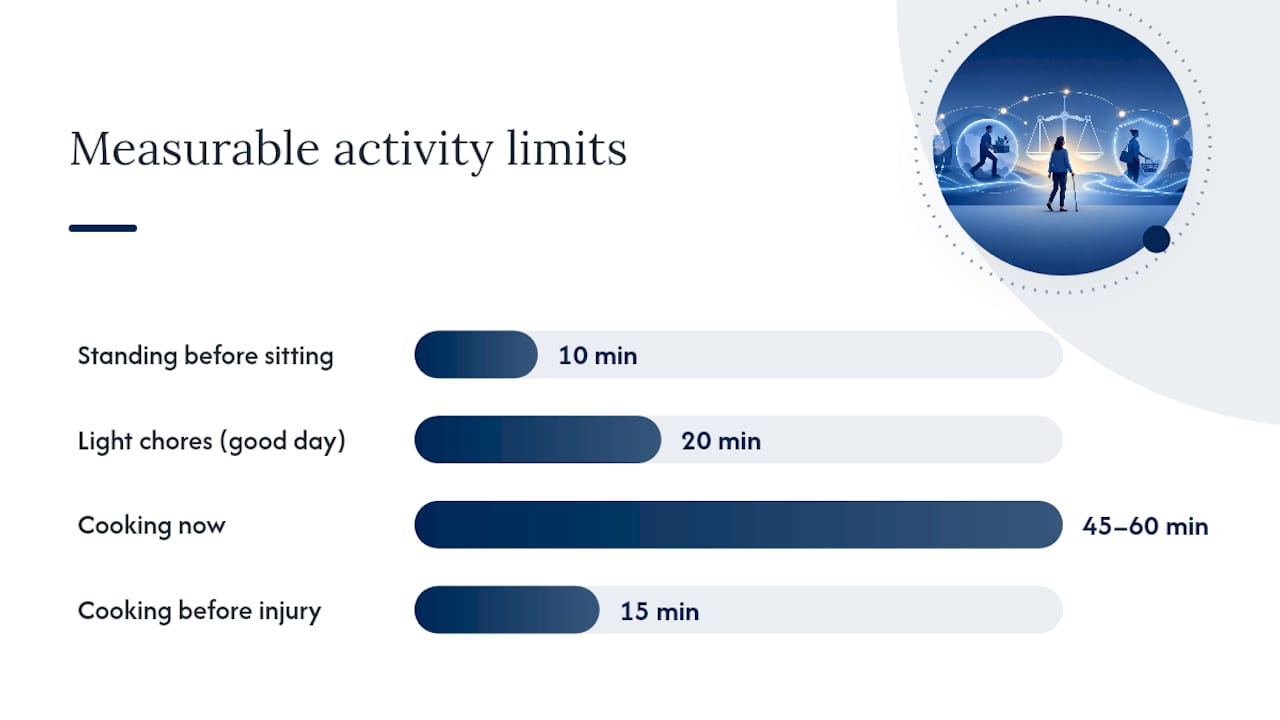
Vague answers are the single biggest self-inflicted wound at a disability hearing. “I can’t stand for long” tells the judge almost nothing. “I can stand for about ten minutes before my back pain forces me to sit down” gives the judge something concrete to weigh against your medical file.
- State the limit, then attach a number. Instead of “I have trouble walking,” say “I can walk about half a block, maybe 150 feet, before I need to stop and rest.”
- Use time, distance, and weight whenever possible. Judges are trained to translate your words into an RFC. If you say “a little” or “sometimes,” you’re forcing them to guess.
- Explain variability honestly. Most chronic conditions fluctuate. Say something like, “On a good day I can manage light chores for maybe 20 minutes at a time. On a bad day, which happens two or three times a week, I can barely get out of bed.”
- Name your coping strategies. If you rest between steps, use a shower chair, or need a family member to carry groceries, say so directly. It shows the limitation is real, not exaggerated.
- Reference your records when it helps you. If a judge asks about a symptom you know is documented, you can say, “That’s consistent with what I told Dr. Martinez in March, it’s in my chart.”
- When you’re not sure, say so. “I don’t remember the exact date” is a far better answer than guessing wrong and creating a discrepancy your representative later has to explain.
Pro Tip: Practice describing one activity out loud, like cooking dinner, using the format: what you do, how long it takes, what help you need, and how you feel afterward. Once you can do that for one task, you can do it for all of them.
A model answer sounds like this: “I can cook a simple meal if someone brings the ingredients and I sit on a stool between steps. It takes me 45 to 60 minutes for something that used to take 15, and I need to rest afterward.” That single sentence gives the judge duration, frequency, and the accommodation you need, which is exactly the kind of specific, measurable testimony that holds up.
Hearing Logistics, Deadlines, And What To Bring
The Social Security Administration typically sends your hearing notice at least 75 days before the scheduled date, giving you time to prepare and, if needed, request a change of venue or a video hearing instead of an in-person one. Any new written evidence needs to be submitted no later than five business days before the hearing, a rule SSA enforces fairly strictly unless you can show good cause for the delay.
Bring the following, organized so you can hand items to your representative without fumbling:
- A one-page summary of your medical conditions, treating providers, and treatment dates
- A current medication list with dosages and side effects
- A daily-activity diary covering at least two to four weeks, noting good days and bad days
- Any written statements from family members or former coworkers describing your limitations
- Government-issued photo identification
- A copy of your exhibit list if your representative provided one
The hearing itself follows a set format. The judge places you under oath, takes your testimony, questions you directly, and often brings in a vocational expert before allowing your representative to ask follow-up questions or make a closing statement. Hearings are informal in tone but are recorded, and everything you say becomes part of the official record.
Credibility Pitfalls That Can Sink An Otherwise Strong Case
Absolute statements are the fastest way to lose credibility. If you tell the judge “I can’t do anything all day” and your file shows a recent trip to visit grandchildren three states away, that contradiction, even with a perfectly good explanation, creates doubt the judge has to resolve.
- Avoid blanket statements like “I never leave the house” unless it’s literally true.
- If you did something unusual, like attend a wedding or take a short trip, explain the context: how you managed it, what it cost you physically afterward, and whether you needed help.
- Never guess at a date or detail you don’t actually remember. “I’m not certain of the exact month” protects you far better than a wrong answer.
- If a question is confusing, ask the judge to rephrase it rather than answering something you didn’t fully understand.
Pro Tip: Judges look for functional consistency between what you say and what your records show, not perfection. An explained exception rarely hurts you. An unexplained contradiction almost always does.
ALJ Questions Versus Vocational Expert Questions
The Administrative Law Judge and the vocational expert (VE) ask fundamentally different types of questions, and knowing which is which helps you answer more effectively. The ALJ’s questions focus on your personal experience: your symptoms, your treatment history, and your account of a typical day. These are subjective, and the judge is weighing your credibility against the medical record.
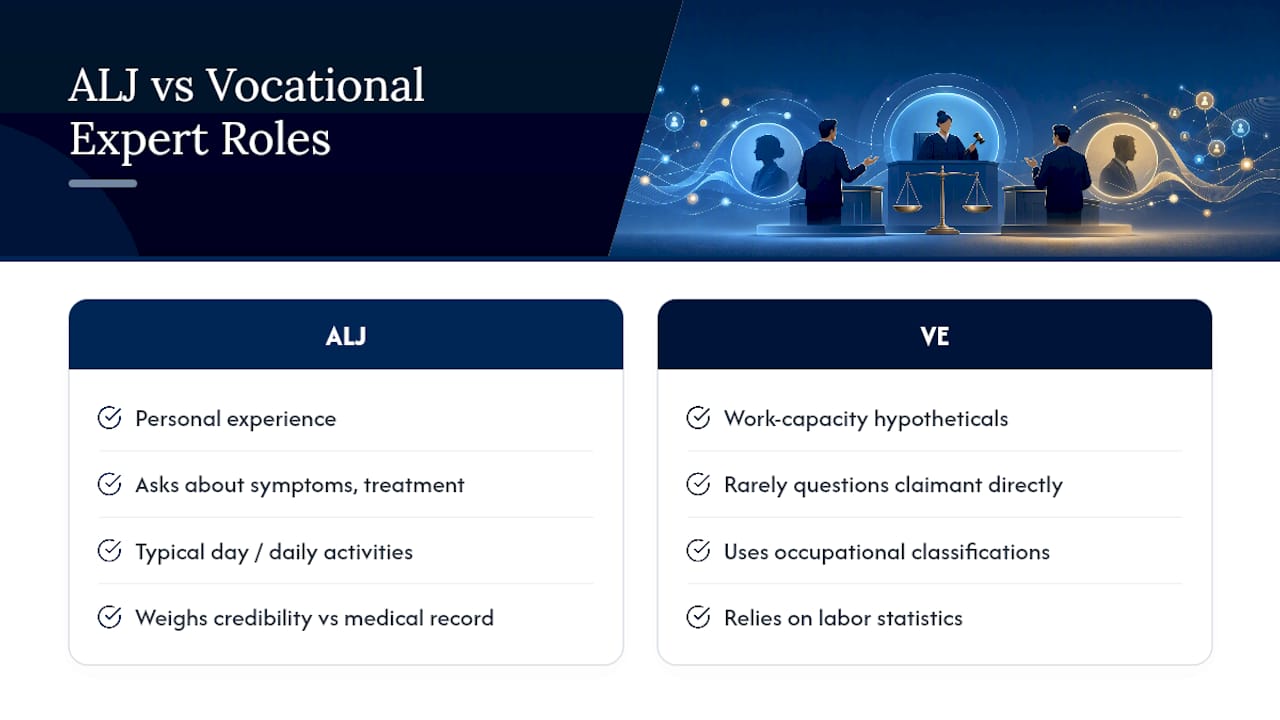
The vocational expert, by contrast, rarely questions you directly. Instead, the VE responds to hypothetical scenarios the judge poses, such as, “Assume a person of the claimant’s age and education who can lift no more than 10 pounds and must alternate between sitting and standing every 30 minutes. Could that person perform the claimant’s past work, or any other work in the national economy?” The VE then answers using occupational classifications and labor statistics.
You may get a chance to respond if your representative questions the VE afterward, often to challenge a hypothetical that doesn’t fully capture your limitations. This is one of the most technical moments in the hearing, and it’s also where an experienced representative earns their value, by making sure the hypothetical the judge relies on actually reflects your real restrictions rather than a generic version of them.
Tricky Questions That Catch Claimants Off Guard
Some questions aren’t designed to trip you up, but they function that way anyway because claimants don’t expect them. “Why haven’t you tried a more aggressive treatment?” can feel accusatory, but it’s often just the judge checking whether cost, access, or medical advice explains a treatment gap.
Another common one: “What do you do on a typical day?” This sounds harmless, but a rambling or overly upbeat answer can undercut months of medical evidence in thirty seconds. Judges also sometimes ask, “Have you looked for any kind of work, even part time?” A defensive answer here can read as evasive, even when the honest answer is simply that you knew you couldn’t sustain it.
Questions about hobbies and social media are increasingly common too. If you posted photos from a fishing trip, expect the judge or your representative to address it directly rather than let it sit unexplained. The goal isn’t to hide activity, it’s to give it accurate context: how long it lasted, what it cost you physically, and whether it’s representative of your typical capability.
Preparing For Your Hearing Without Overrehearsing
Preparation works best when it builds familiarity, not a memorized script. Judges hear rehearsed answers constantly, and overly polished testimony can actually read as less credible than a slightly imperfect but honest one.
Start by reviewing your own medical file, especially your most recent treatment notes, so nothing in it surprises you. Then rehearse describing three or four daily tasks using the duration, frequency, and assistance format covered earlier. Ask a family member to run through the personal background and work history questions with you out loud, since saying answers aloud exposes gaps that reading silently never will.
Review your activities of daily living form and disability report before the hearing so your spoken testimony matches what you wrote months earlier. Inconsistencies between paperwork and testimony are one of the most common credibility issues judges flag, and most of them are simply the result of memory drift rather than dishonesty.
Your Rights To Pause, Clarify, Or Take A Break
You have the right to ask the judge to repeat or rephrase a question you don’t understand. Judges expect this, and asking for clarification reads as careful, not confused. Never guess at what you think a question means, especially when it involves dates, dosages, or specific medical terminology.
You can also request a short break if you’re in pain, feeling overwhelmed, or need a moment to compose yourself. Hearings are recorded and formal, but they aren’t designed to wear you down, and a reasonable request for a pause is routine. If you’re represented, your attorney can ask for the break on your behalf, which often feels less intimidating than doing it yourself.
If English isn’t your first language or you have a hearing or speech impairment, you’re entitled to an interpreter or other accommodation, and this should be arranged well before the hearing date, not requested on the spot.
Sample Answers You Can Adapt To Your Own Case
Here’s how strong answers sound in practice, adapted to different question categories:
On pain and limitations: “My lower back pain is constant, usually a 6 out of 10, but it spikes to an 8 or 9 several times a week. When it spikes, I can’t stand for more than five minutes without needing to lie down.”
On daily activities: “I do light dusting for about ten minutes at a time, then I have to sit. My husband does all the vacuuming and laundry because I can’t lift the basket or stand long enough to fold clothes.”
On work capacity: “My old job required lifting up to 50 pounds regularly. Now I can’t lift more than about 8 to 10 pounds without sharp pain in my shoulder, so I don’t believe I could return to that role or anything similar.”
On medication side effects: “My pain medication makes me drowsy for two to three hours after I take it, so I try to time it around naps rather than during the day when I need to be alert.”
Each example gives the judge a number, a frequency, or a specific consequence, exactly the kind of detail that separates persuasive testimony from testimony the judge has to guess at.
Submitting New Evidence During Or Before The Hearing
New evidence should ideally reach your file well before the five-business-day deadline, since submitting it right at the wire risks the judge excluding it or needing to postpone. If you obtain new records, like a recent MRI or a specialist’s updated opinion, tell your representative immediately so it can be formatted and submitted properly.
Occasionally, evidence surfaces during the hearing itself, such as when a judge asks a question that reveals a gap in your file. If that happens, your representative can ask the judge for a short continuance to submit supplementing records, or request that the record remain open for a set number of days afterward. This is a normal part of the process, not a sign anything went wrong, and objective documentation like imaging results or a functional capacity evaluation from a treating provider tends to carry the most weight when it’s introduced this way.
Good cause exceptions to the five-day rule exist, covering situations like a provider’s delayed records release or a sudden hospitalization, but they require you to explain the delay to the judge rather than simply showing up with late paperwork.
What We See In Hearing Prep That Actually Moves The Needle
The claimants who do best at their hearing aren’t the ones with the most dramatic conditions. They’re the ones who can describe their limitations with specific numbers, consistent details, and honest acknowledgment of good days and bad days. That consistency between testimony and medical records is what an ALJ is actually measuring, and it’s learnable with the right preparation.
Hearings aren’t adversarial by design. The judge’s job is to apply the regulations governing disability review fairly, not to catch you in a lie. Preparation simply removes the guesswork so your real limitations come through clearly.
If you’re getting ready for a hearing and want a second set of eyes on your testimony or your file, reach out for a free initial review.
— Adam
How Keller & Keller Prepares Clients For SSDI Hearings
Walking into a disability hearing without representation means facing a judge, a vocational expert, and a technical process alone, often after already surviving one denial. Keller & Keller’s approach to SSDI hearings centers on the same principle covered throughout this guide: specific, well-documented testimony wins more often than vague testimony, and preparation is what makes that possible.

The intake process often starts with a free consultation where prior denials, current medical records, and potential gaps in a case are reviewed. Identification of missing elements before the hearing date, such as a treating physician’s functional statement, updated imaging, or a clearer activities-of-daily-living account, can help prevent surprises in front of the judge. If you’ve already been denied once, our breakdown of common reasons ALJs deny claims is worth reviewing before your next hearing.
Before you call, gather what you have: a list of your medical providers and treatment dates, your current medications, and a copy of any prior denial notice. From there, we work on a contingency basis, meaning there’s no fee unless we win your case. If you’re preparing for a hearing and want a free case evaluation, get started with Keller & Keller today.
Where To Verify These Rules Yourself
Confirm your own timelines directly with SSA’s official guidance: the hearing process overview covers notice and evidence deadlines, HALLEX I-2-6-1 details hearing procedure, and 20 CFR §404.900 governs your appeal rights.
This article is general information, not a substitute for advice from a qualified lawyer. Consult a qualified legal professional about your own circumstances before acting on anything here.