
Uninsured motorist (UM) coverage is defined as a mandatory protection under New Mexico auto insurance law that pays for your injuries and losses when the at-fault driver carries no insurance or insufficient coverage. Filing an NM uninsured motorist coverage claim is the legal mechanism that activates this protection. The New Mexico Office of Superintendent of Insurance regulates UM and underinsured motorist (UIM) policies, requiring insurers to offer this coverage to every policyholder. Understanding the claim process, documentation requirements, and common pitfalls gives you a real advantage when you need it most.
What does an NM uninsured motorist coverage claim cover?
NM uninsured motorist coverage protects you against two distinct financial threats: a driver with no insurance at all (UM) and a driver whose policy limits fall short of your actual losses (UIM). Both claim types fall under the same general framework, but they follow different procedures and timelines.

Bodily injury vs. property damage coverage
New Mexico UM policies cover bodily injury as a standard feature. This includes medical expenses, lost wages, pain and suffering, and long-term disability costs. Property damage under UM coverage is a separate election. You must specifically add uninsured motorist property damage (UMPD) to your policy, or you will rely solely on your collision coverage for vehicle repairs.
Policy limits and stacking
New Mexico law sets minimum UM coverage at $25,000 per person and $50,000 per accident for bodily injury. Most drivers carry higher limits, and the choice matters significantly when injuries are serious. New Mexico also permits “stacking,” which means you can combine UM limits across multiple vehicles on the same policy. If you insure three vehicles, each with $50,000 in UM coverage, stacking gives you up to $150,000 in available protection.
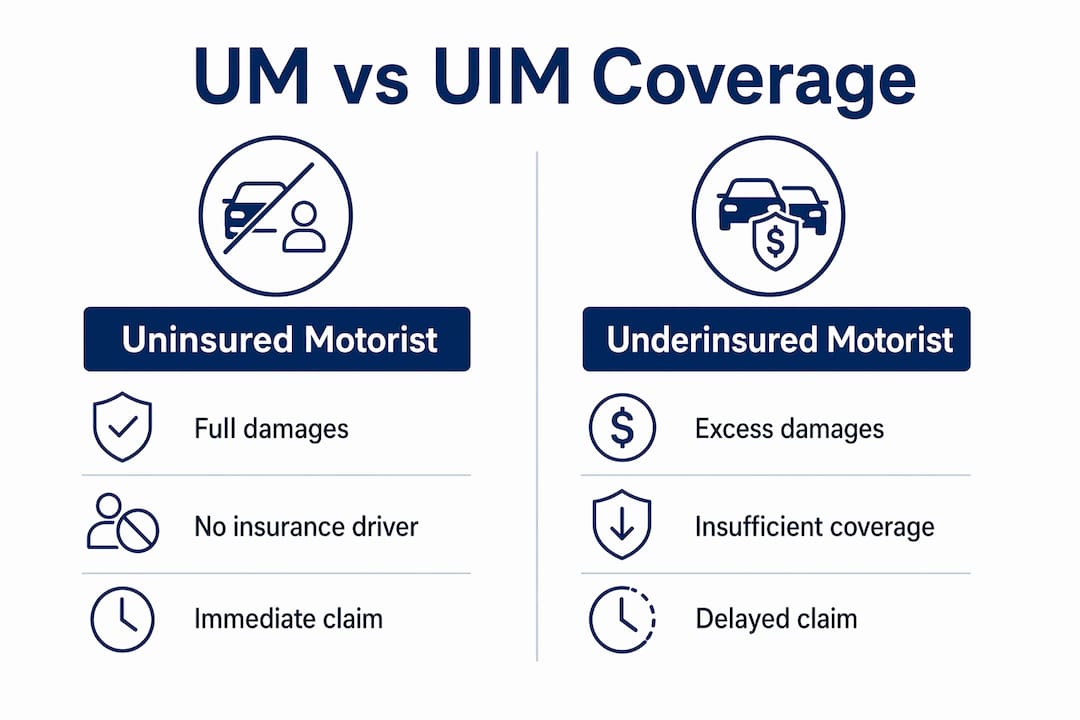
| Coverage Type | What It Pays | Key Distinction |
|---|---|---|
| Uninsured Motorist (UM) | Full damages when at-fault driver has no insurance | Filed directly with your own insurer |
| Underinsured Motorist (UIM) | Gap between at-fault limits and your actual losses | Requires exhausting at-fault policy first |
| UM Bodily Injury | Medical bills, lost wages, pain and suffering | Standard in all NM UM policies |
| UM Property Damage (UMPD) | Vehicle repair or replacement | Must be elected separately |
The difference between UM and UIM claims matters for timing. UIM claims require you to exhaust the at-fault driver’s policy before your own carrier steps in, which extends the resolution process considerably.
What documentation do you need before filing?
Thorough documentation is the foundation of a successful claim. Gaps in your evidence give insurers grounds to reduce or deny your payout.
- File a police report immediately. For hit-and-run accidents, insurance policies require a police report within 24–72 hours of the incident. Missing this window is one of the fastest ways to lose your claim.
- Obtain the official police report number. This document confirms the accident occurred and, in many cases, confirms the other driver’s uninsured status. Request a copy as soon as it is available.
- Gather all medical records and bills. Every treatment, prescription, and specialist visit must be documented. Gaps in treatment give adjusters ammunition to argue your injuries were not serious.
- Document lost wages. Collect pay stubs, employer letters, and tax records that establish your pre-accident income. Self-employed drivers should gather bank statements and client contracts.
- Collect witness statements. Names, contact details, and written or recorded accounts from bystanders strengthen your version of events.
- Keep a personal injury journal. Detailed documentation of daily pain levels, sleep disruption, and lifestyle limitations creates the narrative evidence that supports pain and suffering damages. Medical bills alone rarely capture the full human cost of an injury.
- Review your declarations page. Confirm your UM and UIM limits, check whether UMPD is included, and verify whether your policy allows stacking.
Pro Tip: Start your personal injury journal on the day of the accident, not weeks later. Adjusters and juries both notice when entries begin suspiciously late.
How to file your NM uninsured motorist claim step by step
The New Mexico UM claim process follows a defined sequence. Skipping steps or reordering them creates legal and financial risk.
- Notify your insurer immediately. New Mexico UM coverage requires notification as soon as practicable after the accident. Waiting too long gives your insurer grounds to deny the claim based on late notice.
- Submit a formal Notice of Claim. A verbal call is not enough. Follow up in writing and keep a copy of every communication.
- Do not give a recorded statement without legal advice. Insurance adjusters use recorded statements to identify inconsistencies and challenge your claim. Consulting an attorney before speaking protects your position.
- For UIM claims, exhaust the at-fault driver’s policy first. Your own carrier will not step in until the at-fault driver’s limits are fully paid out.
- Get written consent before settling any UIM claim. Settling with the at-fault driver’s insurer without your own carrier’s written consent can void your UIM benefits entirely. This step is non-negotiable.
- Negotiate the settlement. Submit a demand package with all medical records, wage loss documentation, and your injury journal. Your insurer will respond with an offer. Negotiation is normal and expected.
- Pursue arbitration or litigation if needed. When negotiations stall, New Mexico UM policies typically allow arbitration. Litigation remains an option if arbitration fails.
What to expect for timelines
| Claim Type | Typical Resolution | With Litigation |
|---|---|---|
| Uninsured Motorist (UM) | 3–9 months | Add 6–18 months |
| Underinsured Motorist (UIM) | 12–24 months | Add 6–18 months |
UIM claims take longer because they require the at-fault driver’s claim to resolve first. Understanding this timeline helps you plan financially and emotionally for the road ahead.
Pro Tip: Send all insurer communications by certified mail or email with read receipts. A paper trail of every exchange protects you if the insurer later claims it never received your notice.
What mistakes can derail your NM uninsured motorist claim?
The most preventable claim failures share a common thread: they result from actions taken too quickly or steps skipped entirely.
- Late reporting. Late police report filing and delayed insurer notification are among the most common reasons UM claims are denied. The 24–72 hour window for hit-and-run reports is strict.
- Early recorded statements. Speaking to your adjuster before you have legal guidance is a significant risk. Adjusters are trained to find inconsistencies, and an offhand comment can undermine an otherwise solid claim.
- Settling without written consent. Settling with the at-fault driver’s insurer without your own carrier’s written approval voids your UIM coverage. This mistake is irreversible.
- Incomplete pain and suffering documentation. Medical bills establish cost, but they do not tell your story. Pain and suffering damages require patient journals and, in serious cases, expert opinions. Skipping this step limits your recovery.
- Failing to verify stacking eligibility. Many drivers do not know they qualify for stacked coverage. Check your declarations page before filing.
- Gaps in the paper trail. Missing receipts, undocumented appointments, and informal communications create holes that adjusters exploit.
Settling too fast is the single most costly mistake UM claimants make. Once you accept a settlement and sign a release, you cannot reopen the claim. Take the time to understand your full damages before agreeing to any number.
You can review a broader list of common claim mistakes that apply across UM and standard auto insurance filings. The patterns repeat across claim types, and knowing them in advance saves you real money.
Key Takeaways
Filing a successful NM uninsured motorist coverage claim requires prompt reporting, thorough documentation, and strict adherence to consent and notification rules before any settlement is signed.
| Point | Details |
|---|---|
| Report immediately | File a police report within 24–72 hours and notify your insurer as soon as practicable. |
| Document everything | Combine medical records, wage loss proof, and a daily injury journal to build a complete claim. |
| Get written consent first | Never settle a UIM claim without your own insurer’s written approval or you risk losing your benefits. |
| Know your timeline | UM claims resolve in 3–9 months; UIM claims take 12–24 months before litigation is considered. |
| Consult legal counsel early | Speak with an attorney before giving any recorded statement to protect your claim’s integrity. |
What I’ve learned from watching UM claims succeed and fail
After working with injury victims across New Mexico, one pattern stands out clearly. The claimants who recover the most are not necessarily those with the worst injuries. They are the ones who treated their claim like a legal case from day one.
The drivers who struggle are almost always the ones who assumed the process would be straightforward. They gave recorded statements without preparation, accepted early lowball offers, or settled the at-fault driver’s claim without realizing they had just voided their UIM coverage. These are not obscure technicalities. They are predictable traps that appear in case after case.
The emotional weight of a serious accident is real, and I have seen it push people toward quick settlements just to end the stress. That impulse is understandable. But a settlement signed under pressure is almost always a settlement that leaves money on the table. Your injuries may take months to fully manifest, and your financial losses may extend far beyond your initial medical bills.
My strongest recommendation is this: treat the first 72 hours after an accident as the most legally consequential period of your claim. File the police report, notify your insurer in writing, and do not speak to any adjuster until you understand your rights. The claim settlement timelines for UM and UIM cases are long by design. Use that time to build the strongest possible case, not to rush toward closure.
— Adam
How 2keller supports New Mexico drivers with UM claims
Dealing with an uninsured driver after an accident is stressful enough without navigating the claims process alone.

2keller is a personal injury law firm serving New Mexico drivers who face exactly this situation. The team reviews your UM and UIM coverage, handles insurer communications, and negotiates on your behalf to pursue the full compensation you are owed. When insurers dispute claims or offer inadequate settlements, 2keller is prepared to take the matter to arbitration or litigation. If you are dealing with a denied or underpaid claim, contact 2keller for a consultation and get a clear picture of where your claim stands.
FAQ
What is NM uninsured motorist coverage?
NM uninsured motorist coverage is a state-regulated insurance protection that pays for your injuries and losses when the at-fault driver has no insurance or insufficient coverage. The New Mexico Office of Superintendent of Insurance requires insurers to offer this coverage to all policyholders.
How long does a New Mexico UM claim take to resolve?
UM claims in New Mexico typically resolve in 3–9 months for clear-fault cases. UIM claims take longer, generally 12–24 months, because they require the at-fault driver’s policy to be exhausted first.
Can I stack UM coverage across multiple vehicles in New Mexico?
Yes. New Mexico permits stacking, which allows you to combine UM limits across multiple vehicles on the same policy. This can significantly increase the total coverage available after a serious accident.
Do I need a police report to file a UM claim in New Mexico?
A police report is critical, especially for hit-and-run accidents where policies require filing within 24–72 hours. Without it, insurers have strong grounds to deny your claim for lack of evidence.
What happens if I settle without my insurer’s written consent?
Settling with the at-fault driver’s insurer without your own carrier’s written consent can void your UIM benefits entirely. Always get written approval before signing any release with another insurer.