
Personal injury protection (PIP) pays medical bills, a portion of lost wages, household replacement services, and sometimes death benefits after an accident. Medical payments coverage (MedPay) pays medical bills only. That single difference drives almost every buying decision you will face when reviewing your auto policy.
- Prioritize PIP if you live in a no-fault state where it is required, you have no short-term disability coverage, or you regularly drive household members.
- Consider MedPay if you live in an at-fault state, carry a high-deductible health plan, and want a low-cost way to cover ER copays and deductibles without filing a health insurance claim.
- You can carry both. In states like Florida, MedPay often fills the 20% gap that PIP leaves unpaid on medical bills.
- Check your state first. PIP is mandatory in roughly a dozen no-fault states; MedPay is required in only a handful of jurisdictions. Your state’s rules may make the decision for you.
Your declarations page and your state’s department of insurance (DOI) website are the two fastest places to confirm what applies to your situation.
Key Takeaways
PIP covers medical bills, lost wages, and household services in most no-fault states, while MedPay covers medical bills only and is optional in most at-fault states.
| Point | Details |
|---|---|
| PIP scope | Covers medical bills, lost wages, household services, and funeral benefits in most no-fault states. |
| MedPay scope | Covers medical bills only; does not pay lost wages or replacement services. |
| State law is decisive | PIP is required in no-fault states like Florida, Michigan, and New York; MedPay is optional almost everywhere. |
| Subrogation risk | MedPay is commonly subject to repayment from a third-party settlement; PIP repayment rules vary by state. |
| 2keller | Represents injured drivers in Indiana, Michigan, and New Mexico on contingency; free consultations available to evaluate coverage and liens. |
Table of Contents
- What does personal injury protection (PIP) actually cover?
- What does MedPay cover, and where does it fall short?
- How do PIP and MedPay compare side by side?
- How do state rules change whether you need PIP or MedPay?
- How do PIP and MedPay interact with health insurance, subrogation, and legal claims?
- Should you buy PIP, MedPay, both, or neither?
- Sources
What does personal injury protection (PIP) actually cover?
PIP is a no-fault auto coverage, meaning it pays regardless of who caused the crash. You do not have to prove the other driver was at fault before your own insurer starts paying. That speed matters when hospital bills arrive before a liability claim is resolved.
According to Insure, PIP can cover medical bills, lost wages, and household services, making it broader than any other first-party medical coverage in auto insurance. The specific benefits vary by state and policy, but the core components typically include:
- Medical expenses: Hospital stays, surgery, X-rays, rehabilitation, and follow-up care
- Lost wages: Usually a percentage of income lost while you recover (Texas, for example, covers 80% of lost wages under PIP)
- Household/replacement services: Costs for tasks you cannot perform while injured, such as childcare or housekeeping
- Funeral and death benefits: A defined benefit payable to surviving family members in many states
- Rehabilitation costs: Physical therapy and occupational therapy tied to accident injuries
PIP does not cover property damage, the other driver’s medical bills, or injuries sustained outside the scope of a covered accident.
Who is covered? Most PIP policies extend to the named insured, household family members, passengers in the vehicle at the time of the crash, and sometimes pedestrians struck by the insured vehicle. Coverage for passengers and pedestrians varies by state, so reading your policy declarations carefully is worth the time.
Typical limits and state minimums differ significantly. Florida requires a $10,000 per-person PIP minimum, paying 80% of medical expenses and 60% of lost wages up to that cap. Michigan operates under a separate unlimited PIP framework for certain coverage levels. States like New York and New Jersey set their own minimums, and drivers can purchase higher limits voluntarily. In Texas, insurers must offer at least $2,500 per person in PIP coverage, though policyholders may reject it in writing.
What does MedPay cover, and where does it fall short?
MedPay is narrower by design. Liberty Mutual describes it as a coverage that pays reasonable accident-related medical expenses for you and your passengers, regardless of fault, but without the wage or services components that PIP carries.
What MedPay typically pays:
- Emergency room and hospital bills
- Doctor and specialist visits
- X-rays, imaging, and lab work
- Surgery and anesthesia
- Dental treatment caused by the accident
- Funeral expenses in some policies
What MedPay does not pay:
- Lost wages or income replacement
- Household or childcare replacement services
- Non-medical rehabilitation costs unrelated to direct treatment
- Property damage of any kind
MoneyGeek confirms that MedPay is strictly medical-only and does not pay lost wages, which is the coverage’s most significant limitation for anyone who cannot work after an accident.
Cost and limits. MedPay is generally inexpensive, and InsuranceGeek notes that it functions as a low-cost backup for medical bills and deductibles, particularly for drivers with high-deductible health plans. Common limit options run from $1,000 to $25,000 per person, and modest limits often add only a small amount to an annual premium.

One practical advantage: MedPay often pays immediately without requiring you to file a health insurance claim first. That keeps the accident off your health record and avoids triggering your health insurer’s own subrogation process on smaller claims. For a fender-bender that sends you to urgent care, that speed and simplicity can matter more than the dollar limit.
Scope of coverage. MedPay follows you beyond your own vehicle. If you are injured as a passenger in someone else’s car, or as a pedestrian struck by a vehicle, your MedPay coverage can still apply. It also generally applies out of state, which makes it a useful supplement when you travel. For a deeper look at MedPay mechanics and how it interacts with health insurance, the coverage works as a first-payer in many policy structures, stepping in before your health plan.
How do PIP and MedPay compare side by side?
The core differences between these two coverages come down to scope, state law, and what happens when you also have health insurance.
| Coverage dimension | PIP | MedPay |
|---|---|---|
| Medical bills | Yes | Yes |
| Lost wages | Yes (percentage varies by state) | No |
| Household/replacement services | Yes (in most PIP states) | No |
| Funeral/death benefits | Yes (in most states) | Sometimes |
| Typical per-person limits | $10,000–$50,000+ (varies by state) | $1,000–$25,000 |
| Required by state law | Yes, in no-fault states | Rarely |
| Order of payment vs. health insurance | Usually pays first | Usually pays first |
| Who is covered | Driver, household members, passengers, pedestrians (varies) | Driver, passengers, sometimes pedestrians |
| Subrogation/repayment risk | Varies by state; often limited | Common in many jurisdictions |
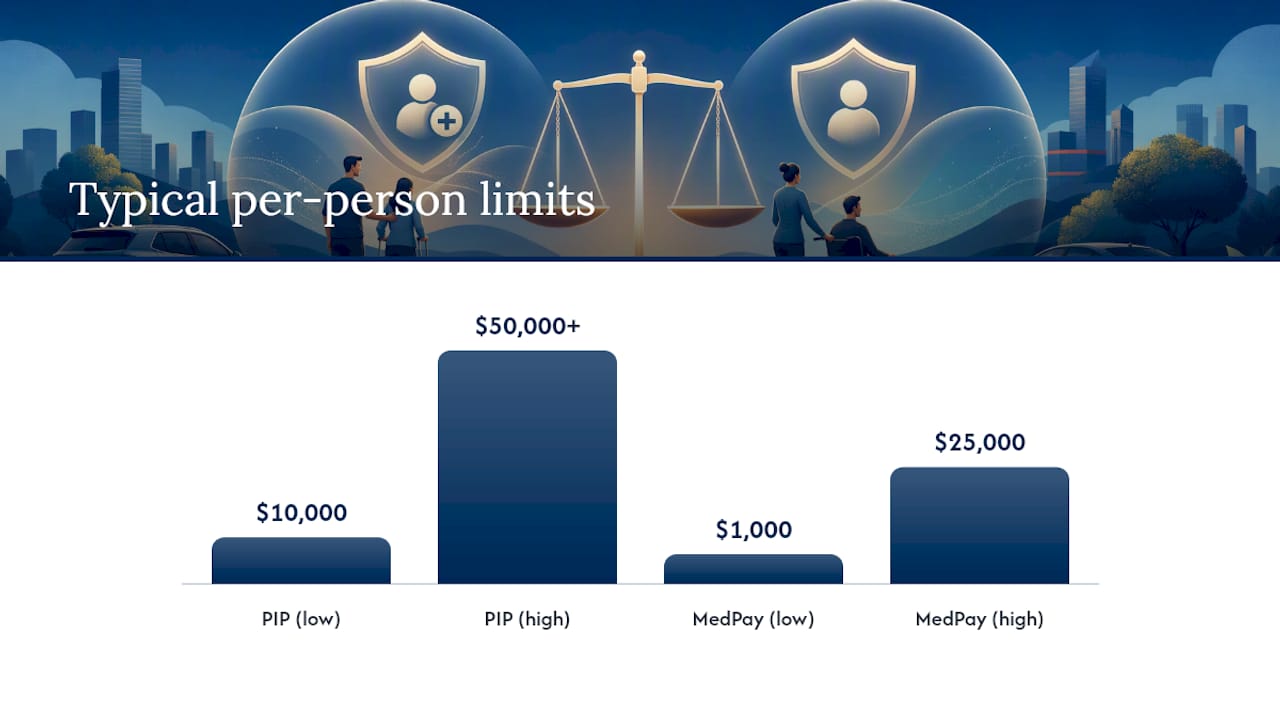
Insurance that both coverages typically pay before health insurance in accident cases, which is an important point when you are managing multiple payers after a crash.
Three scenarios that show the difference:
-
Minor injury, high health deductible. You rear-end another car at low speed and visit urgent care. Your health plan has a $3,000 deductible. MedPay at a $5,000 limit covers the urgent care visit and follow-up X-ray without touching your health deductible. PIP would do the same, but if you are in an at-fault state where PIP is not available, MedPay is your only first-party option.
-
Serious injury with lost wages. A T-bone collision leaves you unable to work for six weeks. PIP pays a portion of your lost income during recovery, covers your medical bills up to the policy limit, and may pay for a home aide if you cannot perform household tasks. MedPay covers only the medical portion. The wage gap is entirely out of pocket without PIP or disability insurance.
-
Out-of-state rental car. You are driving a rental in another state and are injured. MedPay typically follows you and applies to the rental. PIP coverage out of state depends on your policy language and the state you are in, so checking your declarations page before a long trip is worth doing.
Quick verdict: In no-fault states, PIP is the priority coverage. In at-fault states, MedPay is a low-cost way to handle immediate medical costs, especially when your health deductible is high.
How do state rules change whether you need PIP or MedPay?
Your state’s legal framework, not your personal preference, is usually the deciding factor. No-fault states require drivers to carry PIP because the system is designed to pay each driver’s own insurer for medical costs, regardless of fault. At-fault (tort) states do not require PIP, which is why MedPay becomes the primary first-party medical option there.
InsuranceGeek lists the common no-fault states that require PIP: Florida, Michigan, New York, New Jersey, Pennsylvania, Hawaii, Kansas, Kentucky, Massachusetts, Minnesota, North Dakota, and Utah. Each state sets its own minimum limits and benefit percentages.
MedPay is required in only a small number of states. Insurance.com confirms that MedPay is optional in most states, making it a voluntary add-on for the majority of U.S. drivers.
Notable state examples:
-
Florida: Basic PIP pays 80% of medical expenses and 60% of lost wages up to a $10,000 per-person limit. That 20% medical gap and the relatively low cap mean many Florida drivers add MedPay to cover the remainder. MedPay also applies when you travel out of state, where Florida PIP may not follow you. For a full breakdown of Florida PIP benefits and how they work, the interplay between the two coverages is particularly important for residents.
-
Michigan: Michigan operates under a tiered unlimited PIP system with multiple coverage-level options. Drivers choose a PIP tier at renewal, and the interaction with health insurance is complex. The Michigan no-fault insurance framework requires specific steps after an accident that differ from most other states.
-
Texas: Insurers must offer $2,500 per person in PIP, but drivers can reject it in writing. MedPay is available as an alternative. Texas materials clarify that PIP and MedPay have different time limits and repayment rules, so the choice between them has real financial consequences.
-
Indiana and New Mexico: Both are at-fault states where PIP is not required. MedPay is the primary voluntary first-party medical option, and drivers with high-deductible health plans benefit most from carrying it.
Pro Tip: Go to your state’s department of insurance website and search for “PIP” or “MedPay” to find the exact minimum requirements and any consumer guides. Your policy declarations page will also list which coverages you currently carry and at what limits.
How do PIP and MedPay interact with health insurance, subrogation, and legal claims?
Both coverages affect how your medical bills get paid and, critically, how much of your eventual settlement you keep. Understanding the payment order and repayment rules before you settle a claim can protect thousands of dollars.
Payment order. In most states, PIP and MedPay pay before your health insurance when the injury is auto-related. Your health insurer may not even process the claim until PIP or MedPay limits are exhausted. This order matters because health insurers often have their own subrogation rights, and keeping the claim off your health record on smaller injuries can avoid that entirely.
Subrogation and repayment. Sutliff & Stout explain that MedPay is frequently subject to subrogation: if you recover money from the at-fault driver, your insurer may demand repayment of what MedPay paid. PIP subrogation rules vary by state and are sometimes more limited or prohibited. In no-fault states, PIP is often designed to be non-recoverable by the insurer, but that is not universal.
Key interaction rules to know:
- MedPay insurers in many jurisdictions reserve the right to be reimbursed from any third-party settlement you receive.
- PIP subrogation is restricted or prohibited in some no-fault states, meaning you may keep more of your settlement.
- Stacking, where you combine PIP limits across multiple vehicles on one policy, is allowed in some states and prohibited in others.
- Medical liens from hospitals or health insurers can reduce your net recovery independently of PIP or MedPay repayment.
Personal injury attorneys consistently flag the importance of checking policy language for definitions of “reasonable” expenses, subrogation clauses, and stacking rules, because these terms directly affect how much a claimant keeps after a settlement. If your insurer has denied a claim or asserted a repayment right you believe is incorrect, understanding why insurers deny injury claims is a useful starting point before you respond.
For Indiana drivers, the question of paying medical bills after a car accident involves navigating health insurance, MedPay, and liability claims simultaneously, and the order in which bills are submitted can affect the final outcome.
Should you buy PIP, MedPay, both, or neither?
The simplest rule: if your state requires PIP, buy it at or above the minimum. If your state does not require PIP, MedPay is worth considering whenever your health deductible is high or you regularly carry passengers.
Decision checklist:
- You live in a no-fault state (FL, MI, NY, NJ, PA, and others). Buy PIP at the required minimum; consider higher limits if you are self-employed or lack disability coverage. MedPay can fill the percentage gap PIP leaves on medical bills.
- You live in an at-fault state with good health insurance and a low deductible. MedPay at a modest limit ($5,000–$10,000) is a low-cost safety net. PIP is likely unavailable or unnecessary.
- You live in an at-fault state with a high-deductible health plan. MedPay is a strong value. A $10,000 MedPay limit can cover your entire deductible for a fraction of the annual premium cost.
- You are self-employed or have no short-term disability coverage. PIP’s lost-wage benefit is the most important feature. Prioritize PIP wherever it is available.
- You frequently drive non-household passengers (rideshare, carpool). Both coverages extend to passengers, but confirm your policy language. MedPay is a reliable backstop for passenger medical costs.
- You have comprehensive health coverage and rarely carry passengers in an at-fault state. MedPay may be redundant. Skipping it is a reasonable choice, but confirm your health plan covers auto accident injuries without a subrogation complication.
Questions to ask your agent or review in your policy:
- What is my current PIP or MedPay limit, and is it the state minimum?
- Does my policy allow stacking across multiple vehicles?
- Does my MedPay coverage apply when I am a passenger in another vehicle or as a pedestrian?
- Does my PIP coverage apply out of state?
- What are my insurer’s subrogation rights under MedPay?
- How does adding or increasing MedPay affect my annual premium?
Two consumer examples:
Example A: A freelance graphic designer in Florida drives to client meetings daily. She carries the state-minimum $10,000 PIP. After a rear-end collision, her medical bills total $9,500 and she misses three weeks of work. PIP covers 80% of her medical bills ($7,600) and 60% of her lost wages up to the remaining limit. A $5,000 MedPay add-on would have covered the $1,900 medical gap. Without it, she pays that balance out of pocket.
Example B: A retired teacher in Indiana carries a $1,500 health plan deductible. He adds $5,000 in MedPay to his policy. After a minor collision, his ER visit costs $2,200. MedPay pays the full amount directly, his health deductible is untouched, and the claim never touches his health record.
What we see in personal injury cases involving PIP and MedPay
In practice, PIP consistently reduces the immediate financial pressure on injured clients. It covers medical bills and a portion of lost wages while a liability claim works through the system, which can take months. MedPay helps with deductibles and copays, but its repayment obligation often surfaces at settlement and catches clients off guard.
The cases where coverage choices cause the most harm are not the ones where someone skipped coverage entirely. They are the cases where someone carried the state minimum PIP limit, assumed it would be enough, and then faced $40,000 in medical bills after a serious crash. Checking your limits now, before an accident, costs nothing. Checking them after costs everything.
If you have been injured and are unsure how your PIP or MedPay coverage interacts with a liability claim or a settlement offer, a free consultation with our team can clarify your options before you sign anything.
If you were injured in an accident, here is how 2keller can help
After a serious crash, the coverage questions you just read about become real and urgent. 2keller represents injured drivers in Indiana, Michigan, and New Mexico on a contingency fee basis, meaning you pay nothing unless we win or settle your case.

Our team helps clients with:
- Auto accident representation and liability claims
- Medical lien negotiation and subrogation disputes
- Evaluating PIP and MedPay coverage in the context of your full recovery
- Wrongful death, truck accidents, and other serious injury cases
When you come in for a free consultation, bring your policy declarations page, any medical records you have received, and any correspondence from your insurer. That documentation lets us give you a specific, honest assessment of your claim and your coverage. If you are in New Mexico and dealing with an uninsured driver, our New Mexico uninsured motorist guide explains your options in detail. For a broader look at personal injury claim types in Albuquerque, our practice area page covers the full range of cases we handle. Contact 2keller today for a free, no-obligation consultation.
Sources
Your policy declarations page and your state’s department of insurance website are the two most reliable starting points for verifying what PIP or MedPay rules apply to you.
Recommended sources:
- Understanding PIP vs Med-Pay
- What Is Medical Payments Coverage (MedPay)?
- Medical Payments Coverage | Liberty Mutual
- MedPay vs PIP Insurance | Do you need PIP or MedPay coverage?
- Insurance
- Medical payments coverage (Med Pay), InsuranceGeek
- Personal Injury Protection vs. Med Pay: Which Is Better? – Sutliff & Stout
When you bring your declarations page to any legal or insurance consultation, you give the professional you are speaking with the exact coverage details they need to give you accurate, state-specific advice rather than general guidance.
This article provides general information about auto insurance coverages and is not a substitute for legal or insurance advice. Coverage rules, limits, and requirements vary by state and policy. Confirm your specific coverage with your insurer or a licensed professional in your state.